Startup and Venture Investment News for Thursday, 11th June 2026: AI Infrastructure, Deep Tech, Industrial AI, Energy Tech, and New Priorities for Venture Funds
On Thursday, 11th June 2026, the startup and venture investment market remains focused on three key areas: artificial intelligence infrastructure, AI cost optimisation, and industrial deep tech solutions. For venture investors and funds, this signifies that capital continues to concentrate not around abstract AI products but rather around startups that address specific business problems: a shortage of computational power, rising token costs, automation of engineering processes, cybersecurity, and energy.
The global venture market enters June with high activity from large funds, strategic investors, and private equity. The US continues to lead in deal volumes, Europe is strengthening its position in industrial AI and deep tech, while Asia remains a significant source of capital through sovereign funds and tech corporations. The main theme of the day is the transition of venture capital from "trendy" generative applications to the infrastructure without which scaling AI becomes prohibitively expensive.
The Main Trend of the Day: Investors are Purchasing AI Infrastructure
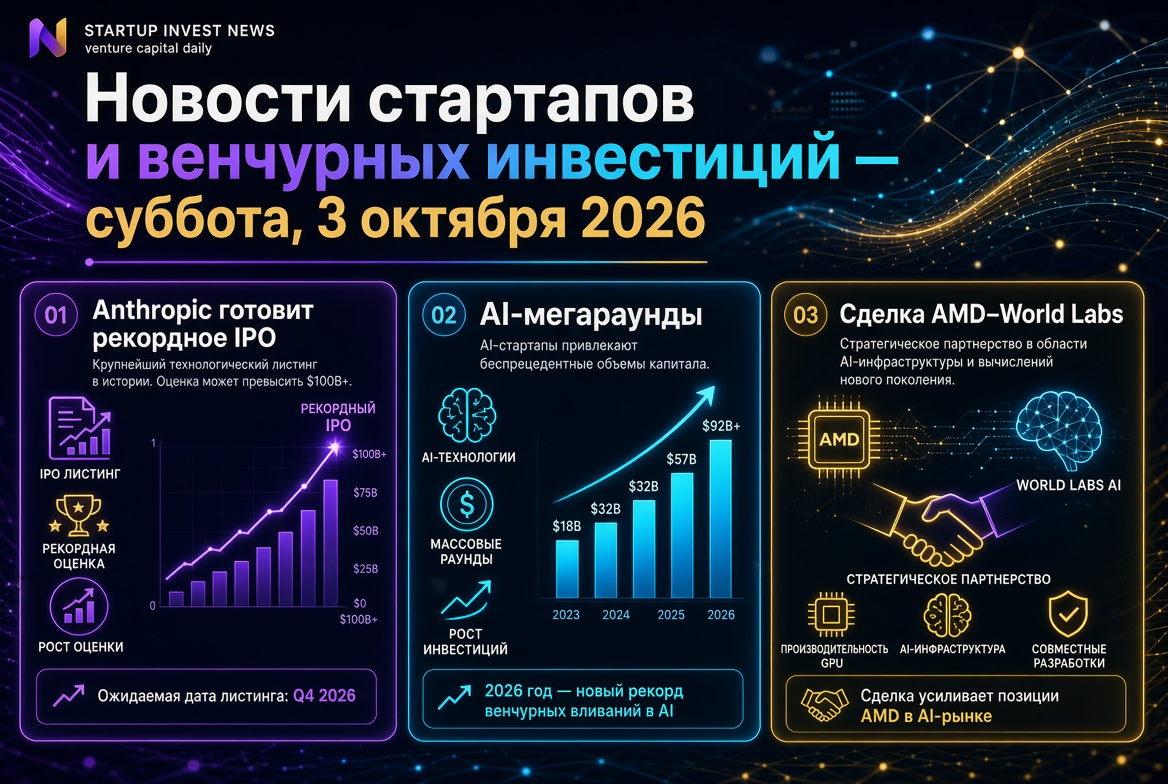
AI infrastructure has become a central topic for venture investments in 2026. Deals surrounding Anthropic, Broadcom, Apollo, and Blackstone illustrate that the AI market is no longer confined to model development. The key question now is who will provide the computational power, data centres, chips, energy, and financial structure necessary for scaling AI.
Funding for Anthropic's expansion of computational capacity into the tens of billions of dollars has sent a signal to the entire market: private equity and large institutional investors are increasingly entering the AI value chain. This shift changes the approach to startup evaluations for venture funds. Companies close to critical infrastructure are now of significant interest:
- cloud and GPU power suppliers;
- developers of alternative AI chips;
- startups in data centres and energy provision;
- AI load management platforms;
- tools for reducing inference and model training costs.
For funds, this implies an expansion of the investment landscape: AI startups no longer need to be model developers. The real value is increasingly generated by companies that help other businesses utilise artificial intelligence more cheaply, quickly, and reliably.
Rounds of the Week: Large Cheques Flow into AI, Fintech, Space Tech, and Defence Tech
Among noteworthy recent deals are significant rounds in the US and Europe. Venture funds continue to support companies that have already proven product value and are capable of scaling in the global market.
The most important sectors for investors are:
- AI developer tools. Supabase has attracted a significant round of funding, reinforcing the trend towards tools for AI application developers.
- Fintech and corporate expenditures. Ramp continues to secure substantial capital, confirming demand for the automation of financial processes in businesses.
- Space tech. Impulse Space demonstrates that space technologies are once again becoming a crucial focus for the venture market.
- Defence tech. Mach Industries and other defence startups are receiving support amidst rising demand for autonomous systems and national security.
- AI enterprise software. AlphaSense is solidifying its position in the corporate analytics and market intelligence sector.
This structure of deals indicates that venture investments in 2026 are becoming more pragmatic. Investors want to see not just technological novelty but also a clear economic model: revenue growth, recurring sales, corporate demand, and prospects for exit through IPO or strategic deals.
PhysicsX and the New Wave of Industrial AI
One of the most notable rounds is the financing of British startup PhysicsX. The company raised $300 million in Series C at a valuation of around $2.4 billion. The startup is developing an AI platform for engineering modelling and industrial simulations. This area is particularly significant for the aerospace sector, semiconductors, energy, defence industry, and advanced manufacturing.
For venture investors, PhysicsX serves as an example of the shift from consumer AI to industrial AI. While early AI applications focused on text, images, and office tasks, this new wave of startups is applying artificial intelligence to physical processes: engine design, materials, heat exchange, aerodynamics, manufacturing cycles, and equipment optimisation.
The investment takeaway is clear: funds are increasingly seeking startups that reduce the time required to develop complex products. In the industrial sector, this can mean savings of millions of dollars on testing, shortening R&D cycles, and speeding up time-to-market.
OpenRouter, Concentrate AI, and PointFive: The Market Tackles Expensive AI
The rising cost of using AI has become a distinct investment theme. Startups OpenRouter, Concentrate AI, and PointFive illustrate that businesses now require more than just access to a large language model. Companies need tools that help select optimal models, monitor expenses, track tokens, prevent overspending, and reduce reliance on a single provider.
OpenRouter previously raised $113 million at a valuation of approximately $1.3 billion, while Concentrate AI emerged from stealth mode with over $5 million in funding. PointFive secured $60 million in Series B for the development of its expense management platform for cloud and AI. Collectively, these deals form a new segment of the venture market—AI cost management.
For venture funds, this is an important signal. As AI is integrated into banking, retail, manufacturing, marketing, and software development, expenses related to computation have become a constant budget line item. Startups that help reduce these costs could become the next generation of enterprise software companies.
Helion and Energy for the AI Economy
Helion Energy's $465 million round at an approximate valuation of $15.5 billion underscores the connection between AI and energy. The mass development of data centres necessitates sustainable sources of electricity, and venture capital is increasingly viewing energy tech as part of AI infrastructure.
Helion works in the field of nuclear energy and plans to accelerate the commercial adoption of its technology. For investors, this is a long-term, high-risk yet potentially strategic bet. If the AI economy continues to grow, demand for energy will become one of the primary constraints on scaling.
As a result, energy tech, grid tech, storage, nuclear, fusion, and software for energy consumption management will remain in the focus of venture funds. Particularly appealing are startups that can bridge the gap between energy, industry, and computational infrastructure.
Europe Strengthens Its Position: The UK, France, and Germany in the Spotlight for Funds
The European startup market in 2026 is increasingly competing for capital in AI and deep tech. The UK remains one of the primary centres for venture investments, thanks to its strong base in fintech, enterprise software, and artificial intelligence. France is consolidating its position in frontier AI, while Germany remains an important venue for industrial tech, manufacturing software, and energy solutions.
For global funds, Europe is attractive for several reasons:
- the presence of strong engineering teams;
- government and development institution support for deep tech;
- growing demand for industrial automation;
- the opportunity to invest in AI outside of the overheated US market;
- the development of defence and energy technologies.
Moreover, European startups are increasingly attracting capital from Asian, American, and Middle Eastern investors. This makes the market more global and intensifies competition for quality deals.
India and Asia: Early Rounds Gain Importance for Global Funds
The Asian direction remains active in AI, healthtech, fintech, and specialised SaaS. Indian startups continue to attract capital from both local and international investors. Recent examples include interest in AI companies and medical services, including solutions for children's healthcare and corporate automation.
For venture funds, India remains a market with a large demographic base, rapid growth in digital services, and strong engineering talent. However, investors are becoming more selective. The most sought-after projects are those capable of scaling not only within India but also in the markets of the USA, Middle East, Southeast Asia, and Europe.
What is Important for Venture Investors and Funds
The current agenda indicates that the venture market of 2026 has become more concentrated. A significant portion of capital is flowing into large rounds, particularly in AI infrastructure, semiconductors, defence tech, robotics, energy tech, and enterprise software. This creates two parallel realities: mega rounds for market leaders and a more stringent selection process for early-stage startups.
Venture investors should pay attention to the following criteria:
- Economic Impact. Startups must demonstrate how their product reduces costs, accelerates processes, or increases client revenue.
- Infrastructure Role. The closer a company is to compute, cloud, energy, cybersecurity, or data layers, the higher the strategic interest.
- Corporate Demand. B2B startups with large clients appear more resilient than consumer projects without a clear monetisation path.
- Global Scalability. Funds are seeking companies capable of selling their product simultaneously in multiple regions.
- Exit Path. IPOs, M&A, and strategic partnerships are again becoming a critical part of the investment thesis.
Venture Investments are Returning to an Infrastructure Logic
The startup and venture investment news for Thursday, 11th June 2026 reveals that the market is entering a more mature phase of the AI cycle. Investors are no longer willing to fund artificial intelligence solely based on hyped positioning. Capital goes to those who are addressing fundamental challenges: the cost of computation, capacity shortages, security, industrial modelling, energy, and corporate efficiency.
For venture funds, this means a necessity to reassess investment strategies. Not only rapid product metrics are coming to the forefront, but also the ability of a startup to become part of the critical infrastructure of the new economy. AI startups, deep tech companies, industrial software, defence tech, fintech infrastructure, and energy tech are forming a new landscape for the global venture market.
The main takeaway for investors is clear: in 2026, the most promising startups are those that transform artificial intelligence from an expensive experiment into a manageable, scalable, and economically justified tool for business.