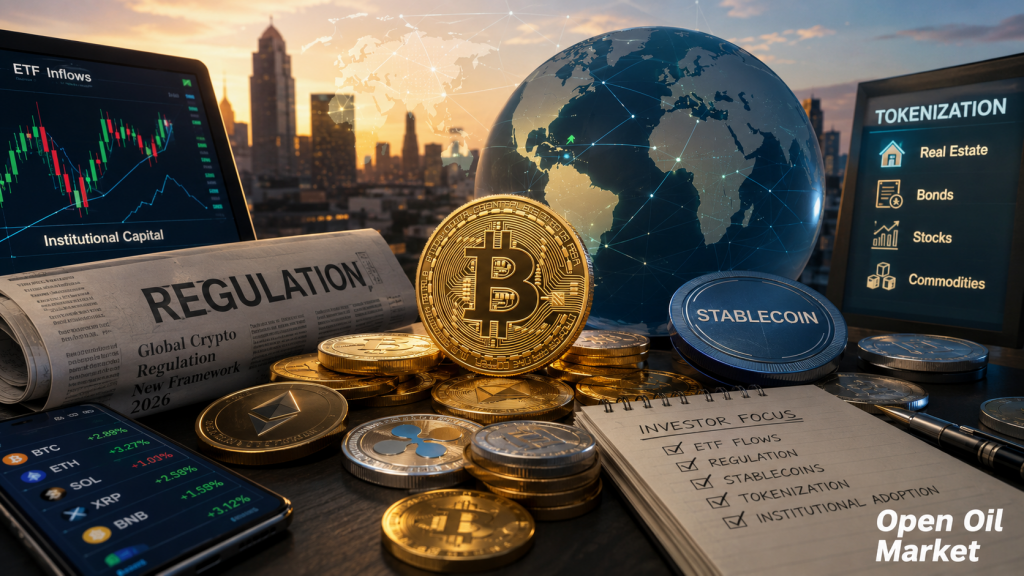
Key Cryptocurrency News for Monday, 13th July 2026: Institutional Demand, Bitcoin and Ethereum, Cryptocurrency ETFs, Stablecoins, Regulation, and the Tokenisation of Global Assets
The cryptocurrency market remains highly sensitive to macroeconomic expectations, dollar liquidity, and sentiments in equity markets. Following a period of reduced interest in risky assets, investors are gradually returning to the largest digital assets, although they are not yet demonstrating an aggressive appetite for risk.
Key features of the current market include:
- Bitcoin continues to be the primary indicator of trust in digital assets;
- Ethereum is viewed as an infrastructural bet on smart contracts and DeFi;
- Stablecoins are enhancing the role of the accounting layer in the crypto economy;
- Major altcoins are moving in tandem with liquidity in BTC and ETH;
- Investors are increasingly assessing not only price but also regulatory risks.
For the global investor audience, the focus is not solely on short-term growth or decline of individual coins but on the overall sustainability of the digital asset sector.
Bitcoin ETF and Ethereum ETF: Institutional Flows Back in the Spotlight
The primary news for cryptocurrencies this Monday is the return of weekly inflows into spot funds for Bitcoin and Ethereum following a prolonged period of outflows. This factor is particularly significant for investors, as ETFs have become one of the main channels for traditional capital to access the cryptocurrency market.
Even though Bitcoin and Ethereum funds have been under pressure since the beginning of the year, the mere fact of a recovery in inflows indicates that institutional investors are not abandoning digital assets but are revising their entry points. The market is becoming more disciplined: funds, family offices, and asset managers are responding to volatility not emotionally, but through the redistribution of portfolio shares.
For investors, this translates into three conclusions:
- ETFs remain the primary indicator of institutional demand.
- The Bitcoin market is increasingly intertwined with the traditional financial system.
- Ethereum is gradually gaining status as a distinct infrastructural investment class.
Bitcoin: The Status of a Safe-Haven Digital Asset Undergoes Testing
Bitcoin retains its position as the largest cryptocurrency and the primary benchmark for the entire digital asset market. However, its role is changing. While BTC was previously perceived primarily as a speculative asset, it is increasingly being viewed as a digital analogue to long-term reserve assets with high volatility.
The dynamics of Bitcoin are currently influenced by:
- inflows and outflows in spot Bitcoin ETFs;
- expectations regarding interest rates in the USA;
- the dollar exchange rate and demand for risky assets;
- the activity of major holders;
- regulatory decisions in the largest jurisdictions.
For long-term investors, Bitcoin remains a foundational asset in the cryptocurrency market, but short-term strategies require caution. Any sharp movements in ETF flows can amplify volatility.
Ethereum: A Bet on Infrastructure, DeFi, and Tokenisation
Ethereum continues to occupy a central role in the development of blockchain infrastructure. Unlike Bitcoin, which is more often perceived as a digital reserve asset, Ethereum remains a working platform for smart contracts, decentralised finance, NFT infrastructure, corporate applications, and tokenisation.
Key drivers for Ethereum include:
- the development of Layer-2 solutions;
- increasing interest in tokenised assets;
- institutional utilisation of smart contracts;
- the growing role of DeFi in the global financial system;
- expansion of the application ecosystem.
For investors, Ethereum continues to be viewed as a more technological play compared to Bitcoin. The potential of ETH is dependent not only on market liquidity but also on the real-world utilisation of the network.
Stablecoins: The Digital Dollar Becomes an Infrastructural Tool
Stablecoins remain one of the most resilient segments of the cryptocurrency market. USDT and USDC are utilised as tools for transactions, liquidity storage, and transitions between digital assets. For global investors, this is an important indicator: if stablecoin volumes are rising, it suggests that the market retains internal liquidity and readiness for rapid capital redistribution.
In 2026, stablecoins are increasingly being viewed not just as part of cryptocurrency exchange infrastructure but also as elements of international payments. They are used for:
- cross-border transfers;
- settlements between companies;
- hedging currency risks;
- DeFi operations;
- maintaining liquidity on cryptocurrency exchanges.
Simultaneously, regulators are imposing stricter requirements on reserves, disclosure, and operational oversight. This increases the trust of institutional players but simultaneously adds pressure on issuers.
Regulation: The USA, Europe, and Asia Set the Rules of the Game
The regulation of cryptocurrencies remains a key factor for the digital asset market. In the USA, investors' attention is focused on the rules for stablecoins, restrictions surrounding CBDCs, and the policy towards cryptocurrency companies. In Europe, the influence of MiCA continues to grow, while major exchanges are compelled to adapt their licensing and operational structures to meet new requirements.
Asia, in turn, remains one of the most competitive regions for the crypto business. Exchanges and fintech companies are keen to obtain licenses in countries with clear regulations, developed payment infrastructure, and high demand for digital assets.
For investors, this means that the geography of regulation is becoming as critical as the technology of the project itself. Cryptocurrencies, exchanges, and blockchain platforms with clear legal frameworks will gain advantages over less transparent market participants.
Top 10 Most Popular Cryptocurrencies for Investors
The most popular cryptocurrencies based on investor interest and their significance in the global digital asset market include:
- Bitcoin (BTC) — the leading digital asset and benchmark for the entire crypto market.
- Ethereum (ETH) — the largest smart contract and DeFi platform.
- Tether (USDT) — the leading stablecoin for transactions and liquidity.
- BNB (BNB) — token of a major crypto ecosystem and exchange infrastructure.
- XRP (XRP) — an asset linked to cross-border payments.
- Solana (SOL) — a high-performance blockchain platform.
- USD Coin (USDC) — a regulated dollar stablecoin.
- TRON (TRX) — a network actively used for stablecoin transfers.
- Dogecoin (DOGE) — the largest meme token with high recognisability.
- Cardano (ADA) — a blockchain project focused on scalability and an academic approach.
These assets form the core liquidity and remain the focus of both retail and institutional investors.
Asset Tokenisation: The Next Phase in Cryptocurrency Market Development
One of the most significant long-term trends is the tokenisation of tangible assets. Banks, asset management companies, and fintech platforms are exploring the possibility of transferring bonds, money market funds, real estate, commodity contracts, and other financial instruments onto the blockchain.
For the cryptocurrency market, this is a strategically important direction. If tokenisation continues to evolve, blockchain will become not only a medium for trading coins but also an infrastructure for traditional financial markets.
Particular interest is being shown in:
- tokenised bonds;
- digital money market funds;
- settlements in stablecoins;
- corporate blockchain platforms;
- the integration of digital assets into banking products.
What Matters to Investors in the Coming Week
On Monday, 13th July 2026, investors should focus not on individual news events but on the overall market picture. Cryptocurrencies are becoming a part of the global investment system, but high volatility persists.
Key indicators for the week include:
- dynamics of inflows into Bitcoin ETFs and Ethereum ETFs;
- news on regulation in the USA and Europe;
- liquidity of stablecoins USDT and USDC;
- behaviour of major altcoins;
- activity of institutional investors;
- development of asset tokenisation projects.
The baseline scenario for the cryptocurrency market is a cautious recovery in interest, while remaining sensitive to macroeconomic factors and regulation. For investors, this is not a market of simple solutions; rather, it is a market of selection: liquidity, transparent infrastructure, regulated products, and projects with real-world utilisation are at a premium.