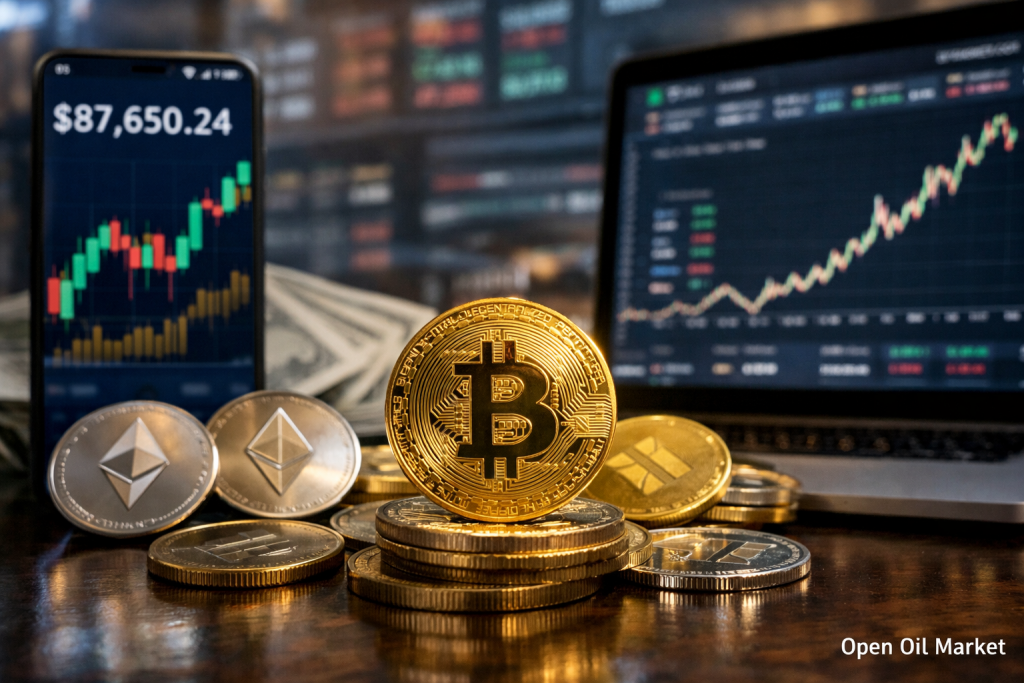
Cryptocurrency News for Saturday, 28 March 2026: Bitcoin Maintains Dominance as Market Awaits New Regulatory Signals
As of Saturday, 28 March 2026, the cryptocurrency market continues to capture a high level of attention from investors worldwide. Bitcoin remains the barometer for the entire segment of digital assets, with institutional participants treating it as a primary indicator for assessing risk appetite. The market remains sensitive to regulatory news, liquidity data, and signals from major financial institutions.
For the global audience, this means one thing: cryptocurrencies no longer exist in isolation from macroeconomics. They move in tandem with expectations regarding interest rates, bond yields, dollar liquidity, and regulatory updates from the US, Europe, and Asia.
Bitcoin Remains the Core Asset for Investors
Bitcoin holds its status as the leading digital asset in the market. It sets the overall tone: when BTC is strong, capital more readily flows back into riskier segments; when Bitcoin weakens, pressure typically increases on altcoins as well. Currently, investors are particularly focused on the resilience of demand for BTC, the behaviours of large holders, and the market’s willingness to buy into dips.
In terms of market structure, this is of greater significance than short-term volatility spikes. Bitcoin is not merely a cryptocurrency; it has become a gauge of trust in digital assets as an investment class.
Ethereum and Smart Contract Assets: Market Awaits Confirmation of Demand
Ethereum remains the second key platform in the crypto ecosystem, but its agenda is markedly different from Bitcoin’s. Here, investors monitor not only price dynamics but also actual network activity: volumes in DeFi, stablecoin growth, asset tokenisation, and the development of layer two infrastructure.
Currently, Ethereum and associated tokens are highly sensitive to the question of whether stronger user demand will return to the market. If network activity accelerates, this tends to bolster not just ETH but the entire segment of smart contract platforms.
Stablecoins Emerge as the Year’s Key Infrastructure Narrative
One of the most compelling trends of 2026 is the rise of stablecoins. For the global investor, they are no longer merely a technical tool for inter-exchange settlements, but a full-fledged layer of crypto infrastructure. Stablecoins are employed for cross-border transfers, DeFi settlements, trading, and liquidity storage.
It is for this reason that the market is increasingly attentive to the regulation of dollar-pegged tokens, to reservation rules, and to how major banks, exchanges, and payment companies will incorporate stablecoins into their products. This is not a peripheral topic, but rather one of the main drivers for future growth in the sector.
Regulation Remains the Primary Factor for Market Revaluation
The news surrounding regulation continues to hold greater importance than many short-term technical signals. In the US, the market is closely following the fate of the Clarity Act and whether Congress will provide clearer definitions regarding the status of digital assets. In this context, Citi has already downgraded expectations for Bitcoin and Ethereum, citing regulatory weakness as a market pressure factor.
The UK is proceeding with caution and is discussing revisions to its stablecoin regulations. In contrast, China is tightening restrictions on virtual currencies, while also allowing for more formal regulations around the tokenisation of real assets. For the global investor, this indicates that the crypto market in 2026 is evolving in multiple regulatory environments simultaneously.
Institutional Demand Remains a Long-Term Bullish Factor
Despite short-term jitters, institutional interest in cryptocurrencies remains robust. Major banks, brokerages, and asset management firms continue to expand access to digital assets through ETFs, custodial services, and trading infrastructure. This reinforces the notion that cryptocurrencies are gradually embedding themselves within the traditional financial market.
For investors, this is particularly significant for one reason: as institutional access widens, demand becomes more stable over the long term. In practice, this reduces the likelihood that the crypto market will revert to being an exclusively retail-driven narrative.
Top 10 Cryptocurrencies for Investor Focus
In the daily market agenda, investors are most frequently tracking the following set of assets. These are not merely the most recognisable names; they are cryptocurrencies that have the strongest impact on liquidity, sentiment, and capital allocation.
- Bitcoin (BTC) — the foundational benchmark for the entire market and digital analogue of a macro asset.
- Ethereum (ETH) — the core of the smart contract economy and DeFi infrastructure.
- Tether (USDT) — the principal settlement asset of the crypto market and source of liquidity.
- BNB — the key token in a leading exchange ecosystem.
- XRP — an asset monitored as a bet on cross-border settlements.
- USDC — an important dollar-pegged stablecoin for institutional infrastructure.
- Solana (SOL) — one of the most notable high-throughput platforms for applications and tokens.
- TRON (TRX) — a strong player in the stablecoin transfer segment and low-cost transactions.
- Dogecoin (DOGE) — a highly volatile retail asset with a strong media effect.
- Cardano (ADA) — a project that continues to attract the attention of long-term holders.
What Investors Should Watch on Saturday
In the near horizon, the market will not be reacting to a single headline but to a combination of factors: the flow of regulatory news, Bitcoin's relative strength dynamics, the behaviour of stablecoins, and activity in altcoins. On such days, discipline rather than emotion is of paramount importance.
Key Signals of the Day
- Is Bitcoin maintaining its leadership, or is capital starting to flow into altcoins?
- Are there signs of expanding demand for Ethereum and infrastructure tokens?
- Is interest in stablecoins as a foundational payment infrastructure strengthening?
- Is the regulatory environment changing in the US, UK, European Union, and Asia?
Practical Conclusion
For the short-term investor, this is a market of selective ideas rather than one of broad unconditional growth. For the long-term investor, this is a market where fundamentally strong assets are increasingly integrating into the traditional financial system.
In Summary: Cryptocurrencies Remain a Market for Those Who Can Read Risk
The cryptocurrency news for Saturday, 28 March 2026, leads to one conclusion: the market remains large, liquid, and global, yet still depends on regulatory clarity and the strength of institutional demand. Bitcoin retains a central role, Ethereum seeks confirmation of user activity, stablecoins are becoming an infrastructural standard, while altcoins continue to exist in a mode of selective picking.
For investors, this is not the time for superficial optimism. It’s a time for precise analysis, position control, and attentiveness to those assets that genuinely shape the new architecture of the digital market.