Current Cryptocurrency News as of 7 January 2026: Bitcoin at the Key Level of $100,000, Ethereum Update, Altcoin Growth and the Top 10 Most Popular Cryptocurrencies in the World. Market Analysis for Investors.
As of the morning of 7 January 2026, the global cryptocurrency market continues to build on the positive momentum seen in the early days of the new year. The total capitalisation of digital assets stands at approximately $3.1 trillion, having increased by about 2% in the past 24 hours. Investors worldwide maintain a cautiously optimistic outlook: improvements in the macroeconomic environment and an influx of institutional capital support interest in cryptocurrencies. The "fear and greed" index for the crypto market has risen into the "greed" zone, indicating an ongoing improvement in sentiment without clear signs of overheating. Trading activity is picking up as we approach mid-week, suggesting that market participants are returning to active engagements. These sentiments are further influenced by a series of positive developments, including a significant Ethereum network update scheduled for today.
Bitcoin: On the Brink of $100,000
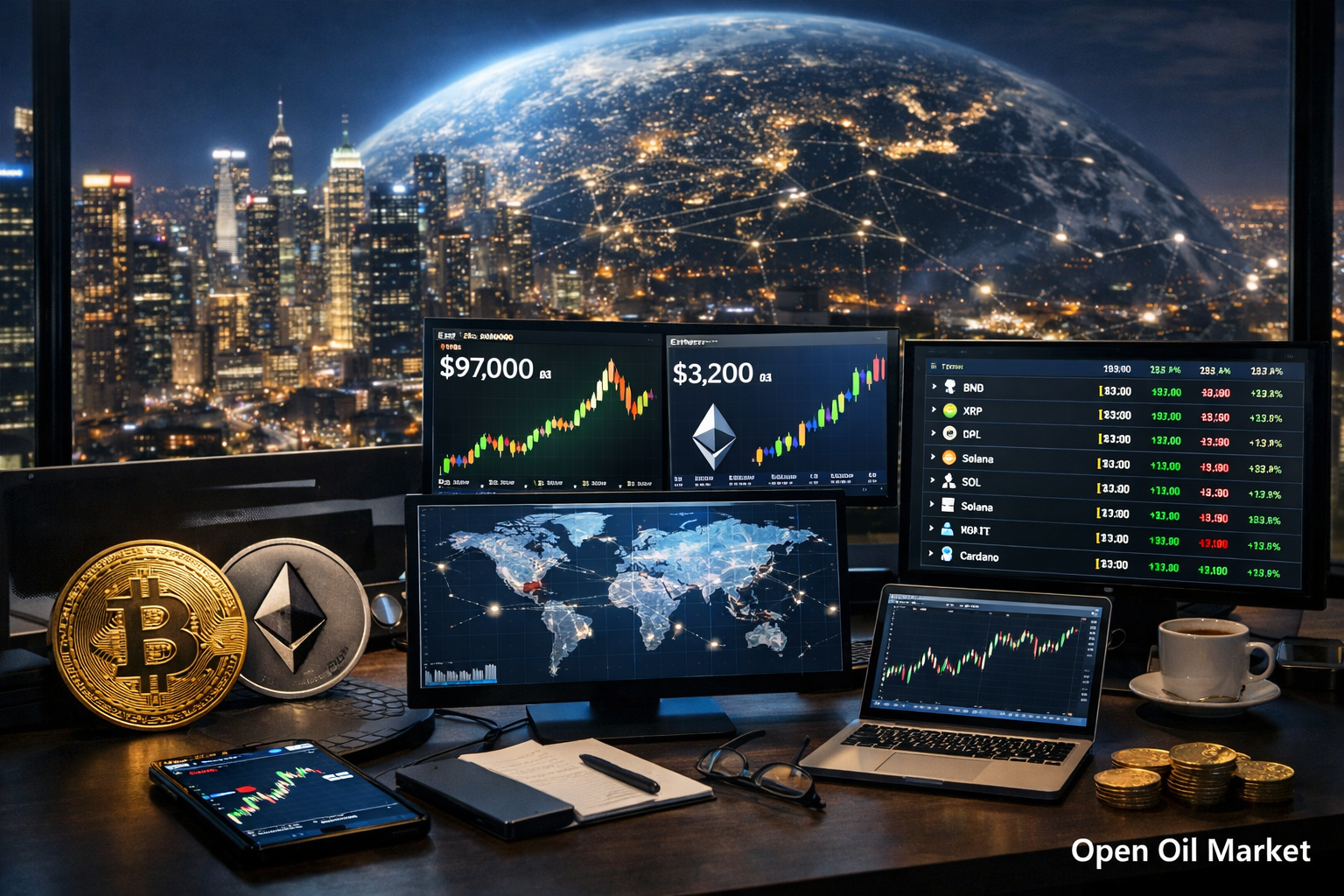
Bitcoin (BTC) is once again in the spotlight as it approaches the psychologically significant threshold of $100,000. The price of the leading cryptocurrency on the morning of 7 January stands at around $97,000, marking the highest level in recent months. Since the beginning of 2026, BTC has appreciated by approximately 8%, reinforcing an upward trend following its consolidation at the end of the previous year. The current price is about 20-25% below its all-time high (~$125,000, set in 2025), and many market participants anticipate a swift breach of the $100,000 mark. Bitcoin's share of the total cryptocurrency market capitalisation remains around 50%, affirming its status as the primary benchmark for the industry.
- Strengthening Demand: Major investors continue to increase their exposure to BTC. Following the launch of spot Bitcoin ETFs in the US and Europe last year, institutional access to the market has been simplified. Early January has seen reports of renewed inflows into cryptocurrency funds and ETFs – a sign that professional investors are once again increasing their allocation to Bitcoin. For instance, one of the largest asset managers, BlackRock, has reported record inflows into its crypto fund in the early days of the year, highlighting a strong appetite for "digital gold".
- Market Signals: There is an uptick in optimism within derivative markets. Options traders are actively purchasing calls targeting above $100,000, betting on further Bitcoin growth. Concurrently, futures volumes remain elevated, and a sharp price increase over the past day has led to the liquidation of short positions exceeding $100 million – indicating a surge in speculative activity and additional "heat" in the market from the closure of bearish positions.
- Macro Factors: The overall economic backdrop remains favourable for risk assets. Expectations that the US Federal Reserve will adopt a softer monetary stance in 2026 (amidst slowing inflation) fuel investor interest in cryptocurrencies. Additionally, geopolitical uncertainty in various regions stimulates demand for Bitcoin as a safe-haven asset. Bitcoin is also benefiting from developments in the precious metals market: traditional gold is near record levels, enhancing Bitcoin's appeal as its digital counterpart.
- Technical Levels and Volatility: In the short term, a key challenge for bulls will be overcoming the ~$100,000 mark. Analysts note that this resistance area could trigger profit-taking and increased volatility. A confident breakthrough above the six-figure threshold would pave the way for Bitcoin to reach new heights and attract more buyers, while failure to breach $100,000 could lead to a pullback. Nevertheless, even a potential correction to the $85,000-90,000 range would not disrupt the overall upward trend, considering the support from fundamental factors.
Ethereum: Major Network Update
Ethereum (ETH), the second-largest cryptocurrency by capitalisation, is trading at around $3,200, demonstrating stability following a strong growth year in 2025. Today, the community is focused on a technical upgrade to the Ethereum network scheduled for 7 January 2026. This significant upgrade aims to further scale the network and reduce fees. Specifically, there are plans to increase the volume of special "blob" data within each block, allowing for cheaper transactions on Layer 2 (L2) solutions. The anticipated increase in throughput is expected to have a positive impact on the ecosystems of popular L2 protocols (such as Arbitrum, Optimism, and Base), making interactions with Ethereum faster and more cost-effective.
Through its continuous development, Ethereum maintains a crucial role in the industry. Although the current ETH price is still below its historical high (~$4,800), the platform firmly holds second place by capitalisation and serves as a foundation for numerous decentralized applications (DeFi protocols, NFT platforms, gaming projects, etc.). Institutional investors also continue to show a strong interest in Ether: in 2025, the first spot ETFs based on Ethereum were launched, leading to a capital influx into the ETH market. The staking opportunity (allowing holders to earn yield) and regular technological updates bolster confidence in the platform. The current network upgrade is another step in Ethereum’s long-term roadmap aimed at improving blockchain efficiency and meeting the growing demand for its services.
Altcoins on the Rise: Investor Attention Beyond BTC
Amid a short-lived respite in Bitcoin’s dominance, investors are increasingly focusing on the largest altcoins in search of higher returns. Many alternative cryptocurrencies among the top 10 are demonstrating outperforming growth relative to BTC in early January, forming a local "altcoin season." For example, Binance Coin (BNB) has surged to ~$430, reflecting ongoing demand for services within the Binance ecosystem. The XRP token from Ripple is holding steady around $0.87: following legal clarity on XRP's status in the US, it remains one of the market leaders, particularly in light of banks' renewed interest in Ripple’s technology for fast cross-border payments. The platform token Solana (SOL) has surpassed $200 for the first time in several years, reaching multi-year highs — positive news surrounding the potential approval of a SOL ETF and the growth of projects on this high-speed blockchain platform sustain investor interest. Cardano (ADA) has risen in price to ~$0.52; this blockchain platform has a dedicated community, and upcoming technical updates along with speculation about launching its own index products (ADA ETF) fuel long-term expectations for the project.
Among other notable altcoins, Tron (TRX) and Dogecoin (DOGE) stand out. Tron continues to attract users with low fees and high transaction speeds, remaining one of the primary networks for issuing stablecoins (a significant share of USDT circulates on the Tron blockchain). The TRX price hovers around $0.11, allowing the coin to maintain its presence in the top ten by capitalisation, partly supported by backing in the Asian region. Dogecoin, the most well-known meme cryptocurrency, is trading around $0.08. Despite the absence of fundamental updates, DOGE continues to receive support from community enthusiasts and periodic attention from celebrities, allowing it to remain among market leaders. Overall, the rise in altcoins is supported by improved market sentiment: investors, having secured some profits from Bitcoin's movement, are exploring new opportunities in riskier assets, increasing demand for promising projects beyond BTC and ETH. However, experts caution that the sustainability of this "alt-rally" will depend on overall liquidity and the absence of shock events in the market.
Institutional Adoption and Traditional Finance
At the start of 2026, the trend of integrating the cryptocurrency market with traditional finance continues. Decisions from major banks and investment funds increasingly incorporate digital assets into the classic financial system. Following Bank of America's recent move (allowing its advisors to include up to 4% Bitcoin via ETF in client portfolios), several Wall Street banks have announced an expansion of cryptocurrency services. For instance, investment firm Fidelity has outlined plans to offer retail clients access to cryptocurrency trading, reflecting rising demand from retail investors. The influx of capital from institutional players is also on the rise: industry reports indicate that total investments through crypto ETFs and trusts have increased by significant percentages in recent months. The share of institutional investors in funds based on Bitcoin and Ether has climbed to about 30% by early 2026 (up from approximately 20% a year prior), illustrating the capital influx from professionals to the market.
The regulatory environment is gradually clarifying, encouraging large capital inflows into crypto assets. In the US, 2025 saw the implementation of the first law regulating the issuance of stablecoins, while the Securities and Exchange Commission (SEC) approved the launch of several cryptocurrency exchange-traded funds. In the EU, the new regulatory framework MiCA has been established, providing clear rules for cryptocurrency companies across the region. In Asia, governments are also supporting market development: for example, last year, Hong Kong opened access to the trading of major cryptocurrencies for retail investors in a regulated manner, attracting new participants to the region. Such government actions reduce legal risks and create a transparent business environment, which has been lacking in the industry in previous years. In this context, traditional financial firms are expanding their crypto services: major auditors and consulting companies (PwC, Deloitte, etc.) have launched divisions to service blockchain projects, banks are testing the issuance of their own tokenised products (such as digital bonds), and central banks in several countries are advancing initiatives for national digital currencies (CBDCs) to maintain control over the monetary system in the new era. All these trends illustrate that the boundaries between classic finance and the world of cryptocurrencies are blurring, forming a unified global market for digital assets.
Top 10 Most Popular Cryptocurrencies
Despite the thousands of digital coins available, the largest and most recognised crypto assets remain market leaders. Below is the current list of the ten most popular cryptocurrencies by market capitalisation as of the morning of 7 January 2026:
- Bitcoin (BTC) — approximately $96,000. The first and largest cryptocurrency, often referred to as "digital gold". It determines the direction of the entire crypto market, with its capitalisation making up over half of the total market capitalisation.
- Ethereum (ETH) — around $3,200. The leading altcoin and platform for smart contracts. The Ethereum network supports DeFi and NFT ecosystems, providing infrastructure for thousands of decentralised applications worldwide.
- Tether (USDT) — ~$1.00 (stablecoin). The largest stablecoin pegged to the US dollar at a 1:1 ratio. It is widely used for trading and settlement, serving as a bridge between traditional currencies and the crypto market.
- Binance Coin (BNB) — approximately $430. The internal token of the world’s largest cryptocurrency exchange Binance and its blockchain ecosystem. It is used for fee payments, participating in DeFi applications, and gaining access to various Binance services. Despite regulatory risks surrounding the exchange, BNB maintains high capitalisation due to its wide range of applications.
- XRP (XRP) — around $0.87. The token of the Ripple payment network facilitating fast international transfers. After the uncertainty surrounding XRP's status in the US was resolved, the coin regained the trust of some investors and is used by financial institutions for cross-border settlements.
- USD Coin (USDC) — ~$1.00 (stablecoin). The second-largest stablecoin issued by the Centre consortium (Circle and Coinbase) and backed by dollar reserves. It is known for its transparency in reporting and is widely used in trading and DeFi sectors due to its stability and trust from institutional players.
- Solana (SOL) — approximately $195. A high-performance blockchain platform and one of the main alternatives to Ethereum. It is characterised by high speed and throughput; the Solana ecosystem is growing due to DeFi applications and real asset tokenisation. Anticipation of new products (including a potential SOL ETF) keeps the token on an upward trend.
- Tron (TRX) — around $0.11. A blockchain platform focused on entertainment and decentralised applications. It features low fees and fast transactions and is widely used for issuing and operating stablecoins. TRX remains in the top 10 due to considerable infrastructure projects and support in the Asian region.
- Dogecoin (DOGE) — around $0.08. The most famous "meme" token, initially created as a joke, but has grown into an asset with a multibillion-dollar capitalisation. DOGE's popularity is supported by community enthusiasm and occasional mentions by influential entrepreneurs, allowing it to persist among market leaders. Its volatility remains high, yet it continues to hold a position in the market's top ranks.
- Cardano (ADA) — around $0.52. A blockchain platform developed on a research basis. It offers smart contract functionality and places a strong emphasis on reliability and scalability. With a dedicated community, regular protocol updates and plans to launch its own financial products continue to sustain ADA's presence among the largest cryptocurrencies.
Forecasts and Expectations
The continuing rally at the beginning of 2026 is generating positive expectations in the market, although experts urge investors to maintain a balance between optimism and caution. Many analysts are bullish: increasing institutional participation and technological progress create a foundation for further growth. There are forecasts that Bitcoin could confidently surpass the $100,000 mark within the year and aim for new records, while Ether could return to historical peak values and exceed $5,000 if macroeconomic conditions remain favourable. Improved regulation and the emergence of new investment products (spot ETFs on various altcoins, exchange-traded funds for the DeFi sector, etc.) may attract even more capital to the market, broadening opportunities for investors.
At the same time, short-term risks persist. The sentiment index has only recently exited the fear zone, indicating that some players remain cautious regarding the rally. Periods of profit-taking following rapid price increases cannot be ruled out. Analysts point out that the first quarter of 2026 could experience heightened volatility and a search for a new market equilibrium. Factors such as changes in central bank policies, geopolitical events, or technical disruptions could temporarily cool the rally. Nevertheless, in the medium and long term, the trend remains upward: cryptocurrencies are increasingly integrating into the global financial system, and their role as an asset class continues to grow. Investors are advised to adhere to a measured strategy and diversification principles as they approach the new year in the crypto market with prudent optimism.