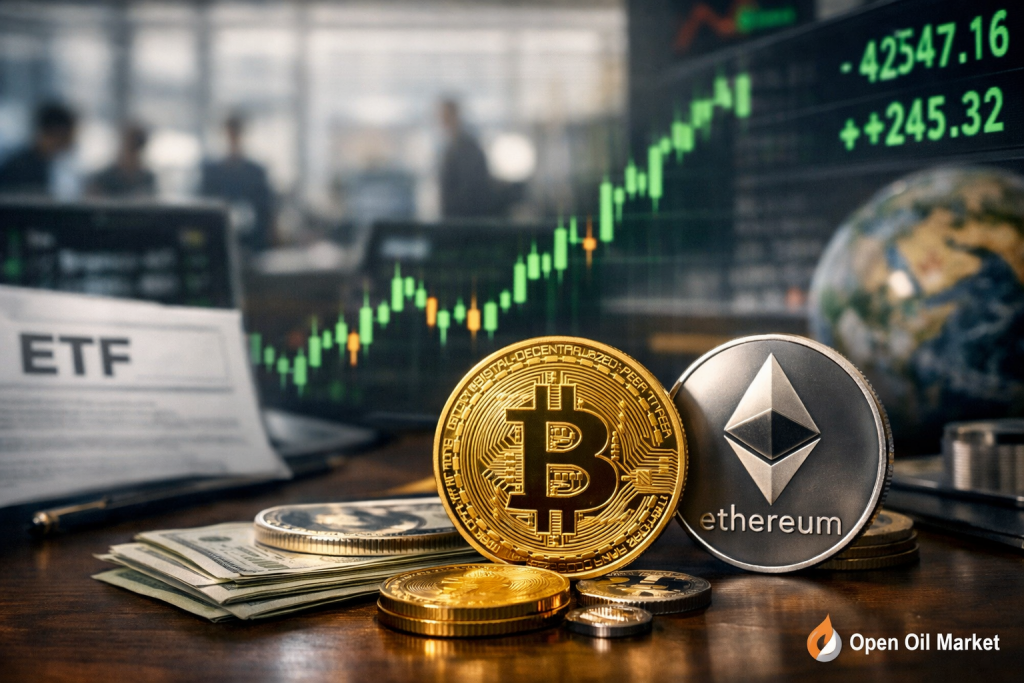
Current Cryptocurrency News as of April 19, 2026: Market Analysis, Bitcoin, Ethereum, Institutional Demand, and the Top 10 Digital Assets
The global cryptocurrency market heads into Sunday in a more resilient state than it did a week ago. Following high volatility earlier this year, digital assets are once again gaining support from a growing global appetite for risk, institutional products, and discussions around new regulatory frameworks. For investors, this is an important signal: the crypto market remains sensitive to macroeconomic factors but is increasingly integrating into the traditional financial system.
Three themes currently take centre stage: Bitcoin's leadership in market structure, the gradual strengthening of institutional presence through ETFs and banking products, and the ongoing battle for the future of stablecoins and digital payment ecosystems. Against this backdrop, the largest cryptocurrencies maintain their status as key indicators of sentiments in the global capital market.
The Market Enters Sunday with Renewed Risk Appetite
By April 19, the cryptocurrency market appears noticeably more stable. The primary impetus has come not only from within the industry but also from broader financial market movements. Improved sentiment in US equities, reduced nervousness surrounding geopolitical tensions, and a renewed interest in risk assets have also supported cryptocurrencies.
This is significant for the market for two reasons:
- Firstly, cryptocurrencies are once again moving in tandem with the technology and risk segments of the global market;
- Secondly, capital is returning not only to Bitcoin but also to large, liquid altcoins.
In other words, the crypto market is not operating in isolation but as part of the broader global financial ecosystem. For international investors, this means that the key factors affecting the market are not only industry news but also the overall dynamics of inflation, interest rates, stock indices, and risk appetite.
Bitcoin Reconfirms Its Status as the Market's Premier Asset
Bitcoin remains the focal point for liquidity. It attracts the majority of attention from institutions, funds, banks, and large private investors. This is clearly evident in the market structure: Bitcoin continues to hold a dominant position and remains the primary barometer of trust in digital assets.
The strengths of BTC at this stage are:
- The maximum liquidity among all cryptocurrencies;
- The highest degree of institutional recognition;
- Perception as a digital analogue to defensive assets in long-term strategies;
- Priority in new ETF products and banking investment solutions.
For investors, this indicates that even in the market recovery phase, Bitcoin remains the principal benchmark. As long as BTC retains its lead in market capitalisation and market share, the entire crypto market appears more stable. Should its dominance begin to decline rapidly, it would signal a shift in capital towards riskier altcoin segments.
Ethereum Maintains Systemic Significance Despite More Reserved Dynamics
Ethereum continues to be the second key asset in the market. Its role for investors is broader than merely price performance. It serves as the foundational infrastructure for decentralised finance, asset tokenisation, stablecoins, and a plethora of blockchain applications. Therefore, interest in ETH reflects a bet not only on the cryptocurrency market but also on the development of digital financial infrastructure.
Currently, Ethereum appears as an asset that lags behind Bitcoin in terms of narrative strength but excels in practical significance. If the market continues to institutionalise, ETH may gain new momentum specifically as an infrastructural digital asset rather than merely as a speculative tool.
For investors, this is particularly important in a global context: the more the theme of tokenisation and digital transactions grows, the higher Ethereum's strategic value in portfolios with a horizon beyond one quarter.
Institutional Capital is Delving Deeper into Cryptocurrencies
One of the key narratives in April is the continued institutional penetration into the crypto market. Leading financial players are no longer merely observing the sector; banks, exchanges, and asset managers are building comprehensive investment products around cryptocurrencies.
This is currently manifested in several forms:
- Expansion of the ETF lineup linked to Bitcoin and other digital assets;
- Growing partnerships between traditional exchanges and crypto platforms;
- Increased interest in regulated liquidity, custodial solutions, and tokenised markets.
The institutionalisation of the market is changing its quality. While it does not eliminate volatility, it does render the sector more mature. For large investors, this transition signifies a reduction in infrastructural barriers. For retail players, it indicates heightened competition for returns and a gradual shift in focus from meme stories towards the most liquid and regulated digital assets.
Regulation Transitions from Background Noise to a Full-Fledged Market Driver
Another significant topic for April 19 is regulation. For the crypto market, this is no longer merely a risk factor but one of the principal drivers of asset revaluation. The clearer the rules of the game become, the higher the likelihood that new institutional money will enter the sector.
Investors are currently monitoring several developments:
- Discussions surrounding the market structure of digital assets in the US;
- New approaches to trading platforms, staking, and asset custody in the UK;
- European competition in the realm of digital payments and stablecoins.
The market receives mixed signals. On one hand, the regulatory framework is becoming broader and clearer. On the other, political delays and disagreements in the US demonstrate that a unified regulatory model is yet to be finalised. For investors, this signifies that the regulatory factor in 2026 will influence cryptocurrencies as much as macroeconomics does.
Stablecoins Move to the Forefront of Financial and Geopolitical Competition
The segment of stablecoins has definitively ceased to be a narrow technical niche. It is now a question of control over digital payments, cross-border transactions, and the future architecture of the monetary market. This is especially noticeable in Europe, where the topic of euro-stablecoins is becoming part of a broader discussion on financial sovereignty.
For the cryptocurrency market, this entails:
- Stablecoins are increasingly integrating into the real financial system;
- The competition now extends beyond trading to payment infrastructure;
- The demand for blockchain solutions will grow not only from crypto projects but also from banks.
If this trend continues to strengthen, those blockchain ecosystems that can offer scalability, settlement reliability, and user-friendly infrastructure for issuing tokenised financial instruments will be the winners.
Major Altcoins Retain Importance, but the Market Remains Selective
In the altcoin segment, the situation appears heterogeneous. Investors are hesitant to distribute capital evenly across the market. The focus remains on the most liquid and recognisable assets: XRP, BNB, Solana, TRON, Dogecoin, and a number of infrastructural tokens.
Several trends can currently be identified:
- XRP and BNB maintain strong positions due to the scale of their ecosystems and brand recognition;
- Solana continues to be one of the main instruments for betting on rapid growth beyond Bitcoin and Ethereum;
- TRON is strengthening its position due to its role in payment and stablecoin flows;
- The market is becoming more welcoming to new participants from the derivatives and exchange infrastructure segment.
This suggests that in 2026, an altcoin season no longer appears to be a chaotic surge of all assets. Money is concentrating in assets with clear demand, high liquidity, and a real role in the ecosystem.
Top 10 Most Popular Cryptocurrencies as of April 19, 2026
As of the start of April 19, the most popular cryptocurrencies by market capitalisation and liquidity include:
- Bitcoin (BTC) — the main market benchmark and key asset for institutional strategies.
- Ethereum (ETH) — foundational infrastructure for smart contracts, DeFi, and tokenisation.
- Tether (USDT) — the largest dollar stablecoin and central settlement asset of the crypto market.
- XRP (XRP) — one of the most recognisable international payment tokens.
- BNB (BNB) — a systemic asset of the largest cryptocurrency ecosystem, Binance.
- USDC (USDC) — the second largest dollar stablecoin with a strong institutional reputation.
- Solana (SOL) — one of the leading representatives of high-speed blockchain platforms.
- TRON (TRX) — a major network with a significant role in transfers and stablecoin circulation.
- Dogecoin (DOGE) — a meme cryptocurrency that retains mass recognition and liquidity.
- Hyperliquid (HYPE) — a new significant entrant in the top ten, reflecting a growing interest in crypto-derivative infrastructure.
For investors, the very fact that the composition of the top ten has been updated is significant. It demonstrates that the market is evolving, and not only traditional coins are rising to the forefront but also assets linked to trading infrastructure and new liquidity segments.
What Investors Should Keep in Mind on Sunday, April 19, 2026
The key takeaway as we approach Sunday is that the cryptocurrency market once again resembles a mature risk asset class rather than a speculative universe unto itself. Bitcoin maintains its leadership, Ethereum retains fundamental significance, and the largest financial institutions continue to build bridges between traditional markets and digital assets.
Investors would do well to monitor several indicators:
- Is Bitcoin's strength maintained relative to the rest of the market?
- Will the institutional expansion of ETFs and banking crypto products continue?
- Are there new regulatory signals emerging in the US, Europe, and the UK?
- Can the stablecoin segment become a new driver of global demand for blockchain infrastructure?
If the current synergy of institutional demand, improving global risk appetite, and gradual regulatory clarity holds, cryptocurrencies may enter a new phase of growth as early as the second quarter. However, for investors, this remains a market where resilience starts not from hype but from discipline, liquidity, and accurate risk assessment.