The Cryptocurrency Market on 7 July 2026: Bitcoin Holds the Market After Strategy Sales, ETF Inflows Return, Ethereum Awaits Updates, Solana Maintains Strength, and Stablecoins Become a Key Theme for Global Investors
The cryptocurrency news for Tuesday, 7 July 2026, presents investors with a mixed yet crucial picture: the digital asset market seeks to stabilise following the downturn in June, Bitcoin recovers to the $63,000–$64,000 zone, Ethereum remains under pressure, Solana shows relative strength, while stablecoins emerge as the main competitive field among cryptocurrency exchanges, banks, and payment companies.
The global cryptocurrency market enters Tuesday without pronounced euphoria. After a phase of outflows from spot crypto ETFs, investors are reassessing digital assets through the lenses of liquidity, regulation, corporate balance sheets, and macroeconomic expectations. For professional market participants, the key question now is not whether a full bull trend has returned, but whether demand is strong enough to absorb pressure from significant holders and financial products.
Bitcoin Remains the Key Risk Indicator in the Crypto Market
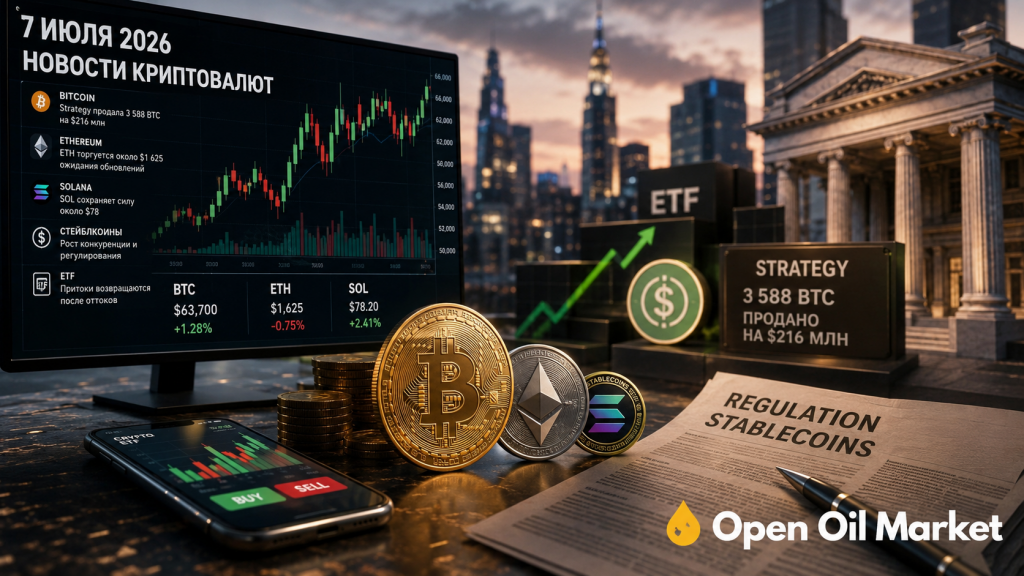
Bitcoin continues to serve as the foundational indicator of risk appetite in the digital asset sector. At the time of writing, BTC is trading close to $63,700, remaining above the June lows but significantly below levels that the market considered as the beginning of a new growth impulse.
Three factors are critical for investors:
- Recovery from the downturn—buyers have returned after June's pressure, but the movement appears more like a technical bounce;
- Response to ETF flows—spot funds are showing signs of inflow again following a series of outflows;
- Behaviour of large corporate holders—the market is closely watching whether companies with large BTC reserves will continue selling off their assets.
The key intrigue on Tuesday is whether Bitcoin can hold above the current range without support from a widespread influx of retail investors. The cryptocurrency market currently feels institutional: prices are driven less by the emotions of individual traders and more by ETFs, the balance sheets of large companies, hedging, and macroeconomic expectations.
The Sale of Bitcoin by Strategy Shifted Perception of Corporate BTC Reserves
The major event for the cryptocurrency market has been the sale of Bitcoin by Strategy, formerly known as MicroStrategy. The company sold 3,588 BTC for approximately $216 million, reducing its total reserves to 843,775 BTC. For the market, this is not just a financial transaction but a symbolic shift: one of the most recognized corporate strategies for accumulating Bitcoin has become more flexible.
Investors are now posing tougher questions:
- Is Bitcoin on corporate balance sheets a long-term reserve asset or a source of liquidity?
- Will other corporate BTC holders sell off assets amid worsening financing conditions?
- How will the market evaluate companies whose capitalisation depends not only on operational business but also on the value of their crypto reserves?
For institutional investors, this represents an important signal: the "buy and never sell" model is no longer perceived as universal. The cryptocurrency market is inching closer to traditional financial markets, where liquidity, cost of capital, dividend obligations, and debt burden may outweigh the ideology of long-term holding.
ETF Flows Again Become the Main Driver of BTC and ETH Prices
Following a series of outflows, spot crypto ETFs have once again attracted investor attention. For Bitcoin, the return of inflows to ETFs serves as a short-term positive signal; however, the market does not yet consider this reversal to be final. In June, funds experienced one of the most challenging periods since their inception, with each new day of inflow or outflow affecting trader sentiment.
The situation surrounding ETFs is critical for several reasons:
- ETFs remain the primary channel for traditional capital access to cryptocurrencies;
- The dynamics of the funds reflect actual institutional demand, rather than solely activity on crypto exchanges;
- Weak inflows increase pressure on Bitcoin and Ethereum, while strong inflows quickly rekindle interest in altcoins.
Ethereum, at the time of writing, is trading around $1,625. For ETH, the key question is whether the network can regain its growth investment narrative following a period of weakness. Investors are monitoring not just the price of Ethereum, but also the activity in Layer 2, DeFi, staking, transaction fees, scaling developments, and competition from Solana.
Ethereum Awaits Acceleration of Its Roadmap and a New Technological Narrative
Ethereum remains the second-largest cryptocurrency and the fundamental infrastructure for smart contracts, DeFi, tokenisation, and Web3 applications. However, in 2026, the market demands of Ethereum not just status, but also speed of execution. Investors are increasingly comparing ETH to faster networks offering low fees and high throughput.
The updated discussion surrounding Ethereum’s long-term roadmap intensifies focus on three areas:
- Scaling—reducing fees and improving throughput;
- Privacy—developing tools for confidential transactions;
- Quantum Resistance—preparing the network for long-term cryptographic risks.
For investors, Ethereum now appears not as a speculative asset for rapid growth, but as an infrastructural bet on the future of digital finance. However, for ETH to regain its market premium, practical updates visible to users, developers, and institutional participants are necessary alongside promises.
Solana Maintains Relative Strength Among Major Altcoins
Solana stands out as one of the most notable assets among the largest cryptocurrencies. At the time of writing, SOL is trading around $78 and appears more resilient than many altcoins. Investors continue to regard Solana as a network for high-frequency applications, tokenising real assets, DeFi, payments, and consumer Web3 services.
The strengths of Solana for the market include:
- High transaction speed;
- Low fees;
- Active ecosystem of developers;
- Institutional interest in tokenised assets;
- Expectations for further development of the network's infrastructure.
It is essential for investors to consider that Solana remains a volatile asset. Its appeal is greater during periods of increased risk appetite; however, during liquidity downturns, altcoins typically decline more rapidly than Bitcoin.
Stablecoins Emerge as a Central Theme in the Crypto Market
In 2026, stablecoins have transitioned from being mere tools for crypto traders to being actively considered by banks, payment systems, fintech companies, and regulators as infrastructure for settlements, cross-border transfers, and tokenisation of financial assets.
Competition between USDT and USDC continues globally, alongside rising interest in new payment networks based on digital dollars. For investors, this indicates that the stablecoin sector is becoming one of the primary bridges between traditional finance and cryptocurrencies.
Regulation is also intensifying. The UK has eased some requirements for stablecoin issuers but maintains a course towards comprehensive oversight. In the US, the key topic remains the structure of the digital asset market and rules governing tokens, exchanges, custodians, and DeFi. The clearer the regulation, the higher the likelihood of the influx of bank and institutional capital.
Top 10 Most Popular Cryptocurrencies as of 7 July 2026
For global investors, the top 10 cryptocurrencies remain a foundational map of the market. These assets underpin the primary liquidity, influence index investing, and often become the first candidates for ETFs, custodial solutions, and institutional products.
- Bitcoin (BTC)—the largest cryptocurrency, a digital reserve asset, and the main market indicator.
- Ethereum (ETH)—the leading platform for smart contracts, DeFi, and tokenisation.
- Tether (USDT)—the largest dollar stablecoin and a key tool for crypto liquidity.
- BNB (BNB)—the token of the Binance ecosystem and BNB Chain.
- USD Coin (USDC)—a regulated dollar stablecoin actively used by institutional participants.
- XRP (XRP)—a token for cross-border settlements and payment infrastructure.
- Solana (SOL)—a high-performance blockchain for DeFi, tokenisation, and applications.
- TRON (TRX)—a network popular for stablecoin transfers and settlement activities.
- Dogecoin (DOGE)—the largest meme cryptocurrency with a loyal community.
- Cardano (ADA)—a blockchain platform with a focus on a research-oriented approach and long-term development.
This list is not only important for retail investors but also for professional market participants. The higher the liquidity of an asset, the easier it becomes to build funds, derivatives, market-making, custodial services, and payment products around it.
What Investors Should Focus on in the Cryptocurrency Market on Tuesday
As of 7 July 2026, the cryptocurrency market remains in a state of cautious recovery. Bitcoin holds a crucial range, Ethereum attempts to regain its technological momentum, Solana maintains relative strength, while stablecoins evolve into a strategic direction for global financial companies.
Investors should pay attention to the following factors:
- The dynamics of inflows and outflows into spot Bitcoin and Ethereum ETFs;
- The behaviour of major BTC holders following the Strategy sale;
- The stability of Bitcoin above the $63,000 zone;
- The relative strength of Solana and other major altcoins;
- News on stablecoin regulation in the US, UK, EU, and Asia;
- The state of global risk appetite against the backdrop of macroeconomic data;
- The market liquidity and trading volumes for the top 10 cryptocurrencies.
The main takeaway for investors: the cryptocurrency market no longer operates solely on internal hype cycles. In 2026, its movements increasingly depend on ETFs, banks, corporate balance sheets, regulation, dollar liquidity, and competition with other high-risk assets, including tech company stocks. Therefore, an investment strategy in cryptocurrencies should consider not only the price of Bitcoin, Ethereum, or Solana but also the state of the entire financial infrastructure surrounding digital assets.