Investors Analyse Bitcoin Decline, Outflows from Cryptocurrency ETFs, and Dynamics of the Top 10 Digital Assets on Global Markets as of June 11, 2026
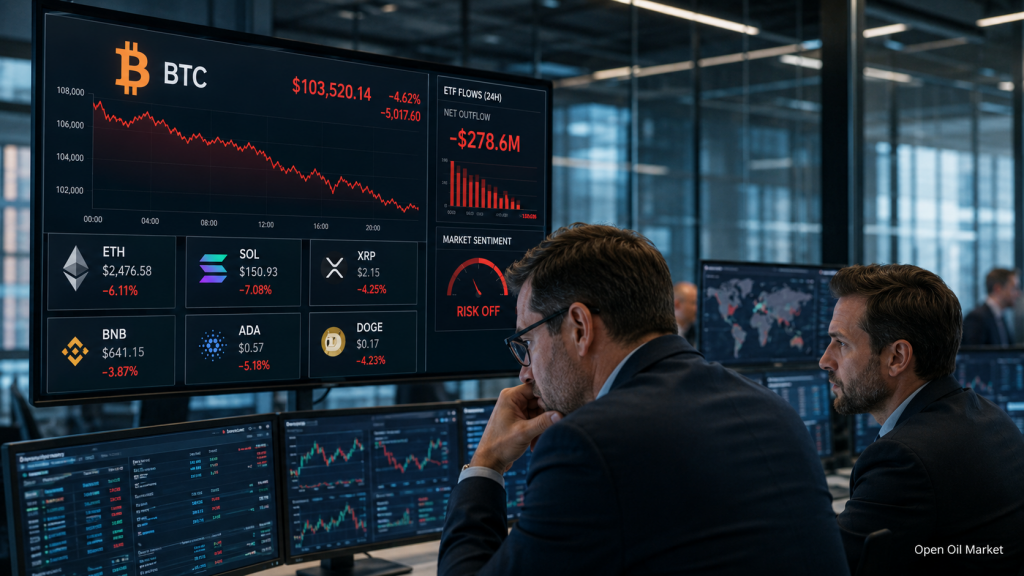
As of Thursday, June 11, 2026, the global cryptocurrency market is operating with heightened caution. Following a period of active decline, investors are reassessing the resilience of Bitcoin, Ethereum, and the largest altcoins amid outflows from cryptocurrency ETFs, macroeconomic pressures, and increasing competition for capital from the technology sector. For participants in the digital asset market, the key question of the day is not only about current price dynamics, but also whether institutional demand for cryptocurrencies remains a distinct asset class.
Today's cryptocurrency news is significant for investors in several respects: Bitcoin's trajectory as a fundamental risk indicator, Ethereum's behaviour as an infrastructural asset, the resilience of stablecoins, demand for regulated instruments, and the status of the top 10 most popular cryptocurrencies. Attention remains firmly on Bitcoin, Ethereum, Tether, BNB, USDC, XRP, Solana, Tron, Dogecoin, and Cardano.
Bitcoin Remains the Primary Sentiment Indicator in the Crypto Market
Bitcoin continues to serve as the primary barometer for the global cryptocurrency market. Its movements set the tone for most digital assets, including Ethereum, Solana, XRP, BNB, and Dogecoin. As of June 11, investors are viewing Bitcoin not just as a cryptocurrency, but as an indicator of the market's attitude towards high-risk assets.
The main pressures on Bitcoin arise from three factors. Firstly, outflows from spot Bitcoin ETFs persist, indicating a decline in short-term appetite among institutional investors. Secondly, capital is partially flowing into technology stocks, artificial intelligence, and anticipated large listings on stock markets. Thirdly, stringent expectations regarding interest rates make investors more selective about assets without cash flow.
For investors, this means that Bitcoin is currently perceived not as an isolated safe asset, but as part of a broader risk segment. If the stock market remains under pressure, cryptocurrencies will also bear additional burdens.
Ethereum: The Infrastructural Role Remains, but Demand is Weak
Ethereum remains the second most significant cryptocurrency and a key platform for DeFi, asset tokenisation, smart contracts, and Web3 infrastructure. However, in the short term, Ethereum is also facing pressure due to a decline in interest for risky digital assets.
For investors, Ethereum is important not only as the ETH coin but also as a technological ecosystem. Decentralised finance, tokenised bonds, stablecoins, NFT infrastructure, and corporate blockchain solutions continue to develop on the Ethereum platform. However, the weak market dynamics suggest that the fundamental role of the network has not yet fully offset the overall capital outflow from the cryptocurrency sector.
A key question for Ethereum over the coming weeks is whether interest in infrastructural crypto assets will return if Bitcoin ETFs stabilise and macroeconomic pressures ease.
The Top 10 Most Popular Cryptocurrencies: What Matters to Investors
The largest and most liquid digital assets remain the focus of the global market. The top 10 cryptocurrencies constitute the majority of trading activity, institutional attention, and retail interest.
- Bitcoin — the primary asset of the crypto market and a main benchmark for institutional investors.
- Ethereum — foundational infrastructure for smart contracts, DeFi, and tokenisation.
- Tether — the largest stablecoin and a crucial liquidity tool.
- BNB — the asset of the Binance ecosystem and one of the largest exchange tokens.
- USDC — a regulated dollar stablecoin, in demand for settlements and institutional infrastructure.
- XRP — a cryptocurrency linked to cross-border payments and banking scenarios.
- Solana — a high-performance network for DeFi, NFTs, meme coins, and consumer Web3 applications.
- Tron — a network actively used for stablecoin transfers.
- Dogecoin — the largest meme coin, sensitive to retail demand and market sentiment.
- Cardano — a blockchain platform focused on scalability and long-term ecosystem development.
For investors, the top 10 cryptocurrencies remain the most indicative segment: it is here that the primary capital flows, liquidity levels, and the market's willingness to take risks are most evident.
ETF Outflows Heighten Institutional Investor Caution
One of the main themes in the cryptocurrency market continues to be spot ETFs on Bitcoin and Ethereum. After a period of active capital inflow, this segment has encountered a significant cooling. Outflows from ETFs indicate that institutional investors are temporarily reducing exposure to cryptocurrencies or reallocating capital to other assets.
ETFs have become an important bridge between traditional finance and the cryptocurrency market. Therefore, changes in flows within these instruments affect not only Bitcoin but also the overall investment narrative surrounding digital assets. If funds continue to lose capital, the market receives a signal of diminishing confidence in short-term growth. Conversely, if outflows slow or turn into inflows, this could signal the first signs of stabilisation.
- Investors should monitor daily flows in Bitcoin and Ethereum ETFs.
- It is important to assess not only cryptocurrency prices but also the behaviour of institutional funds.
- A strong reversal of flows could shift market sentiment faster than local technical signals.
Stablecoins Tether and USDC Maintain Their Role as Market Liquidity Foundation
Amid the volatility of Bitcoin and Ethereum, stablecoins continue to serve as the key infrastructure of the cryptocurrency market. Tether and USDC are utilised for settlements, storing dollar liquidity, transferring funds between exchanges, and participating in DeFi protocols.
The growing prominence of stablecoins underscores that the digital asset market is evolving not only through speculative coins but also through payment infrastructure. For investors, this is an important signal: even amid price declines for Bitcoin and altcoins, demand for cryptocurrency settlements and dollar tokens may remain resilient.
Global attention to stablecoins is increasing in the US, Europe, Asia, and emerging markets. The more actively companies and users apply digital dollars for transfers and settlements, the greater the significance of Tether, USDC, Tron, and networks with low transaction costs.
Solana, XRP, BNB, and Cardano: Altcoins Depend on Liquidity
Major altcoins remain influenced by the overall risk appetite. Solana, XRP, BNB, and Cardano each have different fundamental stories, yet during periods of market stress, investors often assess them as part of a unified high-risk segment.
Solana is attractive to the market due to its high throughput, application activity, and strong retail community. XRP continues to garner attention due to its association with cross-border payments. BNB is tied to the largest exchange ecosystem and the demand for trading infrastructure. Cardano remains an asset for investors focused on the long-term development of blockchain platforms.
However, for all altcoins, liquidity is now of paramount importance. If capital flows back into Bitcoin and Ethereum, it may gradually transition into major altcoins. If pressure on the foundational cryptocurrencies persists, altcoins are usually left more vulnerable.
Regulated Crypto Instruments Become More Important than Speculative Demand
A significant development for the global cryptocurrency market has been the expansion of regulated derivative instruments. The launch of new cryptocurrency index futures enhances the role of traditional exchange infrastructure and provides professional participants with additional hedging mechanisms.
This indicates that cryptocurrencies are continuing to integrate into the global financial system, even as short-term price dynamics remain weak. For institutional investors, it is important not only to hold the coins themselves but also to have the ability to manage risk through regulated futures, options, ETFs, and indices.
The gradual institutionalisation of the market may reduce the volatility of the cryptocurrency sector but simultaneously makes it more dependent on interest rates, the stock market, and the decisions of large asset management companies.
Macroeconomics: Rates, Inflation, and Geopolitics Impact Digital Assets
Cryptocurrencies are increasingly responding to global macroeconomic factors. Investors are monitoring inflation, expectations regarding Federal Reserve interest rates, the dynamics of the dollar, oil prices, and geopolitical risks. The greater the uncertainty, the more cautious capital becomes regarding Bitcoin, Ethereum, and altcoins.
If the yields on traditional instruments remain attractive, some investors prefer bonds, money markets, or equities with clear profitability. For cryptocurrencies, this signals competition for capital. Assets without stable cash flow, including most tokens and meme coins, become particularly sensitive.
As of June 11, 2026, the cryptocurrency market is in a testing phase: will it be able to retain the interest of investors in light of competition from AI, technological IPOs, and traditional financial assets?
What to Watch for as an Investor on June 11, 2026
For cryptocurrency investors, the main scenario of the day is not the search for short-term excitement, but the assessment of market resilience. Bitcoin should demonstrate whether it can stabilise after a series of sell-offs. Ethereum must confirm that infrastructural demand remains in place. Stablecoins should continue to serve as an indicator of liquidity, while altcoins will indicate the market's readiness to take on additional risk.
- The dynamics of flows in Bitcoin and Ethereum ETFs.
- Bitcoin's behaviour concerning key psychological levels.
- The state of Ethereum and demand for infrastructural blockchain assets.
- Liquidity in stablecoins Tether and USDC.
- The rotation of capital among cryptocurrencies, the AI sector, and major IPOs.
- Sentiment regarding Solana, XRP, BNB, Tron, Dogecoin, and Cardano.
The bottom line for the cryptocurrency market can be summarised as follows: digital assets remain at the forefront of global investor attention, but the phase of unconditional optimism has transitioned to a phase of assessing resilience. For long-term capital, this is a period of selecting quality assets, while for short-term traders, it is a market of increased volatility where discipline, risk management, and close attention to macroeconomic signals are crucial.