Bitcoin and the Cryptocurrency Market on 17 June 2026 Against the Backdrop of ETFs, Stablecoins, and Fed Decisions
The cryptocurrency market approaches Wednesday, 17 June 2026, with a cautious recovery following a volatile first half of the month. The main theme of the day for investors is the interplay of three factors: Bitcoin's movement around key levels, the anticipation of a decision from the US Federal Reserve, and a new wave of institutional interest in cryptocurrency ETFs. For a global audience, this is a significant moment: digital assets are once again trading not as an isolated technology sector but as part of the global risk market, influenced by interest rates, liquidity, geopolitics, and regulation.
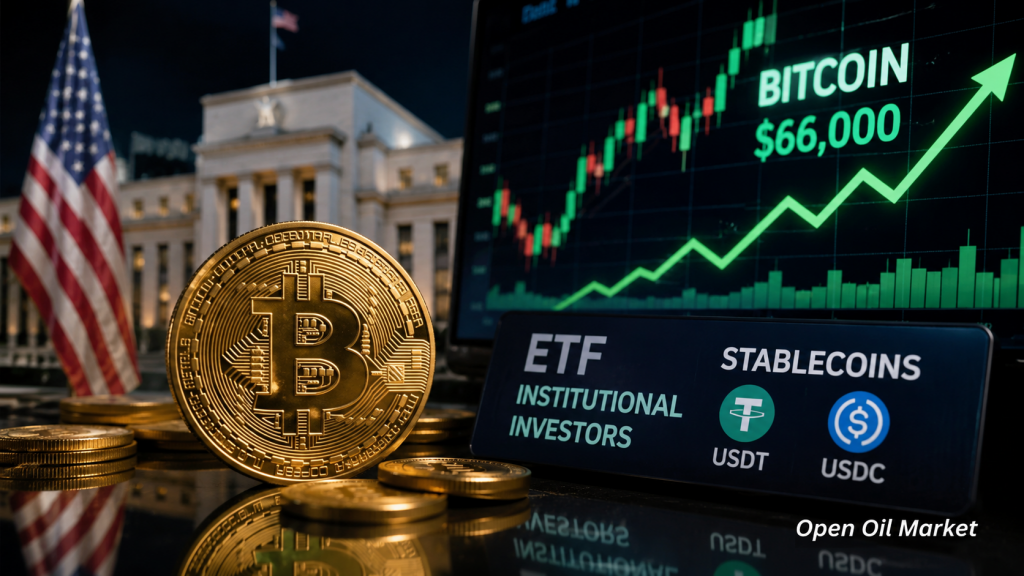
The cryptocurrency news today presents a mixed picture. On one hand, Bitcoin remains around the $66,000 mark, Ethereum hovers near $1,800, and several altcoins are showing signs of recovery. On the other hand, investors are closely monitoring the flows into ETFs, the stability of stablecoins, the state of the DeFi sector, and signals from regulators in the US, Europe, and Asia.
Bitcoin Remains the Primary Indicator of Market Sentiment
Bitcoin retains its position as the benchmark for the entire cryptocurrency market. Following a downturn in early June, the market received support from a resurgence in global risk appetite, a reduction in geopolitical tensions, and a return of some buyers to digital assets. However, the current growth cannot yet be classified as a sustainable trend: investors are assessing whether this recovery is the beginning of a new growth phase or merely a technical rebound after the sell-off.
For Bitcoin, three key factors are currently significant:
- Investors' reactions to the Fed's decision and forecasts on interest rates;
- The dynamics of inflows and outflows from spot Bitcoin ETFs;
- Demand from institutional investors and corporate holders of BTC.
If the Fed maintains a hawkish stance, cryptocurrencies may face downward pressure, as high interest rates make treasury bonds and money market funds more appealing compared to riskier assets. Conversely, if the regulator's tone is softer than anticipated, Bitcoin could receive additional support as a liquid instrument for global investors.
Ethereum is Recovering, But Investors Await a Strong Driver
Ethereum remains the second most significant cryptocurrency and a key infrastructure for smart contracts, DeFi, asset tokenisation, and the NFT sector. As of 17 June 2026, ETH is trading close to the $1,800 mark, but its momentum is less robust than that of Bitcoin. The reason lies in the absence of a powerful short-term catalyst to swiftly restore mass demand within the Ethereum ecosystem.
Nevertheless, the long-term investment rationale for Ethereum remains intact. The network continues to be the largest platform for decentralised applications, and the development of layer two solutions helps to reduce fees and increase throughput. For investors, Ethereum is not only appealing as a cryptocurrency but also as a bet on digital financial infrastructure.
ETFs Become the Main Channel for Institutional Demand
Cryptocurrency ETFs remain one of the most important areas for the digital asset market. After a period of significant outflows from Bitcoin ETFs, investors are reassessing the sustainability of institutional demand. This is fundamentally important for the market: ETFs allow large funds, family offices, and retail investors to gain exposure to Bitcoin and other digital assets through the traditional brokerage account infrastructure.
Special attention is drawn to the SEC's decision regarding the T. Rowe Price Active Crypto ETF. Approval of such a product's listing on NYSE Arca strengthens the trend towards expanding the range of cryptocurrency investment instruments. Unlike a simple product based on a single asset, an active crypto-ETF can include various digital assets and be managed according to market conditions.
For investors, this signifies that the cryptocurrency market is gradually shifting from a phase of speculative purchases of individual coins to a phase of professional management of digital portfolios.
Stablecoins Become the Infrastructure for Global Transactions
Stablecoins continue to be one of the fastest-growing segments of the cryptocurrency market. USDT and USDC rank among the largest digital assets by market capitalisation, and their role extends far beyond exchange trading. They are used for transactions, liquidity storage, cross-border transfers, and operating DeFi protocols.
Regulation of stablecoins is becoming a key topic for the US, Europe, and Asia. In the US, the implementation of the GENIUS Act requirements continues, including provisions for anti-money laundering, sanction compliance, and issuer requirements for payment stablecoins. For investors, this is an important signal: the stablecoin market is becoming more mature but simultaneously more dependent on regulatory standards.
On a global scale, this enhances competition between dollar-denominated digital liquidity, European MiCA regulation, and Asian initiatives in tokenised transactions.
Top 10 Most Popular Cryptocurrencies for Investors
Based on market capitalisation, liquidity, and attention from the market, the focus for investors on 17 June 2026 is on the following cryptocurrencies:
- Bitcoin (BTC) — the primary protection and speculative asset in the crypto market.
- Ethereum (ETH) — the foundational infrastructure for smart contracts and DeFi.
- Tether (USDT) — the largest dollar stablecoin for transactions and liquidity.
- BNB (BNB) — the asset of the Binance ecosystem and associated blockchain services.
- XRP (XRP) — a token linked to cross-border payment solutions.
- USDC (USDC) — a regulated dollar stablecoin with high institutional infrastructure significance.
- Solana (SOL) — a high-performance blockchain for applications, meme coins, and DeFi.
- TRON (TRX) — a network actively used for stablecoin transfers.
- Hyperliquid (HYPE) — one of the most notable assets in the decentralised trading segment.
- Dogecoin (DOGE) — the largest meme coin, sensitive to market demand for risk.
It's important to note that the list of the largest and most popular cryptocurrencies can change rapidly. For investors, key criteria remain not only market capitalisation but also liquidity, ecosystem stability, real use of the network, and regulatory risks.
Altcoins: Recovery is Present, But the Market Remains Selective
Altcoins are currently not showcasing widespread synchronous growth. Investors are selectively choosing projects: blockchains with active user engagement, liquid tokens from large ecosystems, infrastructure solutions, and assets related to decentralised exchanges. This distinguishes the current market from earlier phases when capital mass-migrated from Bitcoin into any high-risk coins.
More promising are facets with clear investment logic:
- Tokenisation of real assets;
- Decentralised exchanges and derivatives platforms;
- Infrastructure for stablecoins;
- Scalable first and second layer blockchains;
- Solutions for institutional storage of digital assets.
For retail investors, this indicates the necessity for more stringent selection. While high returns in altcoins are attainable, the risks remain significantly higher than those associated with Bitcoin and Ethereum.
Macroeconomics: The Fed's Decision May Set the Market Tone
The main macroeconomic event for cryptocurrencies on 17 June 2026 is the anticipation of the US Federal Reserve's decision. For Bitcoin, Ethereum, and altcoins, interest rates remain one of the key factors. The higher the yield on risk-free instruments, the more challenging it is for cryptocurrencies to attract new capital. The closer the market is to expectations of a policy easing, the higher the likelihood of demand for riskier assets.
Investors should monitor not only the rate decision itself but also the tone of the Fed's comments. Even if the rate remains unchanged, updated projections, inflation assessments, and comments on economic growth may trigger sharp movements in the cryptocurrency market.
Regulation Becomes a Factor in Investment Assessment
The cryptocurrency market increasingly relies on regulation. The US is advancing frameworks for digital assets and stablecoins, Europe is tightening oversight through MiCA, and Asian jurisdictions are competing for the status of a digital finance hub. For global investors, this alters the approach to cryptocurrency valuation.
Now, not only technology and the project community are important, but also legal robustness:
- Can the token be classified as a security?
- Is the asset accessible to ETFs or institutional funds?
- Does the project have a transparent governance structure?
- How sustainable is liquidity on major exchanges?
- Is the project dependent on a single regulatory market?
For investors, this means that the regulatory premium is becoming as important as the technological or market one.
What Matters to Investors on 17 June 2026
As cryptocurrencies enter mid-June with a cautious recovery, there is no definitive confirmation of a new upward trend. Bitcoin continues to serve as the key indicator of demand for digital assets, Ethereum maintains its infrastructural role, stablecoins strengthen their positions in global transactions, and ETFs serve as a bridge between the crypto market and traditional finance.
Investors should pay attention to several key signals:
- Will Bitcoin hold its current zone following the Fed's decision?
- Will stable inflows return to Bitcoin ETFs and Ethereum ETFs?
- Will interest in the largest altcoins persist?
- How will regulation of stablecoins evolve in the US and Europe?
- Will institutional capital expand its presence in cryptocurrency products?
The baseline scenario for the cryptocurrency market on Wednesday, 17 June 2026, can be described as cautiously neutral. Growth potential remains, but its realisation depends on macroeconomic signals, ETF flows, and Bitcoin's ability to establish itself above key levels. For long-term investors, cryptocurrencies remain a high-risk yet significant asset class in a global portfolio. For short-term traders, the coming days may witness heightened volatility.