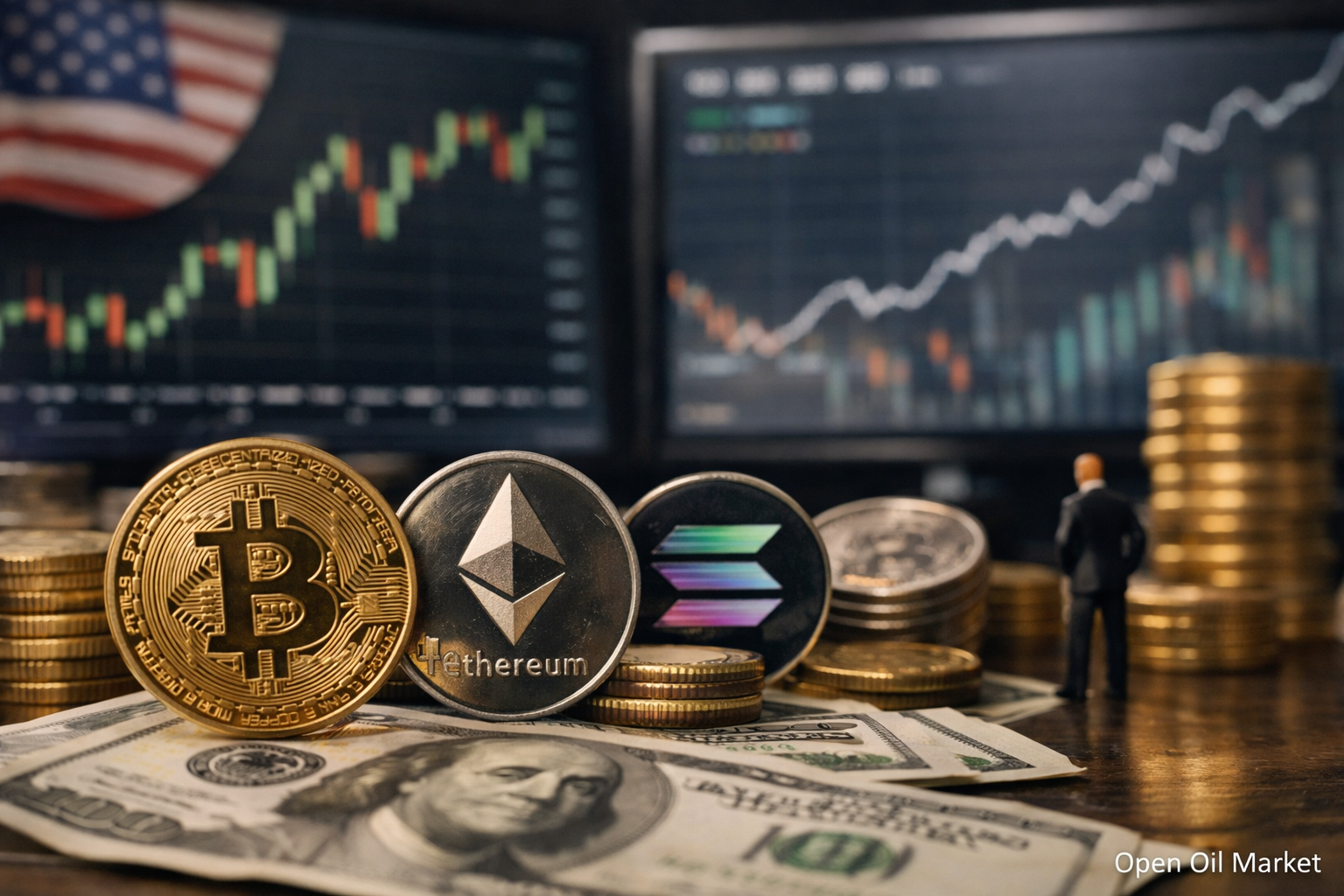
Current Cryptocurrency News as of 21 March 2026: Bitcoin, Ethereum, Top 10 Cryptocurrencies, Institutional Investments, and Global Digital Asset Market Analysis
As the week draws to a close, the cryptocurrency market exhibits a mixed dynamic. Following a series of volatile sessions, investors are reluctant to aggressively increase their positions, opting instead to assess a combination of two factors: regulatory changes and external macroeconomic pressures. For Bitcoin, this translates to a struggle for the status of the primary safe-haven asset within the crypto market, whereas Ethereum and altcoins face the challenge of proving the resilience of their ecosystems amidst more selective capital.
Currently, the cryptocurrency market increasingly resembles a mature risk asset sector: movements are now dictated not only by news within the blockchain industry but also by expectations regarding interest rates, inflation, global risk appetite, and the dollar's performance. As such, a short-term pause in growth does not appear to signal a trend reversal but rather serves as a phase of re-evaluating the market's drivers.
Bitcoin Maintains Leadership and Strengthens Its Status as the Industry's Core Asset
Bitcoin remains the key benchmark for the entire digital asset market. Its share of the total cryptocurrency market capitalisation remains significant, with BTC again serving as the primary indicator of institutional trust in the sector. For global investors, Bitcoin today represents not merely a speculative tool but also a digital macro-asset, sensitive to capital flows, ETF demand, and regulatory changes.
At this juncture, Bitcoin's behaviour illustrates an important characteristic of 2026: the market is willing to support the long-term investment narrative of BTC, but in the short term, it has become significantly more disciplined. Buyers are no longer ignoring risks but are carefully assessing entry points, fiscal and monetary agendas, as well as the likelihood of new institutional catalysts.
- Bitcoin remains the primary benchmark for the cryptocurrency market.
- Investors view BTC as the cornerstone of their digital portfolios.
- Further dynamics will largely depend on global risk appetite and the influx of large capital.
Ethereum Seeks to Reclaim Strategic Initiative Through Infrastructure and Yield
As of 21 March, Ethereum finds itself in a more complex yet potentially intriguing position. Unlike Bitcoin, which benefits from a straightforward investment thesis, Ethereum must simultaneously validate its worth as a technological platform supporting DeFi, tokenisation, stablecoins, and smart contract economies. Consequently, news related to institutional products and the potential for yield generation through staking mechanics holds particular importance for ETH.
The market is increasingly regarding Ethereum as an infrastructure asset. If Bitcoin represents digital scarcity, Ethereum embodies digital financial infrastructure. In this context, the development of exchange-traded products focused on ETH becomes a crucial signal for institutional investors: capital is seeking not only price growth but also more understandable forms of participation in the ecosystem.
Regulatory Developments in the US Become a Key Driver of the Crypto Market
One of the most significant themes of the week has been regulatory clarity in the US. This holds importance for the global cryptocurrency market well beyond American jurisdiction, as the US sets the rules for access to institutional capital, ETF development, compliance, and the circulation of tokenised assets. The clearer the playing field, the easier it becomes for major financial institutions to increase their presence in digital assets.
The market views this agenda with dual perspectives. The positive aspect is that cryptocurrencies are receiving clearer classifications and experiencing less legal uncertainty. The caution lies in the fact that the transition period may take time, implying that some expected drivers will materialise gradually rather than instantaneously.
- Regulatory clarity increases the likelihood of new institutional products.
- Legal certainty reduces barriers for banks, funds, and infrastructure providers.
- However, the market still hinges on the speed of the practical implementation of new regulations.
Asset Tokenisation and ETFs Strengthen the Link Between Crypto Industry and Traditional Finance
A key trend in March 2026 is the further convergence of the cryptocurrency market with the traditional financial system. The topic of tokenising securities, funds, and settlement infrastructure is gradually moving from experimentation to a tangible development vector. For investors, this is particularly significant as the value of many digital assets is increasingly being determined not only by the crypto cycle but also by the depth of their integration with traditional capital.
In this context, the ETF segment plays a vital role. The more regulated investment vehicles that emerge around Bitcoin and Ethereum, the higher the likelihood of a sustained influx of capital from institutional investors, pension structures, wealth management firms, and large private clients. This does not guarantee continuous price growth but makes the market more mature and less marginal.
Top 10 Most Popular Cryptocurrencies: What the Global Market Is Watching
When assessing the most popular cryptocurrencies by market capitalisation and investor attention, the global market converges around the following assets as the week comes to a close:
Top 10 Cryptocurrencies by Capitalisation and Market Influence
- Bitcoin (BTC)
- Ethereum (ETH)
- Tether (USDT)
- XRP
- BNB
- USD Coin (USDC)
- Solana (SOL)
- TRON (TRX)
- Dogecoin (DOGE)
- Hyperliquid (HYPE)
This structure highlights an important characteristic of the cryptocurrency market in 2026. The top assets include:
- Core network assets—BTC and ETH;
- Stablecoins—USDT and USDC;
- Large infrastructural ecosystems—BNB, Solana, TRON;
- Assets with strong market branding and high liquidity—XRP and Dogecoin;
- New rapidly growing platforms attracting speculative and institutional interest.
For investors, this indicates that the market has become significantly more segmented. It is no longer sufficient to simply “buy altcoins”—it is crucial to understand the type of asset each project represents: operational, infrastructural, speculative, ecosystem-based, or income-generating.
Altcoins Retain Potential, but the Market Becomes More Selective
The altcoin segment continues to operate on a selective demand principle. Capital is increasingly concentrating in projects that possess at least one of three qualities: scalable ecosystems, global liquidity, or a strong investment narrative. Solana, XRP, BNB, and TRON continue to capture attention precisely because investors perceive them not just as speculative stories but as entities with real user scenarios, infrastructure, and turnovers.
Concurrently, weaker projects are facing challenges as the market begins to shy away from funding promises lacking proven economics. This represents a significant shift for the entire crypto industry: 2026 increasingly resembles a period of professionalisation, where liquidity is predominantly available to the strongest assets.
Stablecoins Become a Systemically Important Component of Digital Financial Architecture
Stablecoins deserve separate attention. Their role in the cryptocurrency industry can no longer be viewed as auxiliary. USDT and USDC have evolved into not merely a means of settlement between exchanges and traders, but an actual monetary layer within the digital economy. A substantial portion of liquidity, trading volume, and capital movement between various blockchain networks transpires through stablecoins.
For investors, this holds significance for two reasons. Firstly, the growing importance of stablecoins supports the ecosystems in which they are actively utilised. Secondly, substantial legislative discussions are currently centred around the regulation of stablecoins, implying that their development could impact the entire cryptocurrency market—from Ethereum and Solana to payment services and tokenised assets.
What This Means for Investors Over the Weekend and Next Week
As of 21 March 2026, the cryptocurrency market maintains a strategically constructive backdrop, yet it does not provide grounds for reckless optimism. Investors should consider that the sector is evolving along two trajectories: institutional recognition is strengthening while short-term fluctuations remain high due to macroeconomic and geopolitical contexts.
The key takeaway for the global audience of investors is as follows:
- Bitcoin remains the principal barometer of trust in digital assets.
- Ethereum retains potential through its infrastructural role and the development of investment products.
- The top 10 cryptocurrencies indicate an increasing market segmentation.
- Regulatory clarity in the US and the advancement of tokenisation may become mid-term drivers of a new growth phase.
- In the short term, investors should prioritise discipline, diversification, and focus on asset quality.
Indeed, Saturday, 21 March 2026, greets the cryptocurrency market not in a phase of euphoria but rather in a phase of maturation. For long-term investors, this may signal a more robust development: digital assets are progressively transitioning from emotional trading to systemic integration within the global financial architecture.