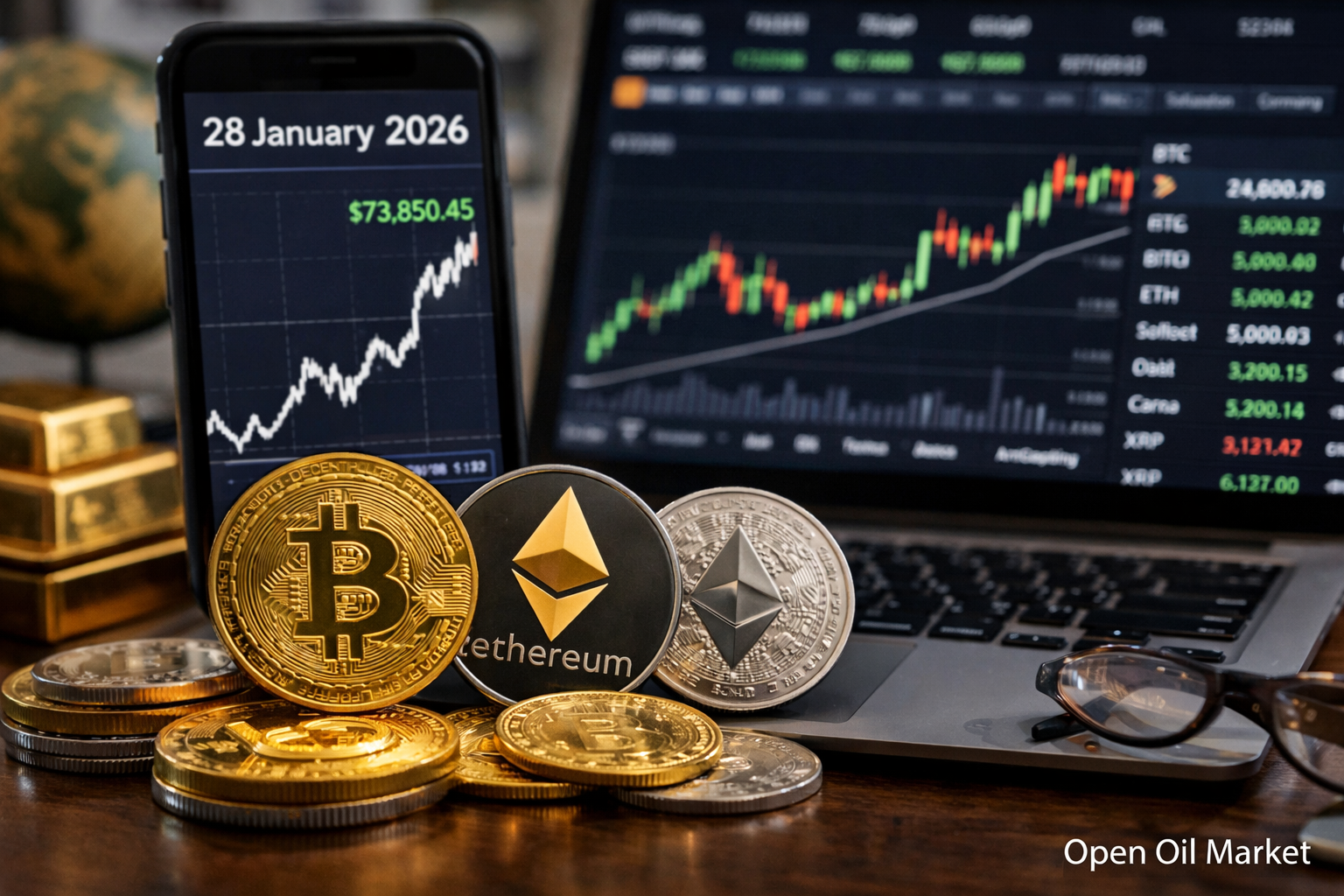
Current Cryptocurrency News — Wednesday, 28 January 2026: Bitcoin Attempts to Stabilise Ahead of US Fed Decision, Gold Holds Near Record Levels, Institutional Investors Shift Focus to Altcoins, Top 10 Cryptocurrency Overview.
As of the morning of 28 January 2026, the cryptocurrency market remains in a state of caution: Bitcoin has failed to regain the psychological level of $90,000, trying to hold up within the upper range of $80,000. Investors continue to reduce risk positions in anticipation of the results from the first Federal Reserve (Fed) meeting of the year amidst a global decline in risk appetite.
External macroeconomic factors are amplifying the uncertainty. The hawkish rhetoric from Fed officials and increased risks of a potential government shutdown in the US are directing capital towards safe-haven assets. Gold prices are holding near record levels of approximately $5,100 per ounce, highlighting the flow of funds into traditional "safe havens." At the same time, Bitcoin, previously regarded by some investors as "digital gold," is not living up to its status as a defensive asset, moving in conjunction with corrections in the stock market.
Bitcoin: Attempting to Hold Steady Ahead of Fed Decision
In recent days, Bitcoin (BTC) has generally been consolidating below a key level. Earlier in the week, its price dropped to around $87,000 (nearly 30% below its all-time high of approximately $125,000 recorded in August 2025). The leading cryptocurrency has not managed to reclaim the $90,000 mark, reflecting the overarching decline in risk appetite across global markets.
Macroeconomic risks remain the primary driver for BTC. Amidst a mass shift of investors towards safe assets (with gold prices at record highs), Bitcoin is currently trading more as a risky asset rather than as "digital gold." In conditions of low liquidity during the weekends, BTC briefly fell to the mid-range of $80,000–$90,000; however, at the start of the current week, it rebounded to around $88,000, still under pressure from sellers.
Ethereum: Decline Amid Market Downturn
The second largest cryptocurrency by market capitalisation, Ethereum (ETH), is reflecting the overall downward trend of the market. The ETH price has fallen below $3,000, losing around 5% over the past week. The current price (approximately $2,900) remains significantly below Ethereum's historical high of around $4,890 reached in 2021. Nevertheless, the ETH network continues to play a crucial role in the industry due to smart contracts, decentralised finance (DeFi), and the issuance of stablecoins.
Institutional interest in Ethereum, which notably increased after the launch of the first spot ETFs for this altcoin in 2025, has somewhat cooled at the beginning of 2026. In the first weeks of January, crypto funds focused on ETH experienced capital outflows amid a general retreat of investors from risky assets. Nevertheless, Ethereum maintains a capitalisation of approximately 12% of the total crypto market, confidently holding its second position behind Bitcoin.
Altcoins: Mixed Dynamics
The alternative cryptocurrencies (altcoins) market is demonstrating heterogeneous movement amidst declines in the leaders. Many large coins from the top 10 saw moderate declines in price over the past day following Bitcoin; however, some assets are holding up better than others. The total market capitalisation of altcoins (excluding BTC) is estimated at around $1.2 trillion, representing a significant market share outside of Bitcoin.
A number of altcoins continue to attract heightened attention due to fundamental factors. For instance, the Ripple token (XRP) is trading near its multi-year high of approximately $2.00 after a recent January surge, spurred by positive news regarding its legal status and increased demand from funds. Binance Coin (BNB) remains around $600, keeping its position in the top 5 despite legal risks surrounding the exchange, thanks to its wide range of use cases (from trading fee payments to participation in the BNB Chain DeFi ecosystem). The blockchain token Solana (SOL) previously rose above $150 on the back of ETF approvals, and after a correction, has settled around $130, significantly higher than levels seen last year. The cryptocurrency Cardano (ADA) rose to $1 by the end of 2025 on expectations of its own ETF launch; it is now trading slightly above $1, supported by an active developer community.
Institutional Investors and Capital Flows
Major investors have noticeably adjusted their strategies in the cryptocurrency market in the new year. Following a robust inflow into crypto funds during the early weeks of January 2026 (totaling over $1.2 billion), a wave of capital outflows has ensued. Investments in Bitcoin funds have particularly sharply declined: over the past two weeks, more than $1 billion was withdrawn from US spot BTC ETFs (with around $394 million withdrawn just last Friday), indicating the caution of "smart money." Ethereum funds have also been impacted by outflows; according to CoinShares, around $350 million has left ETH ETFs in the first weeks of the month.
At the same time, the influx of new investments is shifting towards specific altcoins. By mid-January, ETFs on XRP had accumulated approximately $1.3 billion in assets under management — the second-fastest achievement of this milestone after Bitcoin ETFs. Solana is also attracting institutional interest: the spot ETFs launched in the autumn of 2025 surpassed $1 billion in assets overall. Notably, one of Wall Street's leading banks, Morgan Stanley, submitted several applications for crypto-ETFs (for Bitcoin, Ethereum, and Solana) to the SEC at the beginning of 2026, while Bank of America simultaneously permitted its clients to invest directly in digital assets. These steps affirm the growth of institutional demand for cryptocurrencies beyond the traditional BTC and ETH.
Market Sentiments and Volatility
Investor sentiment indicators have significantly worsened. The "fear and greed" index for cryptocurrencies has fallen to around 25 points out of 100, signalling a state of "fear." This is one of the lowest readings in recent months and a stark contrast to the "greed" mode observed in the autumn. A negative news backdrop and price declines have significantly heightened market participants' caution, causing many to continue reducing risk positions.
Cryptocurrency market volatility remains high. Sharp fluctuations in Bitcoin's price in recent days have been accompanied by massive liquidations of margin positions. Data from Coinglass indicates that forced closures of positions totalled approximately $150 million over the past day, with the majority coming from long positions in BTC and ETH. Experts note that low liquidity during weekend trading exacerbated the "domino effect" during the decline: triggering stop orders and margin calls instigated a chain reaction of sales. Analysts urge investors to exercise caution: historically, periods of extreme fear have often preceded trend reversals and recovery phases, although guarantees of a quick rebound under current conditions are absent.
Forecasts and Expectations
The expert community offers mixed forecasts regarding the future dynamics of the cryptocurrency market. Some analysts maintain a bullish outlook, viewing the current decline as a temporary correction within an ongoing upward trend. For example, several investment banks projected Bitcoin's rise to new highs within the next 12–18 months at the start of the year, although these estimates have been partially lowered following recent volatility (Standard Chartered adjusted its end-of-year forecast for BTC from $300,000 to $150,000). Advocates of the optimistic scenario point to the continued institutional adoption of cryptocurrencies and the potential for monetary policy easing in the latter half of 2026 — these factors could restore capital inflow into the market.
Simultaneously, cautious and bearish viewpoints are gaining strength. Technical analysts warn that if support around $85,000 is breached, Bitcoin may retest last year's lows (approximately $74,000). Some pessimists foresee a deepening decline to as low as $50,000 if macroeconomic conditions worsen. The upcoming days are likely to be decisive for the market: the outcomes of the Fed meeting (expected later this evening) and financial reports from leading tech companies releasing this week will set the tone for the dynamics of risk assets. If regulators issue signals for a softer stance or corporate results exceed expectations, digital assets may receive a boost towards recovery. Conversely, consolidation and heightened volatility may persist until signs of improving macroeconomic conditions emerge.
Top 10 Most Popular Cryptocurrencies
- Bitcoin (BTC) — the first and largest cryptocurrency. BTC is trading around $88,000, approximately 30% below its all-time high; its market capitalisation is approximately $1.8 trillion (≈60% of the total market).
- Ethereum (ETH) — the largest altcoin and platform for smart contracts. The ETH price is around $2,900, significantly below record levels; capitalisation is around $350 billion (~12% of the market). Ethereum remains the foundation for DeFi and NFT ecosystems, confidently holding the second position.
- Ripple (XRP) — the token of the Ripple payment network for cross-border settlements. XRP is trading around $2.00; its market capitalisation is approximately $120 billion. Regulatory clarity regarding XRP's status in the US and growing institutional interest have returned this token to the top three market leaders.
- Tether (USDT) — the largest stablecoin pegged to the US dollar at a ratio of 1:1. USDT is widely used by traders for settlements and capital storage between trades, with a capitalisation of around $150 billion; the coin reliably holds a price of $1.00 (≈₽81.50).
- Binance Coin (BNB) — the token of the largest cryptocurrency exchange, Binance, and the native coin of the BNB Chain ecosystem. BNB is priced around $600; capitalisation is approximately $85 billion. Despite legal pressures on Binance, this asset remains in the top five due to its wide range of uses (fee payments, participation in token sales, operating dApps in the ecosystem).
- Solana (SOL) — a high-performance blockchain platform for decentralised applications. SOL is trading around $130 (capitalisation ~ $52 billion), having recovered a significant portion of last year's decline. Interest in Solana is supported by the launch of ETFs on this token and the revival of projects in its ecosystem.
- USD Coin (USDC) — the second largest stablecoin backed by reserves in US dollars (issuer — Circle). The price of USDC is maintained at $1.00, with a capitalisation of approximately $60 billion. USDC is actively used by both institutional investors and in DeFi protocols due to the transparency of reserves and high reliability.
- Cardano (ADA) — a blockchain platform developed on a research-based foundation. ADA is trading around $1.05 (capitalisation ~ $35 billion) after climbing on expectations of an ETF launch. Cardano attracts attention due to planned technical updates and an active community that believes in the long-term potential of the project.
- TRON (TRX) — a platform for smart contracts and decentralised multimedia applications, particularly popular in Asia. TRX is trading around $0.30; market value ~ $30 billion. TRON remains in the top ten partly due to its broad usage for issuing stablecoins (a significant portion of USDT circulates on the Tron blockchain) and an active Asian audience.
- Dogecoin (DOGE) — the most well-known "meme" cryptocurrency, originally created as a joke. DOGE is holding around $0.18 (capitalisation ~ $27 billion), supported by a dedicated community and occasional celebrity attention. Despite high volatility, this coin continues to remain within the top ten, demonstrating remarkable resilience in investors' interest in risky assets.
Cryptocurrency Market Morning Update, 28 January 2026
Major Cryptocurrency Prices:
- Bitcoin (BTC): $88,200
- Ethereum (ETH): $2,950
- XRP (XRP): $1.95
- BNB (BNB): $620
- Solana (SOL): $132
- Tether (USDT): $1.00 (≈₽81.50)
Market Metrics:
- Cryptocurrency Market Capitalisation: $3.0 trillion
- Bitcoin's Share: 58.5%
- Fear and Greed Index: 25 (fear)
Leaders of Daily Change:
- Increase: Monero (XMR) — +5%
- Decline: Dogecoin (DOGE) — -5%
Analysis: Bitcoin and Ethereum remain under pressure near current price levels, and the sentiment index is at one of its lowest values, reflecting a high level of concern in the market. The rise of Monero signals point interest from investors in projects with unique applied value (such as transaction privacy), while the decline of Dogecoin can be explained by the outflow of capital from highly speculative assets amidst a decline in risk appetite.