Economic Events and Corporate Reports – Friday, April 17, 2026: Eurozone External Sector, Banking Reports and Signals from Turkey
Friday, April 17, 2026, does not present itself as a day dominated by a single significant macroeconomic release but rather as a session where investors will concurrently assess economic events, corporate reports, and geopolitical signals. For the global environment, this combination is crucial: Europe sets the tone through external sector statistics, the US continues its banking reporting season, and the Russian context receives additional political background through the Turkish direction. For the CIS audience, it is a day where it is particularly important to consider not only the numbers but also how they alter expectations regarding interest rates, currencies, commodities, and equities.
Brief Introduction: What Shapes the Agenda
The main characteristic of Friday is that the market is shifting its focus from inflationary releases to the quality of external demand, the resilience of bank profits, and political signals influencing commodity markets. The economic events of April 17, 2026, are primarily significant for those tracking the S&P 500, Euro Stoxx 50, Nikkei 225, and MOEX within a unified logic of global capital.
In brief, investors are set to evaluate three layers of information:
- the state of the Eurozone external sector through the current account and trade dynamics;
- the quality of reports from major financial firms in the US that continue to set the tone for the S&P 500;
- the impact of the diplomatic agenda surrounding Turkey on oil, emerging market currencies, and overall risk appetite.
Eurozone: The External Sector Takes Centre Stage
The morning European block will be critical for assessing the robustness of the Eurozone economy as it enters the second quarter. The focus will be on the current account data for February. For the market, this is not merely a balance of payments statistic, but an indicator of how the region navigates a combination of weak industrial output, expensive energy, and uneven external demand.
This is important for investors for several reasons. Firstly, a strong external sector supports the euro and alleviates concerns about the region's macroeconomic fragility. Secondly, a stable current account is typically perceived positively for bonds and large exporters from the Euro Stoxx 50. Lastly, the external sector provides insight into Europe's ability to offset domestic weakness through trade and financial flows.
A separate market emphasis will remain on the Eurozone trade balance for February. Even if the primary impetus from this release has already been absorbed earlier, on Friday, investors will continue to incorporate this data into their assessments of European exporters, the industrial sector, and the euro exchange rate. For global markets, this holds direct relevance: weak external demand in Europe swiftly translates into a more cautious outlook on cyclical sectors and commodity assets.
Geopolitics: Turkey, Russia and Sensitivity of Commodity Markets
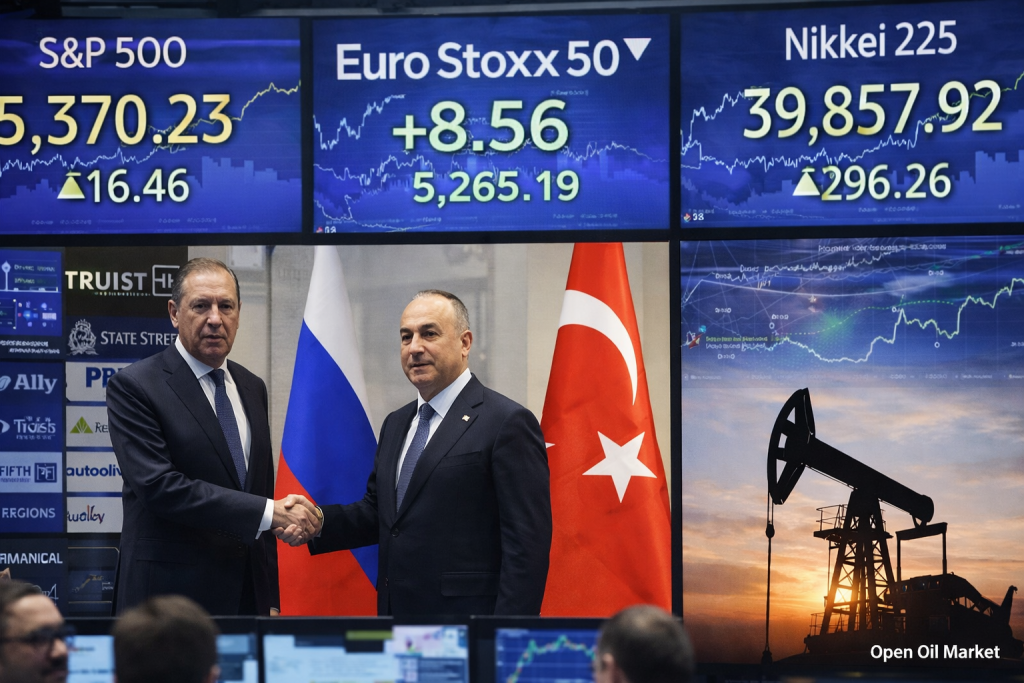
For the Russian audience, the diplomatic agenda in Turkey on April 17-18 carries additional significance. This factor, in itself, is not a classic economic release, yet it has the potential to shift market sentiment through expectations regarding regional stability, logistics, energy flows, and the sanctions backdrop.
In practical terms, investors should monitor three channels of influence:
- the reaction of the oil market and energy companies to any new statements;
- the behaviour of emerging market currencies, including the rouble;
- the change in demand for safe-haven assets, should geopolitical rhetoric harden.
For MOEX, this is particularly important on a day when the local corporate reporting schedule is limited. In this configuration, the external backdrop is likely to exert a stronger influence than usual on banks, oil and gas, transport, and exporters.
USA: A Key Day for the Banking and Financial Segment of the S&P 500
The American corporate reporting block on Friday appears focused and particularly illustrative. The spotlight will be on major financial companies, which means the market will once again evaluate net interest margins, the quality of loan portfolios, the volume of fee income, and management commentary on the economy for the remainder of 2026.
Among the largest confirmed reports of the day in the US:
- Truist Financial – an important benchmark for the regional banking sector and credit activity;
- State Street – a key barometer for custodial business, fees, and institutional flows;
- Fifth Third Bancorp – a measure of the state of the mid-tier banking segment and dynamics of retail-corporate demand;
- Regions Financial – significant for assessing regional lending and deposit base behaviour;
- Ally Financial – particularly interesting as an indicator of consumer lending and the auto credit market.
This set of reports renders the corporate disclosures of April 17, 2026, especially significant for the S&P 500. Should the results confirm robust profitability for banks and no deterioration in asset quality, the market would receive support within the financial sector and likely adopt a more optimistic outlook on domestic demand in the US. However, if management expresses more cautious sentiments regarding reserves, funding costs, or credit risks, this could quickly amplify defensive positioning.
European Companies: Ericsson and Autoliv as Industrial Cycle Indicators
The European corporate calendar for Friday is considerably less crowded compared to the US but is not devoid of significant names. For global market investors, Ericsson and Autoliv hold particular interest.
Why this is important:
- Ericsson provides the market with guidance on telecom infrastructure, operator investment rates, and the resilience of demand for network equipment;
- Autoliv helps assess the state of the global automotive industry and the order structure among car manufacturers and the dynamics of safety component supplies.
For the Euro Stoxx 50, these reports may not carry the same index-weight as the largest European banks or the luxury sector, but in terms of cyclical signals, they are quite valuable. Ericsson reflects capital expenditures and digital infrastructure, while Autoliv denotes real manufacturing demand and the state of international supply chains.
Asia: Jio Financial, Kweichow Moutai and Asian Risk Appetite
In the Asian block, investors will be attentive not only to Japanese indices but also to the broader regional picture. Among the major public companies featuring prominently on Friday are Jio Financial Services in India, as well as Kweichow Moutai in the Chinese consumer segment.
For the market, these represent important signals in two distinct directions:
- Jio Financial Services illustrates how quickly digital financial services are scaling in India and how investors perceive the monetisation of this model.
- Kweichow Moutai remains one of the most significant indicators of premium consumption in China and the resilience of domestic demand.
While these reports do not directly dictate the dynamics of the Nikkei 225, they assist in understanding the overall quality of the Asian corporate backdrop. For global investors, this is vital in assessing choices between defensive and cyclical assets, as well as gauging the strength of domestic demand in the largest economies across Asia.
Russia and MOEX: The Local Market is More Dependent on External Context
In the Russian segment, Friday appears less saturated regarding major confirmed quarterly publications than the US or even Northern Europe. As a result, for MOEX, the main driver will remain a combination of external narratives: Europe, American corporate reports, commodity prices, and news from Turkey.
For Russian investors, this implies that particular attention should be paid to the following linkages:
- the euro and the Eurozone external sector – to evaluate export demand;
- US bank reports – to understand global risk appetite;
- oil and diplomatic signals – for commodity sector stocks and the ruble exchange rate;
- bond yields – to assess reactions to a potential market shift towards a more defensive stance.
It is on such days that MOEX often moves not according to local news but through a global combination of macroeconomics and earnings releases.
What to Watch for as an Investor by Day’s End
By the conclusion of Friday’s session, investors should seek to address several key questions.
- Did the Eurozone data confirm the resilience of the external sector, or does Europe remain vulnerable to weak demand?
- Did American banks and financial companies showcase healthy profit dynamics without any deterioration in asset quality?
- Did Ericsson and Autoliv provide grounds for asserting the stability of the industrial cycle in Europe and the global automotive industry?
- Did the Asian corporate backdrop bolster global risk appetite?
- Did the Turkish diplomatic track exacerbate uncertainty in the energy market or, conversely, reduce tensions?
Should macroeconomic signals from Europe conclude the day on a neutral to positive note, and should the corporate reports from the US confirm the resilience of the financial sector, global markets may finish the week on a constructive note. Conversely, if the Eurozone's external sector disappoints, and US banking comments become more cautious, investors may shift towards a more defensive positioning ahead of the new week.
For CIS investors, Friday, April 17, 2026, is particularly significant as a day of synchronising the global picture: Europe demonstrates the state of external demand, the US translates macroeconomics into corporate profit vernacular, Asia adds regional growth signals, and the Russian market interprets all of this through commodities, currency, and overall risk sentiment.