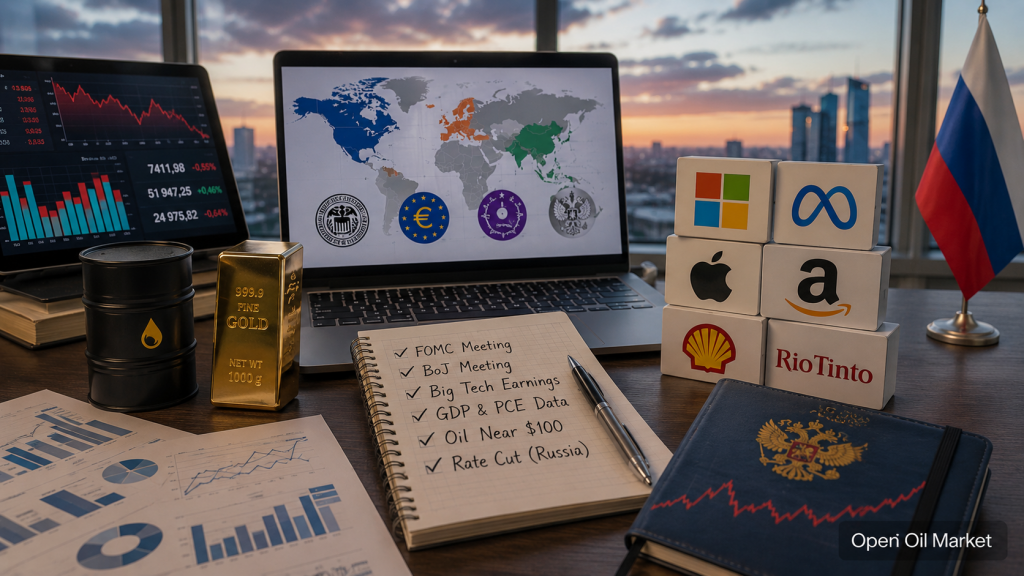
Review of Economic Events and Corporate Reporting on 26 July 2026: Stock Markets Closed, but the Week's Agenda is Set — FOMC Decision, Bank of Japan Meeting, Quarterly Results from Microsoft, Meta, Apple, Amazon, Shell, and Rio Tinto, as well as the Reaction of the MOEX Index to the Key Rate Cut by the CBR
Sunday, 26 July 2026, is a trading halt day with no macroeconomic statistics. Global markets are closed, the economic calendar is empty, and Russia observes Navy Day. However, for investors, this is not a pause but an opportunity for preparation: a particularly busy week lies ahead. The economic events and corporate reports scheduled for 27–31 July include the FOMC's interest rate decision, the Bank of Japan's meeting, the release of the US GDP for Q2 and the PCE deflator, along with quarterly results from companies that constitute a significant portion of the S&P 500's market capitalisation. The backdrop remains the conflict surrounding Iran, keeping Brent oil near three-digit levels.
Summary of the Trading Week on Global Markets
The week concluded with mixed and generally negative results. On Friday, 24 July, the S&P 500 added a mere 0.05% to close at 7,411.98 points, while Dow Jones rose by 0.46% to 51,947.25, and the Nasdaq Composite declined by 0.64% to 24,975.82. Over the five trading sessions, all three US indices ended in the red, with the Nasdaq losing approximately 2%.
- The major shock of the week was the sell-off on Thursday, when the "magnificent seven" collectively lost around $800 billion in market capitalisation.
- Alphabet saw a decline of roughly 7%, while Tesla dropped 14%: both companies reported negative free cash flow for the quarter amid a sharp increase in investments in AI infrastructure.
- Intel lost nearly 8% on Friday, despite reporting better-than-expected earnings — the market penalises spending rather than revenue.
- Apple, conversely, gained about 3.5%, supporting the Dow after reaching all-time highs earlier in July.
Despite this, the earnings season is performing strongly: approximately 88% of the first 95 S&P 500 companies that reported exceeded earnings forecasts. The divergence between solid numbers and the weak reactions of stock prices is a key signal for investors: the market is reassessing not the profits, but capital expenditures.
Oil, Gas, and Gold: Geopolitical Premium in Prices
Commodity markets remain the main conduit for transmitting geopolitical risks into the global economy. On Friday, Brent dropped approximately 4%, closing around $97 per barrel — the largest daily decrease since late June, yet prices rose more than 12% over the week.
- Shipping through the Strait of Hormuz is disrupted, with some export flows from the Persian Gulf redirected.
- Attacks by Houthi rebels on two Saudi tankers in the Red Sea have opened a second front of logistical risks and raised freight rates.
- Gold remains near historical highs (around $4,100 per ounce), reflecting sustained demand for safe-haven assets.
- The refining margin for diesel and jet fuel in Europe remains unusually high amid low supplies.
Central Banks: FOMC, Bank of Japan, and CBR
The week of 27–31 July focuses on monetary policy.
- The US Federal Reserve will meet on 28–29 July. The rate currently stands between 3.50% and 3.75% and no new forecasts (dot plot) will be published. Futures market pricing suggests about a 64% probability of maintaining the rate, with a 35% chance of a 25 basis point hike. The main market event will be the press conference held by Fed Chair Kevin Warsh.
- The Bank of Japan meets on 30–31 July to release its quarterly Outlook Report. Following the rate hike in June, the current rate is 1.0%; consensus anticipates a pause, but comments on inflation could dramatically shift the yen's trajectory.
- The Central Bank of Russia cut the key rate by 25 basis points to 14.00% per annum on 24 July. This marks the tenth consecutive reduction and the fifth in 2026. The regulator signalled a neutral tone, highlighting rising inflation expectations and accelerating prices for fuels and agri-produce, despite stable inflation within the 4–5% range year-on-year.
Corporate Reports for the Week: USA and the S&P 500 Index
The calendar for US public company reporting in the coming week is the busiest of the quarter:
- Wednesday, 29 July: Microsoft, Meta Platforms, Qualcomm, Starbucks, Public Storage, Humana, Boston Scientific, Biogen, Cognizant.
- Thursday, 30 July: Amazon, Apple, Mastercard, Valero Energy, Regeneron, Exelon, Xcel Energy.
- Week of: Procter & Gamble, General Dynamics, L3Harris, Johnson Controls, Amphenol, Garmin, Old Dominion Freight Line, Visa, Coca-Cola, PayPal.
The key question for investors will be not revenue but capital expenditures of hyper-scalers and the dynamics of the Azure and AWS cloud segments.
Europe: Euro Stoxx 50, FTSE 100, and Energy Sector Profit Distortion
European Q2 reporting shows an approximate 17% growth in aggregate profits, but nearly all this increase is attributed to the energy sector. TotalEnergies reported adjusted net income of around $6 billion (+67% y/y), while Repsol's figure was €1.84 billion compared to €598 million the previous year. For industrials, airlines, and the consumer sector, oil represents a cost burden.
This week, AstraZeneca and Vodafone are set to report (27 July), followed by Barclays, GSK, Unilever (28 July), Airbus, Rio Tinto, Standard Chartered, Reckitt, and Glencore (29 July), and lastly Shell, Lloyds, Rolls-Royce, BAE Systems, Anglo American, British American Tobacco, London Stock Exchange Group (30 July), and NatWest, IAG, ITV, and Taylor Wimpey (31 July). The composite PMI for Germany returned to growth territory in July (51.2), slightly improving the outlook for the Eurozone.
Asia: Nikkei 225, Yen, and Chinese Demand
The Japanese market remains near record levels, with the weak yen continuing to support exporters: some investment houses have revised their forecasts for USD/JPY towards further weakening of the Japanese currency. For Asian markets, the Bank of Japan's decision, data on industrial production and inflation in Tokyo, as well as the reaction of Chinese metallurgists and oil refiners to rising raw material prices will be crucial.
Russia: The MOEX Index Following the Rate Cut
The Russian stock market recorded its first weekly gain in nearly twenty weeks. The MOEX Index, which previously dipped below 2100 points ahead of the CBR meeting, regained its losses following the rate decision. The Friday leaders included "Rusagro" (+35.7% on corporate news), the Moscow Exchange (+5.7%), MMK (+4.9%), En+ Group (+4.2%), along with PhosAgro, Yandex, and NLMK.
The corporate event calendar on MOEX includes:
- 27 July — "Nornickel": production results for the first half of 2026.
- 28 July — TGK-1 and "All Instruments": operational results for six months.
- 29 July — "Acron": annual shareholders meeting on dividends (235 rubles per share).
From what has already been published: net profit of "Novatek" under IFRS for the half-year fell to 218.6 billion rubles. An additional factor is the extension of the OFAC license for negotiations on the sale of "Lukoil's" international assets until 22 August 2026.
Weekly Macroeconomic Statistics
- US GDP for the second quarter (first estimate) — Thursday.
- Core PCE Deflator for June — a key inflation gauge for the FOMC.
- Personal incomes and expenditures for Americans, unemployment claims.
- US consumer confidence and Eurozone business sentiment indices.
- Inflation in Tokyo and industrial production in Japan.
Day's Summary: Points for Investor Attention
- Capital expenditures are more important than revenue. The reaction to reports from Alphabet and Tesla demonstrated that the market is willing to penalise aggressive investments in AI even with strong operational results. Reports from Microsoft, Meta, Amazon, and Apple will be a test of whether these investments translate into growth in cloud revenue.
- Dual risk from oil. Brent near $100 simultaneously supports oil and gas exporters (including the Russian market) and acts as an inflationary tax for industry, transportation, and consumers. It is worth assessing on which side of this balance your portfolio stands.
- The FOMC decision without dot plot. The absence of new forecasts increases the weight of the statement and press conference wording. The scenario of a rate hike, which the market assesses at about one-third, is undervalued in the pricing of risk assets.
- New tariffs from the USA. The tariffs of 10-12.5% on major trading partners will gradually manifest in importers' margins and inflation statistics in autumn.
- The Russian market: the easing cycle continues. The key rate drop to 14% reduces funding costs and enhances the attractiveness of equities relative to deposits, but the CBR's neutral signal and rising inflation expectations call for caution in long OFZ.
- Weekend homework. Review diversification across regions and sectors, the share of defensive assets, and the levels of stop orders before Monday's trading opens — the week promises heightened volatility.




