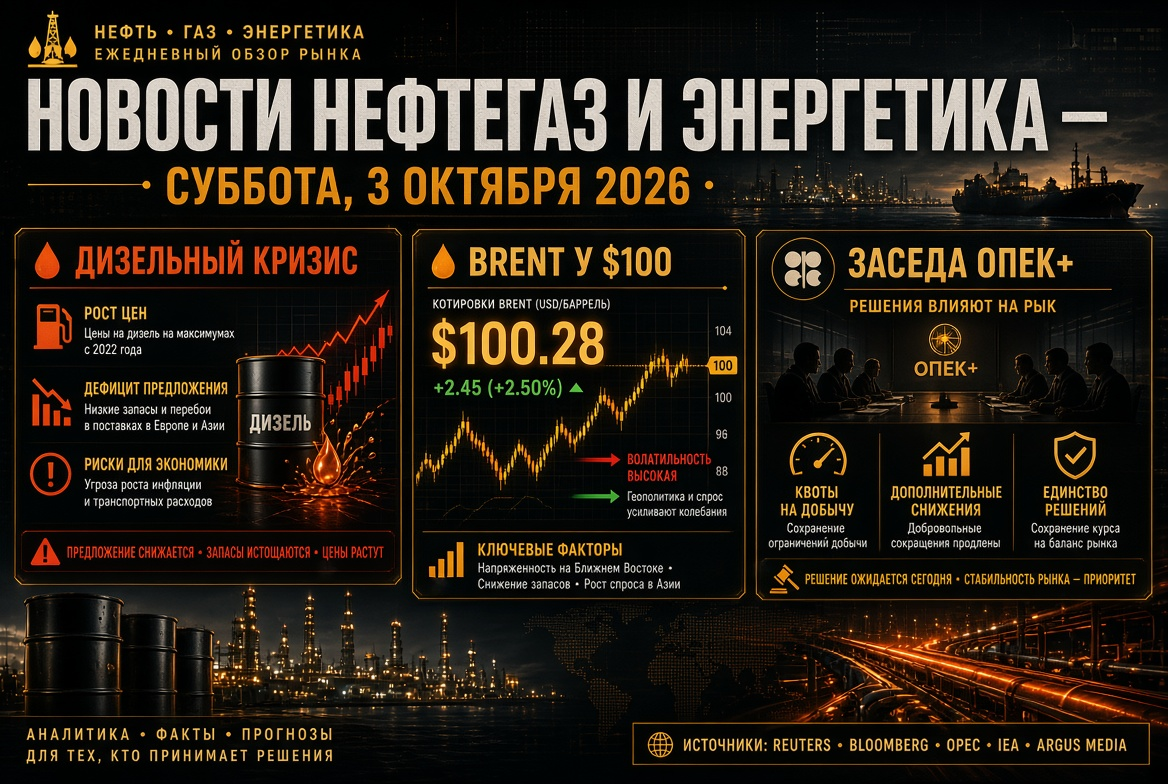
Latest news in the fuel and energy complex as of 7 March 2026: global oil, gas, and LNG markets, the situation in refining and refineries, developments in electricity generation, renewable energy sources, and the coal industry, Analysis of key energy market factors for investors
The agenda of the fuel and energy complex as of 7 March 2026 is shaped at the intersection of two forces: the short-term geopolitical risk premium and the medium-term trend of oversupply in certain segments. In the oil market, investors are balancing between signals of production growth and fears of supply disruptions in key logistics hubs. Gas and LNG are once again in the spotlight amid supply volatility and price sensitivity to any disruptions. Concurrently, the refining industry is entering the planned maintenance season, while the electricity sector is ramping up its focus on storage and network flexibility — fundamentally altering the economics of renewable energy sources and peak power capacity.
Below is a structured overview of key events for investors and participants in the fuel and energy market: oil, gas, LNG, petroleum products, refineries, electricity, renewable energy sources, and coal.
Oil Market: Production Growth vs Geopolitical Leverage
Oil prices remain "two-factor": the fundamental picture of demand and supply balance pressures prices, while geopolitics adds a risk premium. The most significant signal in recent weeks is the acceleration of supply from several producers, which limits the potential for sustained price growth without new escalations.
- Supply: the market is digesting news of increased production from certain countries, enhancing the feeling of comfortable crude inventories in the coming months.
- Risk Premium: any reports of tensions in the Middle East instantaneously broaden the price range, as traders hedge supply chains and freight.
- Demand: consumption in developed economies remains sensitive to interest rates and the industrial cycle; in Asia, the key driver continues to be the pace of industrial and transportation sector recovery.
OPEC+ and Quota Discipline: The Market's Close Attention to "Capacity Signals"
For investors, not only is OPEC+'s formal decision critical, but also how quickly countries can add barrels to the market. Increasing production amid geopolitical risks is perceived as a demonstration of "cushioning capacity," but it simultaneously heightens expectations of surplus in a calm scenario.
- Base Effect: an increase in supply reduces the likelihood of shortages amid moderate demand growth.
- Behavioural Effect: market participants assume that in the event of a sharp price spike, some barrels could be rapidly added.
- Investment Conclusion: volatility is increasing, but the "ceiling" on prices in a calm scenario becomes more tangible.
Gas and LNG: Supply Vulnerability Increases the Price of Flexibility
LNG is once again acting as a "margin" source that determines pricing during stressful periods. For Europe and parts of Asia, the primary risk is supply disruptions or temporary drops in volume, necessitating the replacement of long-term contracts with more expensive spot purchases. Consequently, the premium for flexibility (the ability to quickly redirect cargoes) is increasing.
- Europe: sensitivity to LNG news remains high, especially during periods when the market assesses inventory levels and the speed of replenishment in underground gas storage.
- Asia: importers with limited budgets suffer more when switching to spot purchases; this impacts industry and generation.
- Long-term Trend: expectations of global liquefaction capacity growth bolster the thesis of a more competitive LNG market in the coming years.
Petroleum Products and Refineries: Maintenance Season Alters Margin Structure
The petroleum products segment traditionally operates on its own logic: even with neutral crude prices, crack spreads for diesel, gasoline, and jet fuel can shift significantly due to maintenance, logistics, and regional imbalances. In March, the focus is on the increase in scheduled maintenance volumes at refineries in several regions, which can locally support product prices amid reduced output.
- Diesel/Gas Oil: margins are sensitive to industrial activity and seasonality, as well as to any export/import restrictions.
- Gasoline: the transition to spring/summer demand is supporting premiums in regions with active automotive logistics.
- For Investors: attention is on companies with a high proportion of complex capacities (hydrocracking, coking) and access to cheap raw materials — they are better positioned to maintain EBITDA in a volatile market.
Oil and Logistics: Freight and Insurance as Hidden Drivers
Even without a formal supply shortage, the final cost of a barrel to consumers is determined by logistics. With rising risks on routes, insurance, freight, and tanker turnaround times increase. This raises the effective price of deliveries and broadens regional spreads.
- Key Indicator: dynamics in freight rates and insurance premiums are an early signal of heightened/decreased geopolitical tension.
- Practical Effect: rising logistics costs have a greater impact on import-dependent regions and on markets with stringent fuel specifications.
Electricity: The Cost of Energy and Market Policy Back in Focus
In electricity, the gap between regions in the cost of megawatt-hours is widening — impacting the competitiveness of industries, hydrogen prices, and the speed of transport electrification. Against this backdrop, discussions around pricing rules and risk redistribution between generation, networks, and consumers are intensifying.
- Industrial Factor: energy-intensive sectors are seeking long-term contracts and stable tariff regimes.
- Network Factor: overloading and bottlenecks in the network are becoming the "new oil" — creating price peaks.
- Investment Conclusion: the attractiveness of assets that provide flexibility — manoeuvrable generation, networks, storage, balancing services — is increasing.
Renewable Energy Sources and Storage: Decreasing Storage Costs Boost Hybrid Project Economics
Renewable generation increasingly competes not only on LCOE but also on its ability to provide power on demand. Decreasing battery storage costs and hybrid schemes ("RES + storage") are shifting investor focus towards projects that monetise not only kilowatt-hours but also capacity/balancing services.
- What is changing: "pure" solar or wind stations are increasingly being outvalued by hybrids in terms of value to the grid.
- Who Wins: developers adept at managing grid limitations and equipment manufacturers focused on supply chain reliability.
- Risks: regulation of capacity markets and access to grid connections are becoming key constraints on growth rates.
Coal: The Role of "Cushion" Fuel Persists, but Price Depends on Logistics and Politics
Coal remains an important element in the energy balance of several countries, particularly when gas prices rise or supply restrictions emerge. At the same time, the coal market increasingly relies on logistics, environmental requirements, and financing availability.
- Short-term: during gas shocks, demand for coal in generation can surge rapidly.
- Medium-term: ESG pressures and carbon mechanisms limit new investments, amplifying price cyclicality.
What Investors Should Do: A Checklist for the Coming Days
For the global audience of investors and participants in the fuel and energy market, the key task for the coming week is managing volatility and selecting segments with better margin protection.
- Oil: monitor news from the Middle East and signals regarding actual production/export levels — these will define the price range.
- Gas and LNG: track supply stability and price reactions in the spot market; importers without long-term contracts are vulnerable.
- Petroleum Products and Refineries: assess maintenance schedules and regional deficits; local margin spikes are possible.
- Electricity and RES: focus on flexibility projects (storage, networks, balancing) — this is the most resilient investment narrative regardless of the short-term fuel price trajectory.
The fuel and energy market enters March with heightened nervousness: geopolitics is shaping the risk premium, while supply offers are sufficient to restrain a "long" rally without new shocks. For investors, the most rational approach is a "barbell" strategy: combining hedging positions in traditional energy (oil/gas/refining) with targeted bets on flexibility infrastructure (storage, networks, balancing services), where structural demand is rising irrespective of short-term barrel price fluctuations.