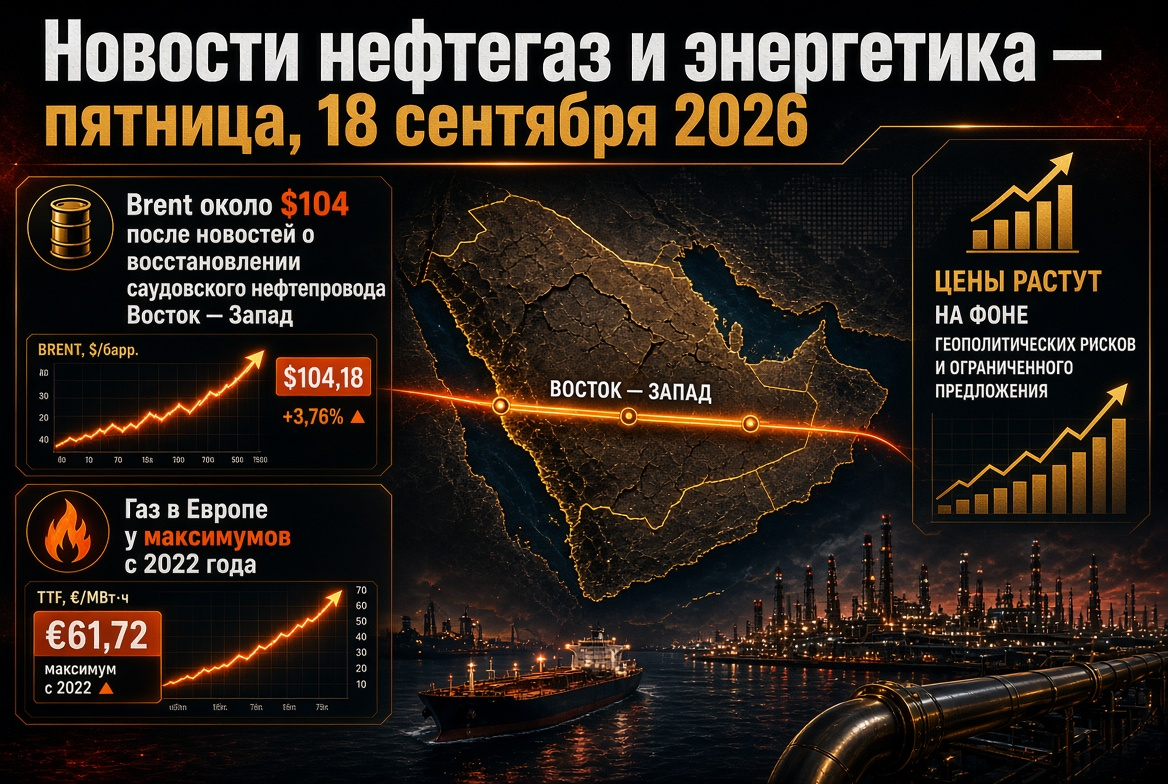
Oil and Gas News and Energy for Friday, 17 July 2026: Oil and Geopolitical Risks, LNG Market, Oil Products, Refineries, Electricity, Renewables, Coal, and Key Global Energy Events for Investors and Fuel Companies
The global fuel and energy complex enters Friday, 17 July 2026, in a highly volatile state. For investors, energy market participants, oil companies, fuel traders, refineries, and major industrial consumers, the key question of the day is how resilient the balance will prove to be between geopolitical risks, the recovery of oil supplies, growth in electricity demand, and limited availability of oil products.
The main theme of the global energy market is the risk premium in oil and oil products. Brent and WTI remain sensitive to news from the Middle East, routes through the Strait of Hormuz and the Red Sea, as well as the ability of alternative suppliers to compensate for falling volumes. Meanwhile, the gas market is displaying a more restrained dynamic: high reserves in the US, stable LNG flows, and cautious demand in Europe are limiting price increases. In the electricity sector, structural themes are intensifying: data centres, artificial intelligence, and industrial electrification are becoming new drivers of investment in generation, networks, renewables, and backup capacities.
Oil: Geopolitical Premium Remains the Key Factor of the Day
The oil market on 17 July 2026 is still under the influence of several factors: tensions in the Middle East, risks of maritime logistics disruptions, demand from Asia, and limited flexibility from some producers. For oil companies and investors, this means continued high sensitivity of Brent, WTI, and regional grades to political statements and military news.
Key factors in the oil market:
- Middle East — the primary source of the risk premium in oil prices.
- Strait of Hormuz and Red Sea — critical routes for global oil and oil products trade.
- Iraq, Saudi Arabia, and other regional producers — potential stabilisers of supply, but their capabilities depend on infrastructure and security.
- China and India — key demand centres determining the medium-term balance of the commodity sector.
For the oil market, both actual production and logistics are essential at this time. Even with resources available at fields, disruptions in export routes can rapidly transform into increases in shipping rates, rising insurance costs, differential changes, and spikes in oil product prices.
OPEC+, Production, and Forecasts: The Market Seeks New Balance
OPEC+ remains the central mechanism for managing supply; however, in 2026, the alliance is operating in a more complex environment. On one hand, high prices are incentivising producers to increase output. On the other hand, geopolitical factors and infrastructure limitations hinder the rapid return of all necessary volumes to the market.
For investors, three scenarios are significant:
- Base Scenario — supplies gradually recover, Brent stabilises within a broad range, and oil companies maintain high margins.
- Stress Scenario — new disruptions in Hormuz or the Red Sea push oil to higher levels, intensifying inflationary pressures.
- Normalisation Scenario — de-escalation reduces the risk premium, and market attention returns to stocks, demand, and the pace of the global economy.
For oil companies, such a situation creates a dual effect. The upstream segment benefits from high oil prices, but downstream and petrochemicals face rising raw material costs, changing logistics, and increased demand volatility.
Gas and LNG: The US Stabilises the Market, Europe Remains Cautious
The gas market appears less overheated than oil. In the US, high production volumes, significant storage reserves, and stable LNG export flows limit price growth. For the global market, this is an important stabilising factor: American LNG remains one of the key sources of flexibility for Europe and Asia.
In Europe, gas demand remains moderate, but the market is closely monitoring preparations for the winter season. Storage filling, competition with Asia for LNG, the state of industrial demand, and weather factors will determine TTF prices in the second half of the year.
Key topics in the gas market:
- stability of LNG supplies from the US;
- levels of European underground gas storage;
- Asian demand for LNG from China, Japan, South Korea, and India;
- the role of gas as a backup fuel for electricity generation.
Oil Products and Refineries: Margins Remain in Focus
One of the most sensitive segments of the energy sector is oil products. Even if oil prices stabilise, the gasoline, diesel fuel, aviation kerosene, and fuel oil markets may remain tense due to limited refining capacity and logistical disruptions.
Refineries currently enjoy support from high crack spreads, particularly in the diesel segment. However, for fuel companies and end consumers, this means rising procurement costs, increased working capital, and higher risks in inventory management.
The most vulnerable areas:
- Diesel fuel — critical for freight transport, agriculture, and industry;
- Aviation kerosene — dependent on seasonal demand for air travel;
- Gasoline — sensitive to the summer driving season;
- Fuel oil — remains important for shipping and certain industrial consumers.
Electricity: Data Centres and AI Changing Demand Structure
The electricity sector is becoming one of the most investment-attractive areas of the global energy sector. The growth of data centres, artificial intelligence, cloud computing, and industrial automation is creating new demand for stable generation, network infrastructure, and energy storage.
For investors, this means an expansion of asset classes within the energy sector. Where the key focus used to be on oil, gas, and coal, the following are now of interest:
- gas power plants as quick backup capacity;
- nuclear energy and small modular reactors;
- solar and wind generation;
- industrial batteries and energy storage systems;
- modernisation of electrical grids and transformer infrastructure.
The main risk is the mismatch between the rate of demand growth and the speed of new capacity construction. In regions with insufficient grid infrastructure, this could lead to rising tariffs, connection limitations, and increased volatility in electricity prices.
Renewables: Energy Transition Continues, but Traditional Generation is Still Required
Renewable energy sources continue to expand their share in the global energy balance. Solar energy, wind farms, storage systems, and hybrid projects are becoming increasingly competitive. However, events in 2026 show that the energy transition does not negate the importance of oil, gas, coal, and nuclear energy for the reliability of energy systems.
Renewables benefit from the long-term trend towards decarbonisation and energy independence. However, the rising share of variable generation requires investments in networks, balancing, backup capacity, and energy storage. Therefore, the most resilient strategy for energy companies becomes not the abandonment of traditional energy sources, but the formation of a diversified portfolio.
Coal: Asia Maintains Demand Despite Climate Pressure
Coal remains an important element of global energy, particularly in Asia. China and India continue to use coal generation to meet baseline electricity demand, even amidst the rise of renewables. For developing markets, coal continues to provide an accessible and scalable source of energy.
At the same time, the coal market faces contradictory signals. On one hand, climate policy and the development of solar energy limit long-term growth potential. On the other hand, hot weather, industrial demand, and the need for reliable generation support the consumption of thermal coal.
What Matters for Investors and Energy Companies
As of 17 July 2026, the global energy sector remains a market of high uncertainty, but it is this uncertainty that creates investment opportunities. The focus is on companies with strong balance sheets, access to infrastructure, flexible logistics, and a diversified asset portfolio.
Investors and market participants should pay attention to the following sectors:
- Oil and gas companies with sustainable production and low cost;
- Refineries and oil products, where high margins can support profitability;
- LNG projects, which benefit from global supply flexibility;
- Electricity linked to the growth of data centres and industrial loads;
- Renewables and storage as a long-term element of the energy transition;
- Coal and the commodity sector in Asia as an indicator of real energy demand.
The main conclusion of the day: the global energy market is reassessing not only the price of a barrel of oil but also the resilience of the entire supply chain — from field and LNG plant to refinery, power plant, fuel company, and ultimate industrial consumer. For the global audience of investors, Friday, 17 July 2026, becomes a day when oil and gas, electricity, renewables, coal, and oil products are viewed as a unified system of energy security and capital investment.