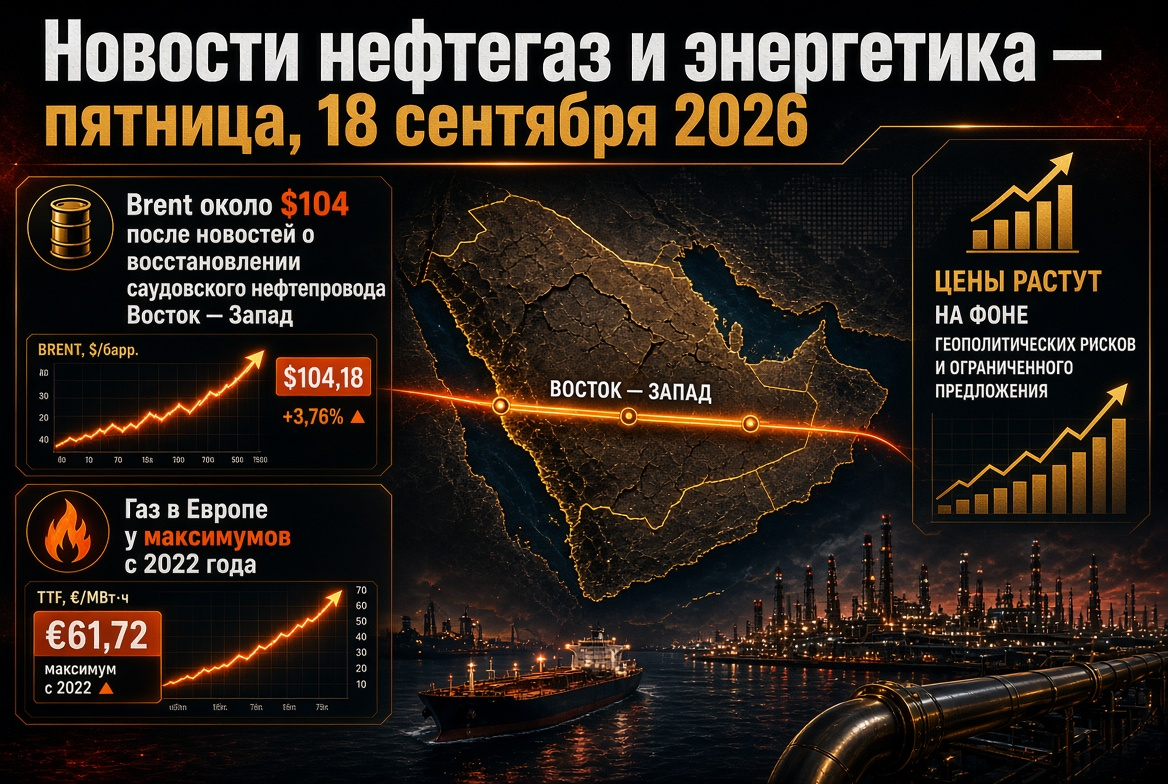
Key News in Oil, Gas, and Energy for 11 July 2026: Oil Market Situation, Petrol and Diesel Shortages, Refining Margins, OPEC+ Decisions, Gas, LNG, Electricity, Renewables and Coal
The global energy sector enters Saturday, 11 July 2026, in a state of rare imbalance: Brent and WTI crude prices have receded from peaks of geopolitical premiums, yet the market for petroleum products, refineries, diesel, petrol, gas, LNG, electricity, and coal remains tense. For investors, fuel companies, oil and gas traders, and energy sector participants, the main question becomes not only the price of a barrel but also the capacity of global infrastructure to process, transport, and distribute energy without new disruptions.
The key topic of the day is the gap between the relatively stable price of crude oil and the acute shortage in refining capacity. While the raw material market watches OPEC+, the Strait of Hormuz, and export flows, the petroleum products market operates under the logic of capacity shortages, high refinery margins, and the risk of rising prices for petrol, diesel, jet fuel, and fuel oil.
Oil: Brent and WTI Stabilise, but Risk Premium Remains
The global oil market continues to be influenced by several factors: geopolitical dynamics in the Middle East, the situation around the Strait of Hormuz, OPEC+ decisions, inventory trends, and demand expectations. Brent remains in a range where investors are no longer pricing in an extreme scenario of prolonged marine supply blockages, but are keeping a premium for potential logistical disruptions.
This presents a mixed backdrop for oil companies. On one hand, oil prices remain comfortable for the upstream segment, particularly for low-cost producers. On the other hand, volatility complicates hedging, capital expenditure planning, and export revenue assessments.
- For oil producers, the resilience of export routes and OPEC+ discipline is crucial.
- For traders, the key aspect remains the spread between grades, freight, and tanker insurance.
- For investors, the main indicator is not only the price of Brent but also the dynamics of refining margins.
OPEC+: More Oil on Paper, but Market Watches Real Barrels
OPEC+ continues to play a central role in balancing the global oil market. Discussions about increasing quotas from August heighten expectations of supply growth; however, investors are increasingly differentiating between formal quotas and the actual capacity of countries to deliver additional volumes. Logistical constraints, infrastructure repairs, geopolitical risks, and internal production discipline make market reactions more cautious.
For oil-exporting countries, the current situation appears mixed. Additional volumes may support budget revenues, but an overly rapid increase in supply can intensify pressure on prices. For consumers, including refineries in Asia, Europe, and the US, the focus is not just on total production volume but on the availability of the required grades of oil at the right ports and at predictable prices.
In practice, the market will assess three parameters:
- How much oil will actually be exported;
- Which grades will be available to Asian and European refiners;
- Whether increased production can compensate for disruptions in petroleum products.
Refineries and Petroleum Products: Diesel and Petrol Become the Centre of the Crisis
The main intrigue in the energy market on 11 July is not a shortage of crude oil, but a refining capacity shortage. Global refineries are under high stress due to repairs, infrastructure damage, export limitations, and rising summer fuel demand. As a result, petrol, diesel, and jet fuel prices are increasing more rapidly than crude itself.
For fuel companies, this translates into increased working capital requirements, greater inventory management needs, and a demand for more precise supply contracts. For oil companies with strong downstream segments, the situation may be favourable: high refining margins support profits even if crude oil prices do not rise as steeply.
The most sensitive areas of the petroleum products market include:
- diesel for freight transport, industry, and agriculture;
- petrol during the summer driving season;
- jet fuel amid a recovery in passenger traffic;
- fuel oil and bunker fuel for marine logistics;
- light petroleum products in regions reliant on imports.
Russia and Global Refining: Attacks on Refineries Shift Export Balance
Damage to Russian refining infrastructure is heightening tensions in the global fuel market. Reduced domestic production of petrol and diesel is significant not only for the internal market but also for global petroleum product flows. If diesel exports decline, Europe, the Middle East, Asia, and Africa begin to compete for alternative shipments.
For oil traders, this creates a new arbitrage landscape: fuel prices depend not only on crude prices but also on routes, tanker availability, insurance rates, sanction limitations, and product quality. For investors, this signals that downstream assets, logistics, storage, and terminal infrastructure may receive elevated premiums in valuations.
Gas and LNG: Market Remains Expensive, but Demand Begins to Adapt
The global gas market continues to restructure under the influence of LNG, the Middle East, European storage, and Asian demand. Europe remains in competition for liquefied natural gas with Asia, and any disruption along routes through the Middle East quickly reflects in TTF and JKM quotes. At the same time, high prices are beginning to limit gas consumption in industry and electricity generation.
For the global energy sector, this signifies sustained high investment attractiveness for LNG projects, particularly in the USA, Qatar, Canada, Mexico, and the Eastern Mediterranean. However, for gas consumers, rising prices remain a pressure factor on margins: chemicals, metallurgy, fertilisers, the glass industry, and power generation are forced to seek flexibility between gas, coal, fuel oil, and electricity.
Electricity: Heatwaves, Data Centres, and Network Constraints Increase Load
Electricity is becoming an increasingly vital part of the investment agenda in the energy sector. Rising demand from data centres, industrial electrification, air conditioning, and transportation is intensifying pressure on energy systems. Even with active integration of renewables, markets face balancing issues: solar generation assists during the day, but evening peaks require storage, gas plants, coal-fired generation, hydropower, or imports.
For electricity investors, the key takeaway is clear: the cost of megawatt-hours is increasingly being determined not only by generation costs but also by reliability costs. Networks, storage, flexible capacities, reserve management, and demand response are becoming as vital as power plants.
Renewables: Growth Continues, but Market Requires Systemic Resilience
Renewable energy remains one of the main investment directions in the global energy sector. Solar and wind generation continue to increase their share in the energy mix, especially in the USA, China, Europe, India, Brazil, and Middle Eastern countries. However, the year 2026 demonstrates that accelerated growth in renewables must be accompanied by investments in networks, storage, digital management, and backup capacities.
For renewable energy companies, the investment focus is shifting. The market increasingly evaluates projects not only by installed capacity but also by the ability to deliver energy at the needed times. Therefore, hybrid models are becoming more attractive:
- solar generation plus storage;
- wind farms plus long-term PPA contracts;
- gas generation as backup for renewables;
- microgrids for industry and data centres;
- digital load management platforms.
Coal: Not Leaving the Energy Balance, but Becoming a Regional Tool
The coal market remains controversial. In developed economies, ESG pressures, climate policies, and the growth of renewables limit the long-term prospects for coal-fired generation. However, in Asia, the Middle East, and certain developing economies, coal retains its role as a fallback fuel, particularly when gas prices are high and LNG supplies are unstable.
For coal companies, this indicates that global demand will become increasingly regional. Investors evaluate not only the price of energy coal but also logistics, access to ports, emissions regulations, coal quality, and companies’ debt risk. Furthermore, high gas prices may temporarily support coal generation where energy security is placed above climate concerns.
What Matters for Investors and the Energy Sector on 11 July 2026
For investors, oil companies, energy market participants, fuel suppliers, refineries, and energy holding companies, the Saturday agenda focuses on infrastructure and margins. While the oil price remains important, it is no longer the sole indicator of industry health.
Points to watch for:
- Refining Margins. High crack spreads may support refinery profits but carry the risk of political pressure on fuel prices.
- Diesel and Petrol. A shortage of petroleum products may impact the economy more swiftly than moderate increases in Brent prices.
- The Strait of Hormuz. Even partial recovery in shipping does not eliminate the risk premium on oil, gas, and LNG.
- European Gas Storage. Injection levels ahead of winter will influence TTF, electricity, and industrial demand.
- Renewables and Networks. Investments in generation without corresponding infrastructure investments increase price volatility risk.
- Coal and Backup Capacities. With high gas prices, coal remains a component of energy security.
Conclusion: The global energy sector on 11 July 2026 enters a phase where the main deficits are not only in raw materials but also in refining, logistics, and energy system reliability. For the oil, gas, electricity, renewable, coal, petroleum products, and refiners’ market, this signifies a growing importance of infrastructure assets. For investors, it is imperative to consider factors beyond the Brent price: the focus should be on refining margins, gas routes, grid resilience, export limitations, and companies' ability to convert energy volatility into cash flow.