Current News in Oil, Gas, and Energy as of 25 March 2026, Including Oil, Gas, LNG, Electricity, Renewable Energy, Coal, Refineries, and Global Market Trends
As of 25 March 2026, the global fuel and energy complex is experiencing heightened volatility. The primary focus for investors, oil companies, fuel firms, and participants in the energy sector remains the energy shock triggered by supply disruptions from the Middle East. For the global oil market, this translates into an increase in geopolitical premiums; for the gas market, it leads to heightened tensions surrounding LNG; for the electricity sector, it results in increased sensitivity to fuel costs; and for the refining and petroleum products segment, it expands refining margins and complicates logistics. Against this backdrop, the energy landscape is increasingly divided into two parallel narratives: the short-term struggle for physical access to raw materials and the long-term competition for the sustainability of energy systems, where renewable energy sources (RES), storage systems, and investments in network infrastructure play an increasingly significant role.
Oil: The Market is Trading on Supply Risks Rather than Comfortable Balances
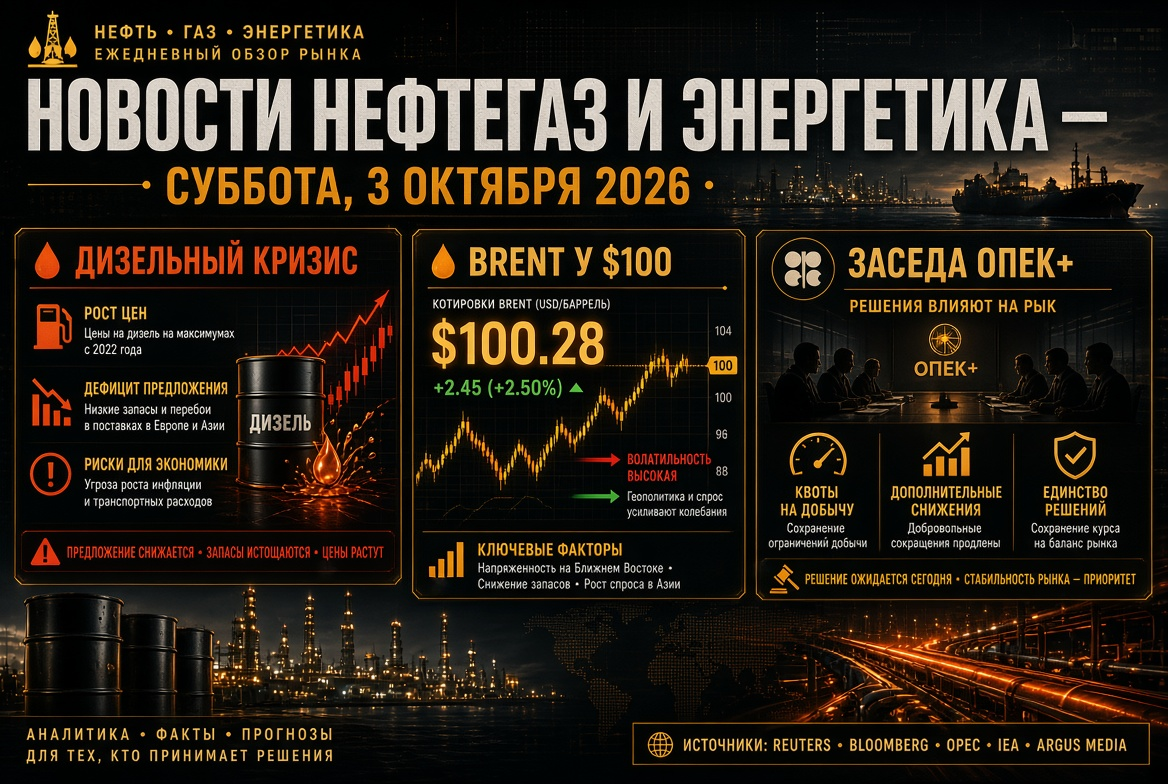
In the oil market, the focus remains less on the fundamental balance of supply and demand and more on the likelihood of prolonged supply disruptions. This shifts the entire pricing structure. Investors in oil, petroleum products, and stocks of oil and gas companies are once again incorporating risk premiums into their quotes, connected to the transportation of raw materials and the functionality of export infrastructure in the Persian Gulf region.
- Brent has settled above a psychologically significant level, bringing the market back into a phase of anxious risk reassessment.
- The key question for oil companies and traders is not only the volume of missed supply but also the duration of the logistical disruption.
- Even a moderate crisis can sharply reduce the availability of export flows and alter supply routes.
For global oil and gas market participants, this signifies a shift from a soft surplus scenario to one of forced adaptation. In such an environment, suppliers with shorter logistics, access to maritime infrastructure outside of risk zones, and stable export discipline are at a distinct advantage. For oil companies, this also creates an opportunity window in upstream activities, albeit accompanied by heightened political and operational risks.
OPEC+ and Supply: Formally the Market Receives Additional Barrels, but Tension is Not Alleviated
OPEC+'s strategy at the beginning of March envisioned a moderate increase in production; however, the current situation has highlighted the limitations of this tool. Formally, the additional volumes are significant as a market signal, but given the prevailing transport constraints and heightened sensitivity to supply routes, even an increase in output does not guarantee a rapid return to normalcy.
- Additional barrels are beneficial for stabilising expectations.
- However, the actual availability of oil depends on logistics, insurance, freight costs, and the physical accessibility of export corridors.
- Consequently, the market evaluates not just production but also the capacity to swiftly deliver raw materials to refineries and end-users.
For investors, this indicates that classic analyses of OPEC+ quotas in the coming days will be overshadowed by assessments of logistics, reserves, and export infrastructure. This is why the oil market remains highly sensitive even to minor news from the supply segment.
Gas and LNG: Pressure is Greater Than that of Oil, with Europe Entering Injection Season Without a Comfort Buffer
The gas market appears even more vulnerable. While oil can be somewhat redistributed across regions, the gas market, particularly LNG, is far more dependent on the continuity of maritime supplies, terminal capacity utilisation, and contract flexibility. For Europe, this is especially critical as the region approaches a new cycle of injecting gas into underground storage with a weaker starting position than a year ago.
- The European gas market remains reliant on LNG imports.
- Any disruptions in supplies from Qatar and through key maritime routes instantly impact TTF prices.
- The summer gas injection season now begins under conditions of higher gas prices and more intense competition for LNG cargoes.
For participants in the gas and electricity markets, this means that volatility in Europe may persist even in the absence of physical shortages on any given day. The market has inherently become more expensive and jittery. For industry, this poses a risk of rising costs; for the utilities sector, it represents a risk of political pressure; and for investors, it reinforces a cautious approach to assessing European energy and energy-intensive sectors.
Refineries and Petroleum Products: Refining Once Again Gains Significant Momentum, but Operational Risks are Increasing
For the refining segment, the current week marks one of the most important periods in a long time. Rising raw material costs, supply disruptions of specific crude grades, and increased demand for diesel, jet fuel, and other petroleum products are expanding refining margins. This is positive for efficient refiners, particularly those with access to a flexible raw material basket and stable export channels.
However, the outlook is not unequivocally positive. As market tension increases, so too do operational risks:
- It becomes more complex to choose raw materials suited to the refinery configuration;
- The costs of transportation and insurance rise;
- The risk of local export restrictions on petroleum products from certain countries intensifies.
For petroleum products, this suggests a market shift towards scarcity premiums. For investors in the downstream segment, it is critical not only to monitor margin levels but also the company’s ability to rapidly adjust logistics and ensure the uninterrupted operation of refineries.
Electricity: Expensive Gas Enhances the Role of Coal, but RES and Storage Become Even More Critical
The electricity sector is entering a new phase where expensive gas is driving systems towards greater utilisation of coal, nuclear power, renewable energy sources (RES), and storage systems. In Asia, this is already leading to increased utilisation of coal-fired power plants. In Europe and North America, the main question is broader: how to maintain the reliability of energy systems without undermining the economics of the energy transition.
The rise in electricity demand, driven by digital infrastructure, industry, and electrification, reinforces this trend. Energy is evolving into a narrative not solely about oil and gas but about baseload capacity, grid flexibility, and the ability to integrate RES without sacrificing stability.
- Gas remains an important fuel for balancing energy systems.
- Coal temporarily regains some positions as a backup resource.
- RES and storage transition from a marketing direction to a category of energy security infrastructure.
For electricity companies, this means an increase in capital intensity. For investors, it necessitates evaluating not just the cost of generation but also access to networks, storage facilities, backup capacities, and long-term energy supply contracts.
Coal: The Market Gains Fresh Momentum as a Hedge Against Expensive Gas
Against the backdrop of high-priced LNG and unstable gas flows, coal is regaining its position in the energy balance of several countries. This does not indicate a strategic pivot in the global energy transition; rather, in the short term, coal is becoming a backup fuel for electricity, particularly in Asia. This supports demand for quality thermal coal and improves the pricing environment for certain exporters.
For participants in the energy sector, two key conclusions arise. First, coal remains a factor in energy security despite climate pressures. Second, high gas prices automatically enhance coal's competitiveness in countries prioritising uninterrupted electricity supply.
What This Means for Investors and Energy Sector Companies as of 25 March
The current market demands a different decision-making logic from investors and energy sector participants. The emphasis shifts from abstract long-term scenarios to specific resilience parameters of businesses against supply shocks.
- In oil, export logistics, political risk, and access to backup routes are crucial.
- In gas, it is about contractual flexibility, access to LNG, and preparedness for an expensive summer injection season.
- In electricity, managing fuel structure, network stability, and backup capacity is vital.
- In refineries and petroleum products, the flexibility of the raw material basket and the resilience of downstream chains are essential.
- In renewable energy sources, it is not solely about the pace of implementation but also the ability to address reliability issues through storage solutions and network upgrades.
This combination of factors will determine the leaders and laggards in the energy sector market over the coming weeks.
The Global Energy Sector is Entering a Phase of Expensive Security and Reevaluation of Assets
As of 25 March 2026, the global markets for oil, gas, electricity, renewable energy sources, coal, petroleum products, and refineries are forming a new price architecture based around costly energy security. Oil and gas are once again receiving a geopolitical premium, LNG is becoming a key scarce resource, refineries are benefiting from increased margins, coal temporarily enhances its position, and the electricity sector accelerates investments in system resilience. For the global energy sector, this is not a fleeting noise but a signal that the cost of reliability is once again becoming a central variable in the market.
For investors, oil companies, fuel firms, and all participants in the energy sector, the coming days will be defined by one question: Who can not only withstand the energy shock but also turn it into a strategic advantage?