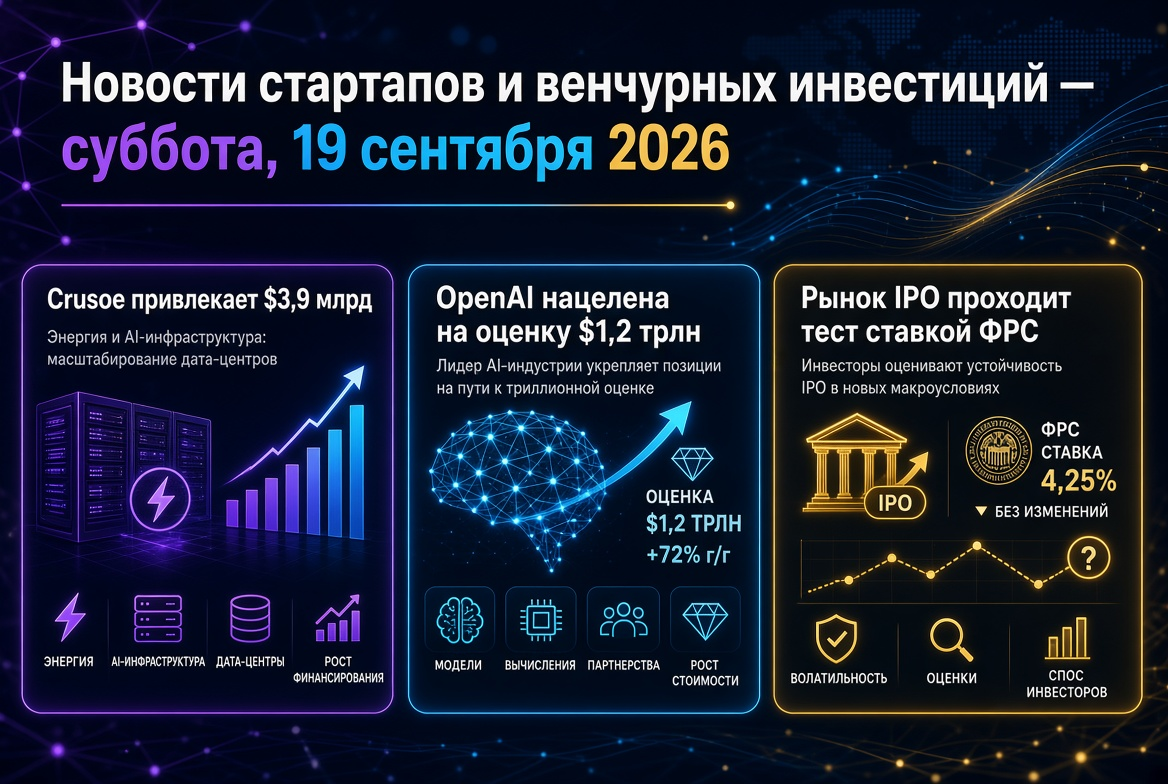
Startup and Venture Investment News - Sunday, 4 January 2026: Mega-Funds Activity, New AI Unicorns, Revitalisation of IPO Market, Return of Crypto Startups, and Market Consolidation
By the start of 2026, the global venture capital market is showing a robust recovery following a prolonged downturn. Investors worldwide are again actively financing technology startups: multi-million dollar rounds are being closed, and the IPO plans of promising companies are coming to the forefront once more. The largest venture funds and corporations are returning with record investment programmes, while governments in various countries are increasing support for innovative businesses. The influx of private capital is providing young companies with liquidity for growth and scaling.
Venture activity is currently encompassing all regions of the world. The United States continues to lead, primarily due to colossal investments in the field of artificial intelligence. In the Middle East, the volume of investments in startups has more than doubled compared to the previous year. In Europe, a shift in power dynamics is evident: Germany has surpassed the United Kingdom in the volume of venture deals for the first time, strengthening the positions of continental tech hubs. India, Southeast Asia, and other rapidly developing markets are attracting record capital, while in China, investors are acting more selectively due to regulatory risks. The startup ecosystems in Russia and the CIS are also striving to keep up, despite external constraints. A new global venture upswing is taking shape: investors have returned to the market, although they remain selective and cautious with deals.
- The return of mega-funds and large investors. Venture leaders are raising unprecedentedly large funds and increasing investments, replenishing the market with liquidity once again.
- Record funding rounds and a new wave of AI unicorns. Unusually large investments are elevating the valuations of startups to unseen heights, especially in the artificial intelligence segment.
- A revival in the IPO market. Successful public offerings of tech unicorns and new applications confirm that the "window of opportunity" for exits remains open.
- A renaissance in crypto startups. The growth of the cryptocurrency market has revived investor interest in blockchain projects, enhancing the inflow of capital into the crypto industry.
- Defence and aerospace technologies are attracting investment. Geopolitical factors are stimulating investment in military technologies, space projects, and robotics.
- Diversification of sector focus: fintech, climate projects, and biotech. Venture capital is directed not only to AI but also to fintech, climate tech, and biotechnology, broadening market horizons.
- A wave of consolidation and M&A deals. High valuations of startups and competition for markets are provoking consolidation: large mergers and acquisitions are opening up new opportunities for exits and growth.
- Global expansion of venture capital. The investment boom is extending beyond traditional centres—apart from the US, Western Europe, and China, a strong influx of capital is being observed in the Middle East, Asia, Africa, and Latin America.
- Local focus: Russia and the CIS. Despite sanctions, new funds totalling up to 10–12 billion roubles are emerging in the region, aimed at developing local startup ecosystems, signalling a gradual recovery of venture activity.
Return of Mega-Funds and Influx of "Big Money"
The largest investment players are triumphantly returning to the venture market, signalling an increased appetite for risk. The Japanese conglomerate SoftBank has announced the establishment of a new Vision Fund III, totalling approximately $40 billion, aimed at investments in advanced technologies (AI, robotics, etc.). Concurrently, SoftBank has placed an unprecedented bet on OpenAI, investing over $20 billion in the company and increasing its stake to approximately 11%. Sovereign funds from Gulf countries have also become more active: Saudi Arabia, the UAE, and others are pouring billions into technology projects and launching state megaprojects to develop the startup sector, transforming the Middle East into a new global tech hub.
Simultaneously, dozens of new venture funds are emerging worldwide. US venture funds have accumulated record reserves of "dry powder"—hundreds of billions of dollars in unallocated capital ready to be deployed. The influx of this "big money" is filling the ecosystem with liquidity, providing resources for new funding rounds and supporting the growth of promising company valuations. The return of mega-funds and large institutional investors not only intensifies competition for the best deals but also instils confidence in the sector regarding the continued influx of capital.
Record Rounds and New Unicorns: Investment Boom in AI
The artificial intelligence sector remains the primary driver of the current venture upswing, setting records for funding volume in 2025. According to analysts, the combined capital raised by AI startups over the year exceeded $150 billion (compared to the previous record of approximately $92 billion in 2021). Investors are eager to back AI leaders, directing colossal sums into the most promising companies. For example, Elon Musk's startup xAI raised around $10 billion, while OpenAI secured approximately $8 billion at a valuation of about $300 billion. Both of these rounds were heavily oversubscribed, underscoring the frenzy surrounding leading AI teams. Notable among the largest deals of the year was Anthropic's $13 billion raise in September 2025, backed by major technology partners.
Venture capital is being directed not only into direct AI applications but also into the infrastructure supporting them. Investors are willing to fund even the "picks and shovels" of the AI ecosystem: reportedly, one AI data storage startup is nearing the close of a multi-billion dollar round at an extraordinarily high valuation. The rapid influx of funds is birthing a new wave of unicorns. Nevertheless, experts warn of overheating risks: valuations in the AI segment are rising too quickly, and a correction may occur with changes in market conditions.
IPO Market Revives: Window of Opportunity for Listings
The global IPO market has confidently revived after a prolonged lull and continues to gain momentum. In Asia, a new wave of listings has been initiated by Hong Kong: in recent weeks, several large technology companies have successfully gone public, collectively raising billions. This confirms investors' readiness to actively participate in IPOs once again. The situation is also improving in the US and Europe: American fintech unicorn Chime recently debuted on the stock exchange, with its shares soaring approximately 30% on the first day of trading. Following suit, several other well-known startups are preparing to enter the market, ensuring that the "window" for new IPOs remains open longer than many anticipated.
The return of activity in the IPO market encompasses a wide range of companies and is critically important for the entire venture ecosystem. Successful public offerings allow funds to realise profitable exits and redirect released capital into new projects. Despite investors' caution, the prolonged "window of opportunity" is prompting an increasing number of startups to consider going public in order to take advantage of the favourable situation.
Crypto Startups Experience a Renaissance
After a long downturn, the cryptocurrency market surged again in 2025, reviving venture investors' interest in blockchain projects. Capital is once again flowing into the crypto industry—from infrastructure solutions and cryptocurrency exchanges to DeFi platforms and Web3 startups. Major sector-specific funds have resumed activity in this segment, and new companies are attracting significant funding rounds amid rising valuations of digital assets.
The industry is also undergoing consolidation. A notable example among the largest exits of the year was the acquisition of South Korean cryptocurrency exchange Upbit (Dunamu) for approximately $10 billion, demonstrating that the strongest players are ready to absorb competitors. Overall, investors are currently focusing on more mature areas: infrastructure, financial services, and compliance. This focus lays a foundation for further growth of the industry on a more sustainable basis.
Defence and Aerospace Technologies Attract Investment
The geopolitical landscape and rising defence budgets are driving capital inflows into military and aerospace technologies. Startups creating innovations for the defence sector—from drones and cybersecurity to artificial intelligence for the military—are receiving support from both government and private investors. Riding this wave of demand, related industries are also thriving: developers of satellite systems, rocket technologies, and robotics are successfully closing funding rounds, capitalising on the strategic interest of major players.
The defence and aerospace segment is experiencing a new boom. Governments are partnering with startups to access cutting-edge developments, while venture funds are creating specialised programmes for investing in dual-use technologies. This trend strengthens the link between the technology sector and the traditional defence industry, opening avenues for startups to access substantial budgets and accelerating their growth.
Diversification: Fintech, Climate Projects, and Biotech
In 2025, venture investments covered an increasingly broad range of industries and no longer limited themselves to the realm of AI alone. Following the downturn of previous years, a revival is being noted in fintech, climate technologies, and biotech. Fintech startups are once again attracting capital, largely due to adaptations to the new regulatory environment and the integration of AI (for instance, in payment services and neobanks). Climate ("green") projects are receiving intensified support amid the global push for decarbonisation: investors are funding innovations in energy infrastructure, industrial decarbonisation, and eco-adaptation technologies. Biotech companies are also returning to the spotlight—breakthroughs in medicine, vaccine development, and the application of AI in pharmaceuticals are drawing new funding rounds.
The broadening sector focus indicates that the venture market is becoming more balanced. Investors are diversifying their portfolios by distributing capital across various sectors of the economy. This approach reduces the risks of overheating any one segment and establishes a foundation for more resilient, quality growth across the entire startup market.
Market Consolidation: Major M&A Deals Return
High valuations of startups and fierce competition for markets have led to a new wave of mergers and acquisitions. In 2025, the number of large M&A deals significantly increased, reaching record levels in recent years. Technology giants and financial corporations are once again actively acquiring promising young companies, aiming to solidify their presence in strategic niches. The scale of some acquisitions is impressive: Google has agreed to acquire cloud cybersecurity startup Wiz for approximately $32 billion—one of the largest technology deals in history. Major acquisitions have also occurred in fintech and the crypto industry, confirming the trend towards market consolidation.
For venture investors, the surge in M&A represents long-awaited exits and the return of investments. For the startups themselves, integration into larger companies opens access to resources and global customer bases, accelerating expansion. The wave of consolidation indicates maturity in technology: the strongest market players are joining forces, while investors gain an additional exit strategy beyond IPOs. Although some mergers are driven by forced measures (due to challenges with organic growth), the overall trend towards M&A adds dynamism to the venture market and provides investors with more strategic opportunities.
Venture Capital Expands into New Regions
The boom in venture financing over the past months has spread far beyond Silicon Valley and other customary centres. Currently, more than half of the world’s venture capital originates from countries outside the US, and new "growth spots" are appearing on the map. The Gulf region is rapidly evolving into a powerful hub for technological investments due to multi-billion dollar initiatives from Middle Eastern funds. Activity in Asia is shifting: India and Southeast Asia are setting records for venture deal volumes, while in China, the pace has somewhat slowed due to regulatory restrictions. In Europe, for the first time in many years, Germany has taken the lead in venture investments, surpassing the UK. Africa and Latin America have also produced their first unicorns, reflecting the genuinely global nature of the current upswing.
The geographical expansion of venture capital leads to increased competition for promising projects worldwide. International funds are increasingly looking towards emerging markets, where startup valuations are still lower and growth potential is high. For the global venture industry, such expansion opens new horizons, allowing capital to be allocated more efficiently and supporting innovation where it has previously under-received financing.
Russia and the CIS: Local Initiatives Amid Global Trends
Despite external constraints, a certain revival of startup activity is being observed in Russia and neighbouring countries at the local level. In 2025, the volume of venture investments in the Russian Federation declined overall, but private investors and funds have not lost their cautious optimism. New funds for technology financing have emerged: for example, PSB bank established a fund of 12 billion roubles for investments in IT startups, while the venture fund "Voskhoд" launched a pre-IPO fund of 4 billion roubles. Alongside state development institutions, these initiatives aim to support local startup ecosystems amid limited access to Western capital.
There is a noticeable shift towards more mature projects in the region. Investors prefer companies with proven revenue and sustainable business models that can thrive even with limited inflow of new capital. This approach increases the chances of success in the current macroeconomic environment. Gradually, a new local venture ecosystem is forming, relying on internal resources and regional players. The emergence of significant deals and new funds instills cautious optimism: even in isolation from global financial streams, the Russian and neighbouring markets are attempting to build a self-sufficient infrastructure for innovation, laying the groundwork for future growth.