Oil, Gas and Energy News for 18 July 2026: Brent $84–85, blockade of the Strait of Hormuz, Europe’s gas storage filled to 49.7%, TTF gas €50.6/MWh, Greece blocks 21st EU sanctions package on LNG, crisis in the Russian petroleum products market, OPEC+, coal and renewable energy sources
The energy market is entering the weekend of 18 July 2026 under a structural tension that the global energy sector has not experienced since the crisis of 2022. The resumption of maritime blockades in the Persian Gulf has effectively paralysed shipping through the Strait of Hormuz, with Brent crude holding steady at around $84–85 per barrel, while European underground gas storage is less than half full, marking the lowest level for mid-July in recorded history. Simultaneously, Greece has blocked the 21st package of EU sanctions due to a ban on the transportation of Russian LNG, as the Russian fuel market faces its most severe deficit of petroleum products amidst a decline in oil refining to its lowest level since 2005. Below is a detailed overview of key events in the oil and gas and energy sector for investors, participants in the energy market, and fuel and oil companies.
Oil Market: Strait of Hormuz Blocked, Prices Stable
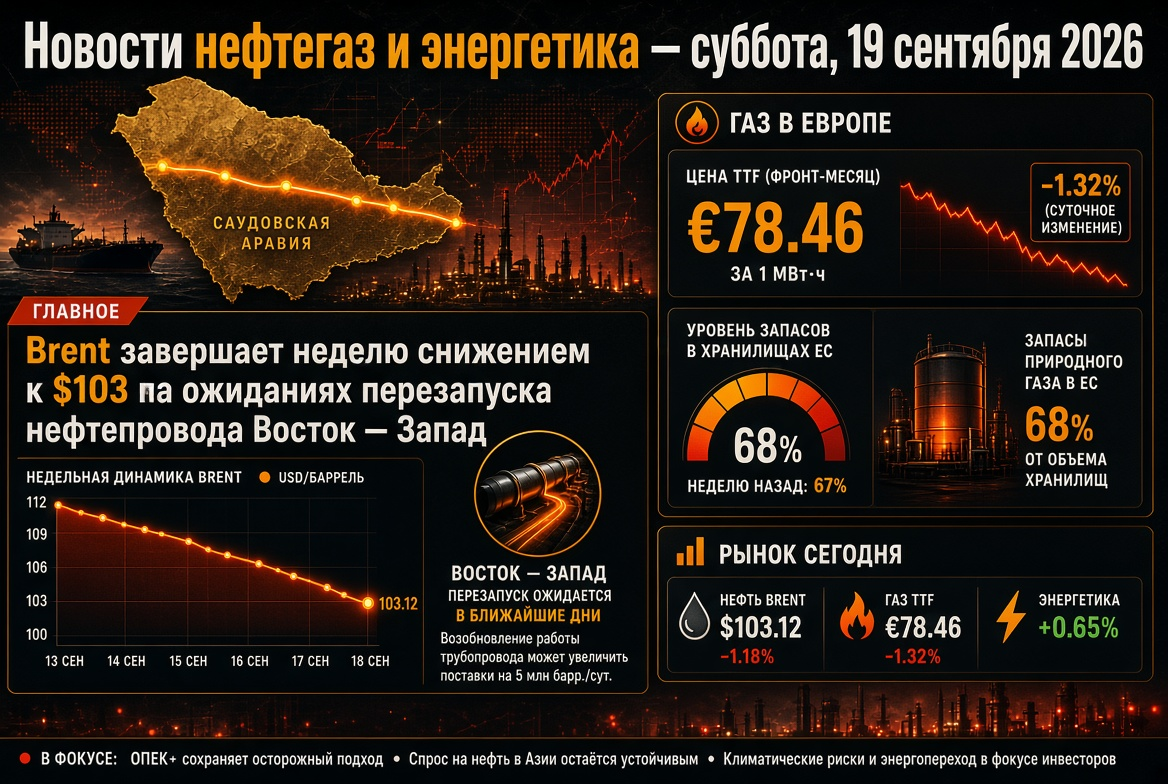
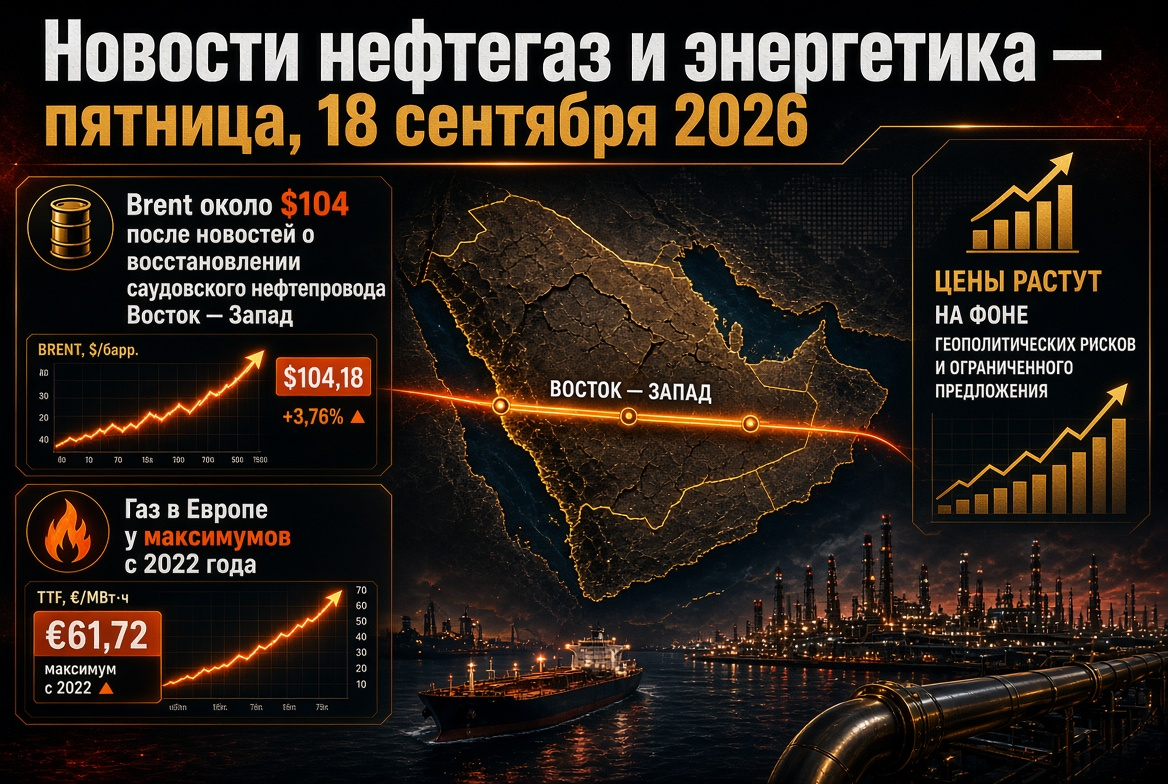
The main paradox of the current moment in the global oil market is that an unprecedented logistical shock is not translating into a price rally. As of 16 July, Brent prices were around $84.85 per barrel, having decreased by 0.6% from the previous session. However, since the beginning of 2026, oil prices have increased by nearly 39%, gaining approximately 2.6% since June.
Key factors driving oil price dynamics:
- Strait of Hormuz Blockade. After recent strikes on military facilities in Iran and Tehran's retaliatory actions against bases in the Persian Gulf, shipping through the strait has virtually stopped. AIS data shows that the passage of tankers through Omani waters has ceased. The United States resumed its maritime blockade of vessels heading to Iranian ports on 14 July.
- Managed Corridor. A significant number of analysts believe that alternating phases of escalation and de-escalation are keeping oil prices within the $75–90 per barrel range, with participants striving to avoid sharper fluctuations.
- Monetary Factors. The persistent understanding that the Federal Reserve is unlikely to move to rate cuts in the near term limits expected liquidity and exerts downward pressure on the entire commodity complex.
- Inventories. According to the American Petroleum Institute (API), US commercial crude oil inventories decreased by just 0.564 million barrels during the reporting week, against a consensus forecast of a decline of 2.7 million — a moderately bearish factor.
For oil companies and investors, the fundamental takeaway is as follows: the oil market has ceased to respond to geopolitics in a linear manner. Risk premiums are largely factored into prices, and any further price increases require not just headlines, but actual reductions in volumes.
OPEC+ After UAE Exit: Quotas Increase, Production Stagnates
The configuration of the oil alliance has undergone fundamental changes in 2026. The United Arab Emirates exited OPEC and OPEC+ on 1 May to increase its own production, which dealt a significant blow to the institutional stability of the deal in recent years.
July 2026 Quotas
- Seven key OPEC+ countries — Saudi Arabia, Russia, Iraq, Kuwait, Kazakhstan, Algeria, and Oman — have increased the July quota by 188,000 barrels per day.
- The alliance’s overall quota for July has been set at 35.83 million b/d without accounting for compensations from quota violators.
- Russia's quota for July was raised by 62,000 b/d to 9.8 million b/d; Saudi Arabia received a similar increase, bringing its target to 10.353 million b/d.
- The compensation period for overproduction has been extended until the end of 2026.
Discrepancy Between Plan and Reality
A significant story of the mid-2026 oil market is the colossal gap between allowed and actual production volumes. In June, OPEC+ increased production by 1.18 million b/d compared to May, but fell short of its own plan by 7.1 million b/d. The shortfall in quotas for individual countries is as follows:
- Saudi Arabia — down 3.444 million b/d from quota;
- Iraq — down 2.382 million b/d;
- Kuwait — down 1.176 million b/d;
- Russia — down 834,000 b/d (actual production in June decreased by 61,000 b/d compared to May, to 8.928 million b/d);
- Kazakhstan — surpassing quota by 1.152 million b/d; Oman — exceeding by 126,000 b/d.
The underperformance of Middle Eastern producers is directly linked to regional conflict and the inability to export crude. In effect, OPEC+ quotas have lost their function as a tool for managing supply: the market is balanced not by ministerial decisions, but by the state of straits and port infrastructure.
IEA and OPEC Forecasts: Demand Stable, Supply Uncertain
In its July report, the International Energy Agency (IEA) offered a notably cautious assessment of the oil market outlook, revising down its forecast for global oil supply. Last month, the agency had anticipated that a restoration of transit through the Strait of Hormuz would allow for an increase in global production in 2027 of about 8 million b/d, generating a significant surplus. The revision of this premise implies that the scenario of oversupply is postponed.
OPEC, on the other hand, remains constructive regarding demand:
- The forecast for global oil demand growth for 2027 has been increased to 1.94 million b/d from 1.73 million b/d;
- Growth expectations for the global economy remain at 3.1% in 2026 and 3.2% in 2027;
- The forecast for production outside OPEC+ for 2026 has been raised by 10,000 b/d to 54.84 million b/d.
The long-term framework also remains inflationary for commodities: according to Deputy Prime Minister of Russia Alexander Novak, global oil demand will continue to grow at least until 2050, with the share of hard-to-recover reserves (HTR) in Russian production potentially reaching 87%.
European Gas Market: Storage Depleted, LNG Competition Intensifies
The most vulnerable segment of the global energy market as of mid-July 2026 is European gas. The injection season commenced on 1 April; however, by mid-summer, EU underground gas storage is filled to an average of 49.7% — an absolute minimum in recent years. At the beginning of July, the figure was 49.22%.
Reasons for the Injection Failure
- Cold winter of 2025/26 and high rates of gas extraction from underground storage.
- Collapse of Middle Eastern LNG. According to the IEA, liquefied natural gas production in Qatar and the UAE shrank nearly 80% year-on-year from March to June due to infrastructure damage and shipping issues through the Strait of Hormuz.
- Asian Competition. In July, LNG purchases by Asian countries may rise to a six-month high of 23.05 million tonnes, while European purchases are expected to reach only 6.9 million tonnes — a two-year low. China, Japan, and South Korea are actively securing US shipments that would have typically gone to Europe.
- Unfavourable price conditions reduced traders' economic motivation for injection in the first half of the season.
Price Benchmarks
Gas at the TTF hub is trading around €50.6 per MWh. At the beginning of July, prices exceeded $535 per thousand cubic meters at a level of €44.13 per MWh. A relatively calm scenario for the upcoming months suggests a range of €45–60 per MWh. However, if shipping through the Strait of Hormuz is restricted again and Qatari exports do not recover, prices could rise to €60–80. Additionally, an abnormal heat wave in Europe is increasing demand for electricity for cooling purposes.
Sanction Framework: Greece Blocks 21st EU Package
The EU's sanctions policy has faced internal resistance. Greece has opposed the 21st sanctions package, which proposes banning European companies from transporting Russian LNG to third countries. The reason is the protection of the shipping company Dynagas, owned by Greek businessman George Procopiou, which possesses an ice-class fleet for working with the Yamal LNG project in Arctic conditions. Athens claims this measure will destroy the Greek shipping industry.
Additional circumstances vital for market participants include:
- To approve the 21st package, the support of all 27 EU countries is required;
- Member states have agreed to maintain the price cap on Russian oil at $44.10 per barrel until 23 July while efforts are underway to reach a broader agreement;
- Restrictions on imports of Russian pipeline gas have been in effect since 17 June 2026 for short-term contracts and will come into force on 1 November 2027 for long-term contracts;
- In December 2025, the EU decided to accelerate the phase-out of Russian LNG, terminating long-term contracts by the end of 2026 and prohibiting short-term supplies from April 2026;
- Previously, Greece submitted a roadmap to the EU for a complete phase-out of Russian gas by the end of 2027 — underscoring the selective, rather than ideological, nature of the current veto.
For investors, this episode exemplifies a key risk of European energy policy: with storage levels below 50% and a shortage of LNG on the global market, the implications of stricter sanctions become palpable for EU member states themselves.
Asia: India Balances Between Imports and Costs
Asian consumers remain the principal centre of gravity for global energy demand. Recent Indian statistics demonstrate the effects of price shock:
- In May 2026, India reduced its oil imports by 2% — to 21.95 million tonnes from 22.41 million tonnes the previous year;
- However, in monetary terms, shipments surged nearly 1.7 times to $18.98 billion;
- LNG imports in May increased by 3% — to 2.236 million tonnes;
- Russia once again emerged as the largest supplier of oil to India in May.
Physical volumes are stagnating as import costs rise dramatically — a direct reflection of the loss of discounts and the rising logistics expenses. Prior to the onset of the conflict, nearly half of India's crude oil imports, along with significant volumes of LNG, came from the Gulf countries, transiting through the Strait of Hormuz. Some vessels under the Indian flag have remained blocked to the west of the strait. Pakistan officially approached Saudi Arabia in March for the redirection of supplies through the Yanbu port on the Red Sea.
For China, stakes are similarly high: the country imports approximately one-third of its oil through Hormuz while maintaining a strategic reserve of around one billion barrels. Europe depends on Qatari LNG passing through the strait for 12–14%. Additionally, up to 30% of global fertilizer trade transits through Hormuz, further extending the energy crisis to the agri-food sector.
Russian Oil Products Market: Refining at Lowest Level Since 2005
The internal fuel market in Russia is experiencing its most acute phase of crisis in recent years. Oil refining in the country has dropped to its lowest level since 2005 — a result of damage and unscheduled shutdowns of refineries amidst drone attacks. The Bank of Russia has separately noted the negative impact of refinery downtime on economic dynamics.
Crisis Mechanics
- Supply Constraints. Some refineries have reduced output, trade volumes on the exchange have fallen, wholesale prices have surged, and retail prices are following suit.
- Market Overheating. In June, sales of AI-95 on the SPbMTSB exchange plummeted by 43%, while the wholesale price per tonne of diesel fuel exceeded historical highs. Supply deficits with a lag of 2–3 weeks have overflowed into retail fuel stations.
- Seasonal Peak. The automotive season lasts from late April to October; the burden on the fuel stations along federal highways M-4 “Don” and M-12 “Vostok” has increased dramatically.
- Panic Buying. As queues form, drivers fill their tanks and stockpile fuel for the future, exacerbating shortages.
- Retail Differentiation. Large networks maintain price increases within inflation limits, whereas independent gas stations in certain regions have seen prices surge substantially.
Regulatory Measures
- Expansion of damper payments to oil companies to compensate for the difference between export and domestic prices.
- Strengthened control over wholesale sales to prevent the redirection of supplies to export at the expense of the domestic market.
- Monitoring of exchange quotations with the potential for rapid regulatory intervention.
- Official prioritization of supplying the domestic market — a stance reinforced by Alexander Novak's statements that oil companies are keeping retail prices at inflation levels.
Particular attention from regulators is focused on diesel fuel: agricultural producers are preparing for the harvest, carriers are operating at capacity, and sudden surges in diesel prices are immediately reflected in food and freight prices.
Budgetary Implications: Russian Oil and Gas Revenues Under Pressure
The financial performance of the sector reflects a combination of sanctions, currency, and production factors. The volume of oil and gas revenues in Russia for the first half of 2026 has decreased by 22.7% compared to the same period last year. Despite a nearly 39% increase in the dollar Brent price since the beginning of the year, such a decline indicates a combination of a strong rouble, expanding damper payments, discounts on Urals, and a physical decline in refining.
Simultaneously, the sector is seeking technological solutions: Gazprom Neft has introduced equipment to enhance the efficiency of hydraulic fracturing, demand for gas engine fuel and related equipment is increasing — agricultural holding companies have begun to transition their fleets to gas, a direct consequence of the fuel crisis.
Electric Power and Renewable Energy Sources: Solar Records Amidst Coal Resilience
The energy transition in 2026 continues at an accelerated pace, despite hydrocarbon turbulence.
Renewable Energy
- Global solar energy generation in 2025 rose by 636 TWh, exceeding the previous year's figures by 30%; according to Ember, renewable energy sources have fully met the increase in global electricity demand for the first time, preventing an increase in fossil fuel generation.
- Global investments in the energy transition reached $2.3 trillion in 2025.
- The share of renewable energy sources has surpassed one-third of global electricity production, outpacing coal.
- IEA forecasts indicate that solar energy will surpass nuclear generation in 2026, with the share of renewables in global generation increasing from 30% (2023) to 37% (2026).
- India remains the third-largest solar energy market and plans to add 200 GW of solar power in the next five years to achieve a target of 500 GW of renewables by 2030.
Coal and Balancing Generation
Coal maintains its systemic role in the Asia-Pacific region. China is committed to controlling the growth of coal generation and gradually limiting it from 2026 to 2030; however, under conditions of abnormal heat and peak loads for air conditioning, coal capacities remain a safety net for energy systems. Most new renewable energy capacities are still concentrated in Asia — 421.5 GW, or 72% of global growth. For energy systems with a high share of solar and wind, critical investment directions are now energy storage systems and grid modernization.
Conclusions for Investors and Energy Market Participants
The configuration of the global energy market as of 18 July 2026 consists of several stable regularities that will determine price movements in the coming weeks:
- Oil. The range of $75–90 per barrel appears to be the baseline scenario. The key trigger for an upward breakout is not headlines about escalation, but confirmed physical volume drops from the Persian Gulf. The downward trigger is the restoration of transit through Hormuz, which could pave the way for oversupply in 2027.
- Gas and LNG. The European market is the most vulnerable link. Underground storage levels below 50% in mid-July mean that any supply disruption in autumn will immediately be reflected in TTF prices without a buffer. The range of €45–60 per MWh is optimistic; €60–80 is realistic if restrictions persist.
- Sanctions. The discord within the EU regarding the 21st package demonstrates that the limits of sanction pressure are defined not by political will, but by the physical availability of alternative gas volumes.
- Petroleum Products and Refineries. The Russian fuel market remains in a supply deficit; normalization depends on the completion of repairs and the recovery of refining rather than on regulatory measures as such.
- Renewables and Coal. The energy transition is accelerating in electricity generation but does not eliminate the need for balancing capacities. The investment focus is shifting to grids and storage systems.
The overall conclusion for fuel and oil companies, traders, and institutional investors is this: the mid-2026 energy market is one of logistics, not barrels. Price formation is determined not by the volume of reserves in the ground but by the ability to deliver commodities through a few narrow geographical points. Managing risks in such conditions requires not merely an accurate forecast of price direction but a readiness to adapt swiftly to new information.