Economic Calendar for the Week and Corporate Earnings Reports: July 13–17, 2026 - US CPI and PPI, China's GDP, OPEC Report, Bank of Canada's Decision, Earnings from Major Banks, ASML, TSMC, Netflix, and Other Public Companies
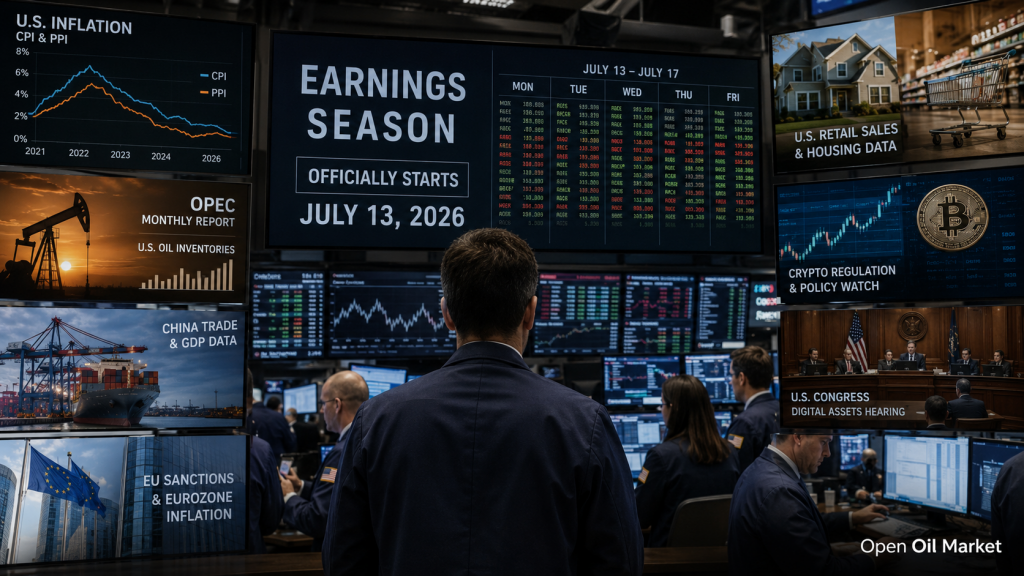
The week from July 13 to July 17, 2026, promises to be pivotal for global markets in the middle of summer. Investors in the US, Europe, Asia, and Russia will focus on several key factors: the official start of the US earnings season, June's CPI and PPI inflation reports in the US, China's GDP for the second quarter, data on retail sales, industry, and the housing market, the Bank of Canada's interest rate decision, OPEC's monthly oil market report, and the potential advancement of the EU's 21st sanctions package against Russia.
The main intrigue of the week will be whether the market can maintain its risk appetite after a strong first half of the year and whether the earnings reports from major public companies can confirm the sustainability of profits. The earnings season will kick off with the US banking sector: JPMorgan Chase, Bank of America, Goldman Sachs, Wells Fargo, Citigroup, and Morgan Stanley are set to set the tone for the S&P 500. In Europe, investors will be watching ASML, BP, Ericsson, Rio Tinto, Nordea, ABB, Atlas Copco, Volvo, Sandvik, and Assa Abloy. In Asia, key indicators will include TSMC, Wipro, Tech Mahindra, and macro data from China. For the Russian market, the operational results of Aeroflot, X5, and Henderson will be significant, as well as dividend events related to Sberbank and other issuers.
Key Themes for Investors This Week
The economic events of the week will create a dense network of signals for assessing monetary policy, corporate profits, and global demand. Investors should focus on several directions:
- US Inflation: The CPI on Tuesday and PPI on Wednesday will reveal how persistent price pressures remain after the volatility in commodity markets.
- Fed and Waller's Rhetoric: Speeches in the House and Senate could affect expectations regarding interest rates, Treasury yields, and the dollar.
- Corporate Earnings: US banks, technology firms, equipment manufacturers, pharmaceuticals, and the consumer sector will showcase the real state of margins.
- Oil Market: The OPEC report, API, and EIA inventories will serve as benchmarks for Brent, WTI, Urals, oil and gas companies, and commodity currency valuations.
- China and Asia: Data on trade and GDP from China will be important for Nikkei 225, industrial metals, semiconductors, and European exporters.
- Europe and Sanctions: The potential adoption of the 21st package of EU sanctions against Russia could increase the geopolitical risk premium in energy, logistics, and the financial sector.
Economic Events for Monday, July 13: EU Sanctions, OPEC Report, and US Federal Budget
Monday will open with a focus not so much on macro statistics but rather on geopolitical and commodity signals. Discussions are expected regarding the potential advancement of the EU's 21st sanctions package against Russia, as well as the coalition meeting on Ukraine. For investors, this is an assessment of the risk premium concerning Russian assets, energy, logistics, the banking sector, and European industrial companies.
At 14:00 MSK, the monthly OPEC report on the oil market will be released. This document is crucial for assessing the supply-demand balance, OPEC+ quotas, global oil consumption forecasts, and production dynamics outside the cartel. For the oil and gas sector, this is one of the key documents of the month; reactions in Brent and WTI can influence the stocks of oil companies, currencies of commodity economies, and inflationary expectations.
At 21:00 MSK, the US will publish federal budget data for June. The budget deficit, dynamics of tax revenues, and expenditures will be important for the US bond market, particularly amid discussions regarding the trajectory of public debt and Treasury yields.
Corporate Earnings on Monday: Notable companies include PrairieSky Royalty in Canada, Thermador Groupe in France, and operational results for Aeroflot in the Russian market. For MOEX, dividend events for specific issuers, including register closures and the final days for buying shares with dividends, will also be significant.
What Investors Should Watch: The tone of the EU sanctions package, OPEC's oil demand forecast, reactions from the rouble and oil and gas stocks, as well as developments in US Treasury yields following budget data.
Economic Events for Tuesday, July 14: US CPI, China's Trade Data, and Earnings from Major Wall Street Banks
Tuesday will mark the first truly significant day of the week. At 06:00 MSK, China will release its global trade data for June. China's exports and imports are essential for assessing external demand, the industrial cycle, raw material prices, and Asian market prospects. Weak data may heighten pressure on cyclical sectors, whilst strong figures could bolster metallurgists, logistics, industrial companies, and the Nikkei 225.
At 09:00 MSK, Switzerland will report industrial PPI for June. Although this metric is not a key global driver, it helps gauge price pressures in Europe. The main event of the day will be the US CPI at 15:30 MSK. Investors will focus not just on the overall consumer price index but also on core inflation excluding food and energy. The US CPI is poised to significantly alter expectations regarding Fed rates, the dollar, gold, the S&P 500, and Nasdaq.
At 17:00 MSK, Waller is expected to speak at the House Financial Services Committee. The market will be looking for signals regarding the feasibility of further tightening or a pause in Fed policy. Late in the evening, at 00:30 MSK, the API will release its oil inventory data for the US.
Corporate Earnings on Tuesday: The crucial part of the US earnings season kicks off, with reports from JPMorgan Chase, Bank of America, Goldman Sachs, Wells Fargo, and Citigroup. Also in focus are Fastenal, BP, DNB Bank, Ericsson, and Rio Tinto. For US banks, investors will assess net interest margins, reserves for credit losses, deposit dynamics, trading revenues, and investment banking fees.
What Investors Should Watch: The US CPI in comparison to expectations, reactions from two-year Treasuries, reports from US banks, dynamics of the S&P 500's financial sector, and signals from China regarding exports and imports.
Economic Events for Wednesday, July 15: China's GDP, US PPI, Bank of Canada Rate Decision, and Fed's Beige Book
Wednesday will consolidate several key segments: China, the US, Canada, Russia, and the corporate earnings of global leaders. At 05:00 MSK, China will publish its GDP for the second quarter of 2026. This is one of the most significant macro indicators of the week for global investors, as it influences expectations regarding demand for oil, gas, metals, semiconductors, consumer goods, and transportation.
At 12:00 MSK, the Eurozone will release its industrial production data for May. This metric is vital for Euro Stoxx 50 as an indicator of the condition of Europe's manufacturing core. At 15:30 MSK, the US will release the NY Empire State Manufacturing Index for July and the PPI for June. If PPI shows an acceleration in producer prices, the market may begin to price in a firmer Fed rhetoric.
At 16:45 MSK, the Bank of Canada will announce its rate decision, followed by a press conference at 17:30 MSK. Simultaneously, EIA will release its US oil inventory data. At 19:00 MSK, Russia will publish its CPI, which is important for expectations regarding the Bank of Russia's rate, the rouble, and Russian bonds. At 21:00 MSK, the Fed will present the Beige Book—a qualitative overview of the economy's state across US regions.
Corporate Earnings on Wednesday: Reports will come from ASML, Johnson & Johnson, Morgan Stanley, BlackRock, Progressive, Bank of New York Mellon, PNC Financial, Elevance Health, Cintas, United Airlines, M&T Bank, Conagra Brands. In Europe, focus will be on Richemont, Antofagasta, SEB, SEB S.A., and other issuers. ASML will be the key indicator of demand for semiconductor and AI infrastructure equipment.
What Investors Should Watch: China's GDP, US PPI, the Bank of Canada's decision, the tone of the Fed's Beige Book, ASML's report, and the dynamics of the US second-tier banks.
Economic Events for Thursday, July 16: UK GDP, US Retail Sales, and Earnings Reports from TSMC, Netflix, UnitedHealth, and GE Aerospace
Thursday will be the busiest day of the week for corporate earnings. At 09:00 MSK, the UK will release its GDP for May, which is crucial for the pound, FTSE 100, and European cyclical assets. At 12:00 MSK, the Eurozone will present its trade balance for May, allowing an assessment of European export competitiveness amid currency fluctuations and weak industrial demand.
At 15:30 MSK, the US will publish three significant metrics: Initial Jobless Claims, Philadelphia Fed Manufacturing Index, and retail sales for June. This set of data is robust for evaluating consumer demand, labour market conditions, and industrial activity. At 17:00 MSK, Pending Home Sales will be released, followed by EIA's natural gas inventory data at 17:30 MSK.
Corporate Earnings on Thursday: Earnings will come from TSMC, UnitedHealth Group, Netflix, GE Aerospace, Abbott Laboratories, Prologis, U.S. Bancorp, State Street, Citizens Financial, Intuitive Surgical, Nordea, Telenor. In Europe, reports from Vinci, Publicis Groupe, Aéroports de Paris, ABB, Investor AB, Atlas Copco, SSE, and Experian are expected. In Asia, attention will be on TSMC, Wipro, and Tech Mahindra. In the Russian market, investors will look to see the operational results of X5 for the second quarter and the first half of 2026, as well as the operational data from Henderson.
TSMC will serve as a critical indicator of demand for chips and AI computing. Netflix will assess the resilience of the subscription model and advertising monetisation. UnitedHealth and Abbott will provide benchmarks for the healthcare sector, while GE Aerospace will signal about the aviation cycle, and Prologis will address warehouse real estate and global logistics.
What Investors Should Watch: US retail sales, reports from TSMC and Netflix, guidance from UnitedHealth, orders from GE Aerospace, operational results from X5, and reactions in the technology, healthcare, and real estate sectors.
Economic Events for Friday, July 17: Eurozone CPI, US Industrial Data, Michigan Sentiment, and Hearing on the CLARITY Act
Friday will conclude the week with significant macroeconomic data from Europe and the US. At 12:00 MSK, the Eurozone will publish its CPI for June. For Euro Stoxx 50 and European bonds, this is the main inflation indicator of the week: it affects expectations for ECB policy, the banking sector, consumer stocks, and the euro/dollar currency pair.
At 15:30 MSK, the US will present Housing Starts for June. At 16:15 MSK, industrial production data will be released, followed by the preliminary Michigan Consumer Sentiment index for July and consumer inflation expectations at 17:00 MSK. This block of data is significant for assessing the resilience of the American consumer, production dynamics, and further Fed policy.
A separate focus for investors in digital assets will be the anticipated hearing on the CLARITY Act in the US Congress concerning the structuring of the cryptocurrency market. Regulation of cryptocurrencies, the status of tokens, distribution of powers among regulators, and rules for trading platforms may influence the market for Bitcoin, Ethereum, public crypto companies, and the fintech sector.
Corporate Earnings on Friday: Expected reports include Travelers, Regions Financial, Truist Financial, Fifth Third Bancorp, Volvo, Autoliv, SKF, Husqvarna, Sandvik, Assa Abloy, Danske Bank, Swedbank, EQT, Saab, and Epiroc. For regional US banks, the quality of the loan portfolio, funding costs, and deposit dynamics will be crucial. For European industrial companies, incoming orders, margins, currency effects, and demand projections for the second half of the year will be significant.
The Russian Market: Friday is also significant for MOEX investors due to the final day for purchasing Sberbank shares with dividends. Dividend events may affect turnover, short-term volatility, and demand structure in the Russian blue-chip stocks.
Indices and Risk Geography: S&P 500, Euro Stoxx 50, Nikkei 225, and MOEX
For global investors, the week of July 13–17 will serve as a test of several investment hypotheses. In the US, the S&P 500 and Nasdaq will depend on inflation, bond yields, and the quality of corporate earnings. Banks will highlight the state of the credit cycle, tech companies will demonstrate the resilience of AI capex, and consumer data will reveal the strength of internal demand.
In Europe, the Euro Stoxx 50 will react to Eurozone CPI, trade balance, industrial production, and reports from ASML, ABB, Nordea, Volvo, Sandvik, and Assa Abloy. For the Nikkei 225, key factors will include China, TSMC, the semiconductor cycle, and the yen currency factor. For MOEX, the main drivers will remain oil, the rouble, the sanctions agenda, inflation in Russia, dividends, and operational results from major issuers.
- S&P 500: banks, US inflation, retail sales, and reports from Netflix, UnitedHealth, GE Aerospace, and TSMC through the global technology chain.
- Euro Stoxx 50: ASML, European inflation, industry, banks, and exporters.
- Nikkei 225: China, semiconductors, yen dynamics, and global demand for electronics.
- MOEX: oil, EU sanctions, CPI in Russia, dividend calendar, and operational data from companies.
What Investors Should Pay Attention to by Week's End
The week of July 13–17, 2026, may prove pivotal for assessing the second half of the year. Should the US CPI and PPI confirm a slowdown in inflation, and if the earnings reports from banks and technology companies exceed expectations, the market will have arguments in favour of continuing a risk-on approach. Conversely, if inflation accelerates anew and companies express caution regarding demand and margins, investors may shift towards profit-taking in overheated sectors.
- US Inflation: CPI and PPI will set the trajectory for rates, the dollar, and bond yields.
- Bank Earnings: JPMorgan, Bank of America, Goldman Sachs, Wells Fargo, Citigroup, and Morgan Stanley will indicate the health of the US financial system.
- China: Trade and GDP figures will serve as indicators of global industrial demand.
- Oil and Gas: The OPEC report, API/EIA inventories, and geopolitics will impact Brent, WTI, Urals, and oil and gas stocks.
- Technology: ASML and TSMC will deliver crucial signals regarding AI infrastructure and semiconductors.
- Europe and Russia: EU sanctions, Eurozone CPI, and Russia's CPI are key for currencies, bonds, energy, and MOEX.
- Crypto Regulation: The hearings on the CLARITY Act may heighten volatility in digital assets and fintech.
Investors should approach this week as a period of high event concentration. The optimal strategy is not to evaluate individual releases in isolation but to consider the collective signals: inflation, rates, earnings, oil, China, and geopolitics. The intersection of these factors will determine the dynamics of the S&P 500, Euro Stoxx 50, Nikkei 225, MOEX, commodity assets, and emerging market currencies in the latter half of July.