Overview of Key Economic Events and Corporate Reports for 8–12 June 2026: US CPI, ECB Rate, Inflation in China, Russia, Germany, India and Brazil, Oil Reports, Oracle, Adobe, Lennar and Other Public Company Earnings
The week of 8–12 June 2026 will be one of the most significant for global investors in the first half of the month. The focus will be on economic events related to inflation, interest rates, the oil market, consumer expectations, and corporate earnings from major public companies. For the S&P 500, Euro Stoxx 50, Nikkei 225 and MOEX, this week is important not only because of macroeconomic statistics, but also due to signals from companies in the technology, consumer, construction, energy and commodity sectors.
The main themes of the week are consumer inflation in the US and China, the European Central Bank's rate decision, Japan's GDP data, inflation in Russia, Germany, India and Brazil, oil market reports from the US Energy Department and OPEC, as well as quarterly results from Oracle, Adobe, Lennar, RH, Vail Resorts, Campbell’s, J.M. Smucker, Chewy, Casey’s General Stores and several companies from Europe, Asia and North America.
Brief Introduction: A Week of Inflation, Rates and Corporate Outlooks
The investment calendar for 8–12 June 2026 shapes several directions for assessing market risk. First, investors will receive fresh inflation data from the US, China, Russia, Germany, India and Brazil. These indicators will influence expectations regarding monetary policy from the Fed, ECB, Bank of Canada, Central Bank of Turkey and other regulators.
Second, the week takes place against a backdrop of heightened geopolitical attention: Xi Jinping’s state visit to North Korea on 8–9 June may be a factor for Asian markets, the defence sector, regional currencies and the assessment of political risk in Northeast Asia. Third, the oil market will receive several reference points: the US Energy Department’s short-term outlook, API and EIA data on oil inventories, the OPEC monthly report and US natural gas storage statistics.
For investors worldwide, this week is important because it combines macroeconomic releases and corporate results. If inflation turns out higher than expected, bond yields could rise and growth stocks could come under pressure. If, however, the results from Oracle and Adobe confirm sustained demand for cloud services, artificial intelligence and enterprise software, the technology sector could find support even against a tight macro backdrop.
Monday, 8 June 2026: Japan GDP, US Inflation Expectations and Results from Campbell's, Vail Resorts
Monday will set the tone for the whole week. In Asia, investors will assess Japan's Q1 2026 GDP data, due at 02:50 Moscow time. For the Nikkei 225, this release is important as an indicator of domestic demand, exports, corporate investment and the resilience of the Japanese economy amid a volatile yen and shifting global trade flows.
An additional factor for Asia will be the first day of Xi Jinping’s visit to North Korea. This event matters not only for politics, but also for investors working with Chinese, Korean and Japanese assets. Any signals about trade, infrastructure or military-political cooperation could influence perceptions of regional risk.
In the US at 18:00 Moscow time, the New York Fed’s May consumer inflation expectations will be released. This indicator is important for assessing the persistence of inflationary pressure. If households continue to expect high inflation, the Fed may maintain a cautious stance on rates for longer. Australia will have no trading, so liquidity in the Asian session may be less uniform.
Monday’s corporate reports: before the US market open, attention will be on FuelCell Energy, Campbell’s, Graham, Duluth Holdings, Motorcar Parts of America and VinFast. After the close, Vail Resorts, Mission Produce and Mama’s Creations will report. For investors, Campbell’s and Mission Produce will provide signals on consumer demand and food inflation, Vail Resorts on premium tourism and affluent household spending, and FuelCell Energy on market interest in hydrogen energy and alternative technologies.
Tuesday, 9 June 2026: China Trade, US Trade Balance, Oil and Lagarde’s Speech
On Tuesday, the focus will shift to global trade and the energy market. At 06:00 Moscow time, China will publish May global trade data. For investors, this is a key indicator of global demand, industrial supply chains and China’s export momentum. Weak data could heighten fears of a global economic slowdown, while strong data may support commodity assets, Asian equities and emerging market currencies.
At 15:30 Moscow time, the US will release the April trade balance. At 17:00 Moscow time, May existing home sales data will be published. The housing market remains an important indicator of the US economy’s sensitivity to rates: weak sales could confirm the pressure of expensive mortgages, while resilient data may show that the consumer sector retains a safety margin.
At 19:00 Moscow time, the US Energy Department will present its short-term oil market outlook. At 19:30 Moscow time, investors will watch ECB President Christine Lagarde’s speech. At 23:30 Moscow time, the API will publish US oil inventory data. For the Brent and WTI markets, this set of events is important as it combines demand forecasts, inventory dynamics and expectations for European monetary policy.
Tuesday’s corporate reports: before the market open, results are due from Academy Sports + Outdoors, United Natural Foods, J.M. Smucker, Lands’ End, SailPoint, Titan Machinery and Designer Brands. After the close, investors will await results from Casey’s General Stores, Bark, Cracker Barrel, Domo, Skillsoft, Lakeland Industries, Suja Life and Limoniera. In Europe, notable updates include Groupe Partouche. For the market, the reports from J.M. Smucker and United Natural Foods are important as indicators of food demand, Casey’s as a measure of US consumer resilience, and SailPoint and Domo as signals for enterprise software.
Wednesday, 10 June 2026: US CPI, China CPI, Bank of Canada Rate and Oracle Results
Wednesday will be the central day of the week for global markets. At 02:50 Moscow time, Japan will publish May producer inflation (PPI). At 04:30 Moscow time, China will release May consumer inflation (CPI). These data are important for assessing price pressures in the two largest Asian economies and may influence the yen, yuan, Asian equity indices and commodity demand.
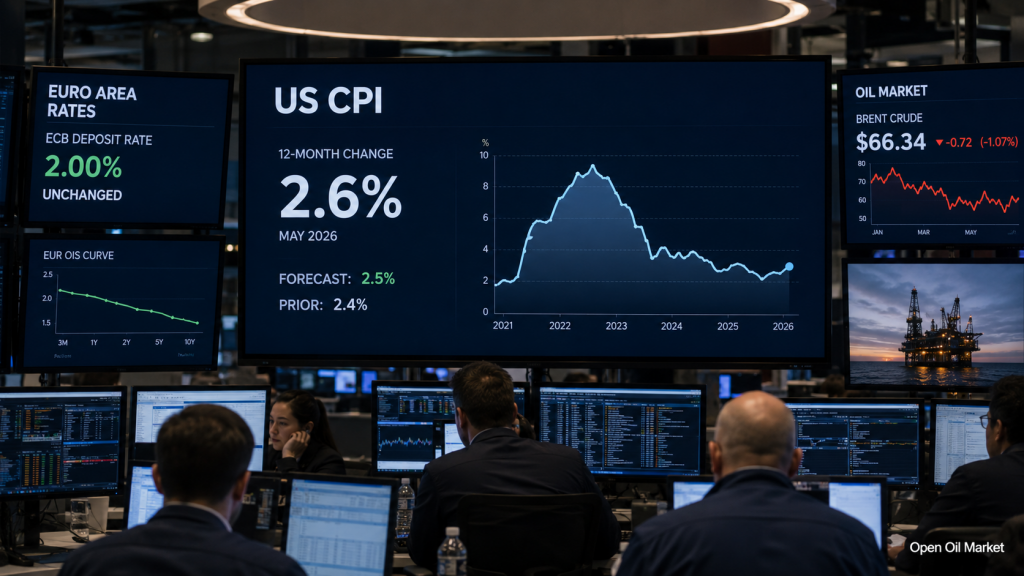
The main release of the day is the US May consumer inflation (CPI) at 15:30 Moscow time. This indicator may determine the behaviour of the S&P 500, Nasdaq, dollar, gold and Treasury yields. Higher inflation would strengthen expectations of a hawkish Fed stance and could hit growth stocks. A softer CPI, conversely, could support risk appetite and increase interest in the technology sector.
At 16:45 Moscow time, the Bank of Canada will announce its rate decision, followed by a press conference at 17:30 Moscow time. At the same time, the US will release EIA oil inventory data. At 19:00 Moscow time, Russia’s CPI inflation will be published, and at 21:00 Moscow time, the US federal budget for May will be released. For investors in Russian assets, Russian inflation is important for expectations regarding the Bank of Russia’s rate, the rouble’s dynamics, OFZ bonds and valuations of domestic demand companies.
Wednesday’s corporate reports: before the market open, results are due from Chewy, J.Jill and Core & Main. After the close, the main event will be Oracle’s report. Also expected are results from Stitch Fix, Navan and Oxford Industries. In Europe, attention will be on Figeac Aéro. Oracle is the key report of the week for the technology sector: investors will assess cloud infrastructure growth, AI capacity demand, margins, capital expenditure and management guidance. Chewy is important for analysing online retail and consumer spending, while Core & Main is useful for assessing US infrastructure and construction demand.
Thursday, 11 June 2026: ECB Rate, US PPI, OPEC Report and Results from Adobe, Lennar, RH
Thursday is the second main day of the week after Wednesday. In Europe, a Eurogroup leaders’ meeting will take place, and at 15:15 Moscow time the ECB will announce its interest rate decision. At 15:45 Moscow time, an ECB press conference will follow. For the Euro Stoxx 50, European banks, eurozone bonds and the euro-dollar currency pair, this is the key moment of the week. Investors will assess not only the rate decision itself but also the tone of Christine Lagarde’s comments on inflation, economic growth and the future path of monetary policy.
At 14:00 Moscow time, the OPEC monthly oil market report will be released. At the same time, the Central Bank of Turkey will announce its rate decision. At 15:30 Moscow time, the US will publish initial jobless claims and the May producer price index (PPI). At 16:00 Moscow time, Russia will present its April trade balance. At 17:30 Moscow time, EIA data on US natural gas inventories will be released, and at 19:00 Moscow time, the WASDE report on agricultural markets will be published.
This set of releases makes Thursday critically important for commodity markets. Oil, gas, grains, emerging market currencies and energy company shares may react to updated demand, supply and inventory forecasts. For oil and gas sector investors, the OPEC report, gas data and Russia’s trade balance are especially important.
Thursday’s corporate reports: before the market open, results are due from Lovesac, Hooker Furnishings, Aurora, McGraw Hill and Vera Bradley. After the close, results from Adobe, Lennar and RH will be released. In Europe, notable reports include BT Group, Halma, LPP, Oeneo and Groupe LDLC; in Canada, Dollarama. Adobe will be a key indicator of demand for software, digital content and generative AI monetisation. Lennar will show the state of the US housing market, RH will indicate demand for premium furniture and home goods, while BT Group and Halma will provide signals on European telecommunications and industrial technologies.
Friday, 12 June 2026: Germany CPI, UK GDP, India and Brazil Inflation, US Consumer Sentiment
Friday will close the week with a block of macroeconomic statistics from Europe, Asia, Latin America and the US. At 09:00 Moscow time, Germany will publish May consumer inflation (CPI), and the UK will release April GDP. These data are important for assessing the state of the European economy after the ECB decision and for forecasting Bank of England policy.
At 10:00 Moscow time, Turkey will present the central bank’s inflation forecast for end-2026. At 13:30 Moscow time, India will publish May consumer inflation (CPI), and at 15:00 Moscow time, Brazil’s CPI will be released. For emerging market investors, these releases are important because inflation determines expectations for rates, currencies, debt markets and capital inflows.
At 17:00 Moscow time, the US will publish the preliminary June Michigan Consumer Sentiment index and preliminary consumer inflation expectations. This is an important final indicator of the week: if consumers downgrade their economic outlook or raise inflation expectations, the market may reassess the rate scenario and consumer stocks.
In Russia, 12 June falls on a holiday period, so liquidity in Russian assets may be lower than usual. Investors should check trading schedules for specific sections of the Moscow Exchange and St Petersburg Exchange in advance, especially if their portfolio includes Russian equities, currency instruments, futures or securities of foreign issuers. In the US, few major corporate releases are scheduled for Friday, so the focus will shift to macroeconomics and the outcomes of previous days.
Sector Signals for the S&P 500, Euro Stoxx 50, Nikkei 225 and MOEX
For the S&P 500, the main guides of the week will be US CPI, US PPI, consumer expectations, and reports from Oracle, Adobe, Lennar and RH. The technology sector will assess Oracle and Adobe’s ability to sustain growth amid competition in artificial intelligence and cloud services. The construction and consumer sectors will receive signals from Lennar, RH, Casey’s, Campbell’s and J.M. Smucker.
For the Euro Stoxx 50, the key event will be the ECB’s rate decision. Banks, insurance companies, industrial holdings and consumer companies in Europe will be sensitive to forecasts on inflation and economic growth. Additional signals will come from the reports of BT Group, Halma, LPP, Oeneo and Groupe LDLC.
For the Nikkei 225, Japan’s GDP, Japan’s PPI, China’s trade and CPI data, and the geopolitical backdrop surrounding Xi Jinping’s visit to North Korea are important. For MOEX, the main factors will be Russian inflation, the trade balance, oil reports, Brent dynamics and expectations for the Bank of Russia’s rate.
Key Risks of the Week for the Global Investor
- Inflation risk. US CPI and US PPI could change rate expectations and trigger a revaluation of growth stocks, bonds and the dollar.
- Risk of hawkish ECB rhetoric. If the ECB signals a longer period of high rates, pressure on European equities and bonds may intensify.
- Oil risk. Reports from the US Energy Department and OPEC, as well as API and EIA data, could alter the balance of expectations for Brent, WTI, oil and gas companies and inflation.
- Geopolitical risk. Xi Jinping’s visit to North Korea could heighten attention to security in Asia and affect perceptions of regional markets.
- Corporate guidance risk. Even strong actual results from Oracle, Adobe or Lennar could be viewed negatively if management guidance proves cautious.
What the Investor Should Watch at the End of the Week
By the end of the week, the investor should compare three blocks of data: inflation, central bank decisions and corporate outlooks. If US CPI, US PPI and inflation expectations confirm sustained price pressure, markets may price in a tighter rate trajectory. In this scenario, growth stocks, long-duration debt instruments and highly leveraged companies will come under pressure.
If inflation data prove moderate and results from Oracle, Adobe, Lennar and consumer companies confirm sustained demand, equity indices may find support. In such a case, investors will seek opportunities in quality technology companies, the consumer sector, infrastructure businesses and selected exporters.
Special attention should be paid to oil and gas. Several energy-focused releases during the week could affect inflation expectations, oil and gas company profits, commodity-currency dynamics and CIS market trends. For a global investor’s portfolio, the week of 8–12 June 2026 is a test of balance between macroeconomic risk, corporate resilience and geopolitical uncertainty.