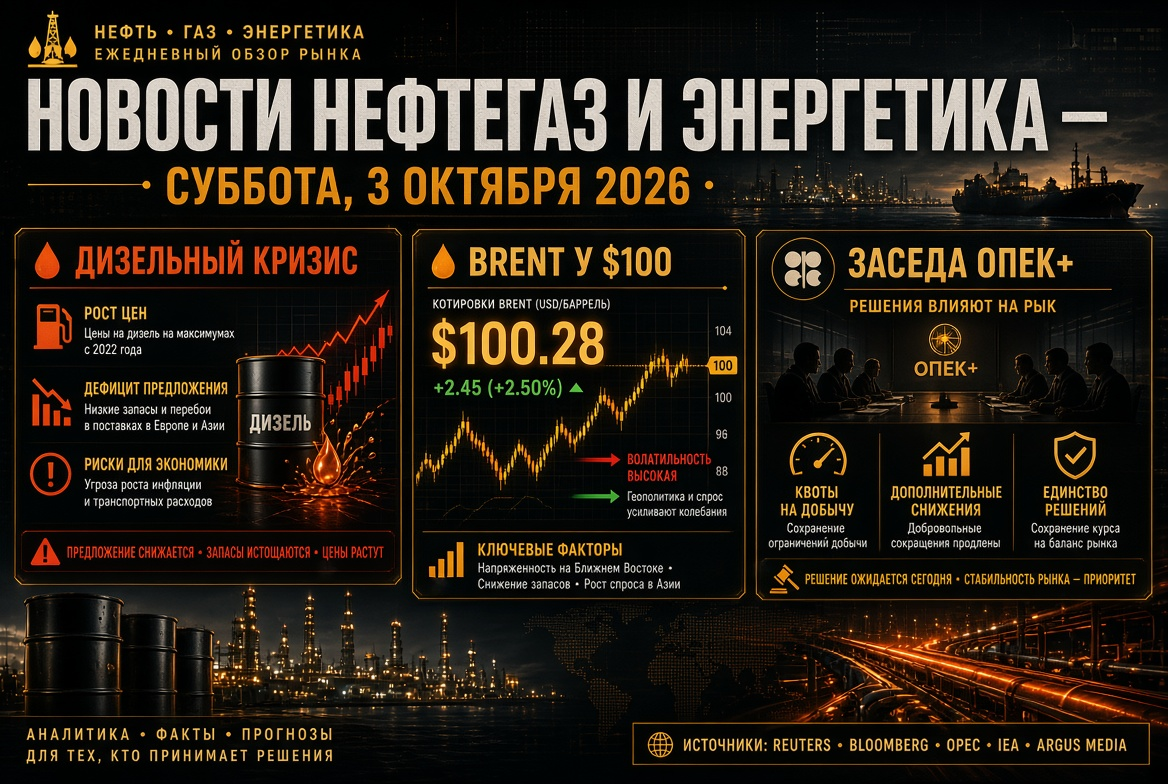
Global Overview of the Oil, Gas and Energy Market as of April 2, 2026, Including Oil, Gas, LNG, Electricity and Oil Products in the Context of Rising Geopolitical Risks
The oil market commenced April following one of the most significant monthly movements in many years. The primary factor is not the classic increase in demand, but rather a supply shock and concerns regarding the sustainability of exports through critical routes. Currently, for the oil market, it is not just about how many barrels are produced, but also about the volumes that actually reach buyers without delays, rising freight costs, and insurance risks.
- Brent and WTI remain in a zone of high volatility following a sharp spike in March.
- The risk premium for supplies is embedded in the price across nearly the entire supply chain—from crude oil to oil products.
- The market is increasingly sceptical about a rapid return to calm scenarios even with a softening rhetoric.
For investors in oil and gas, this means that the stock prices of oil companies and trading houses will increasingly depend not only on the absolute price of oil but also on their ability to manage logistics, export channels, and contract portfolios. This is especially crucial for oil products and refineries, as an expensive barrel does not guarantee profits if the availability of crude worsens or transportation costs rise.
OPEC+ and Production: The Market Awaits Real Additional Barrels, Not Words
Additional attention is focused on OPEC+'s actions. Formally, the market has entered a period where any decision to increase production could partially temper prices; however, the actual effect depends on the speed, volumes, and logistical feasibility of such increases. Currently, the energy sector is evaluating not just quotas but the actual delivery of additional barrels to the physical market.
- If OPEC+ signals flexibility to the market, oil prices may temporarily stabilise.
- If additional volumes prove to be limited, the risk premium will persist longer.
- If supply disruptions continue, attention will shift from paper balances to physical shortages.
For energy market participants, the psychological factor is significant: following the price shock in March, the market has become sensitive to any statements regarding production, exports, and reserve capacities. This maintains high speculative activity and amplifies intraday fluctuations in oil and oil products.
Gas and LNG: The Global Market Has Become Stricter, and Europe and Asia Compete for Molecules Once Again
As of April 2, the gas market remains one of the most nervous segments of the energy sector. Liquefied natural gas (LNG) has once again become a strategic asset rather than merely a flexible balancing tool. For Europe, it is a question of energy security; for Asia, it is a matter of price and availability of fuel for power generation and industry.
Against the backdrop of disruptions in the Middle East and shipping restrictions, competition for LNG has intensified. Some Asian buyers are facing rising spot prices and are forced to seek alternatives. Concurrently, Europe maintains a high demand for reliable gas supplies, whilst Russian pipeline and LNG flows continue to affect the regional balance more significantly than anticipated just a few months ago.
- The spot LNG market remains tense.
- Europe and Asia are intensifying the battle for available fuel shipments.
- Logistics and vessel availability are becoming as crucial as the resource price.
For investors and companies in the gas sector, this creates a favourable environment for operators with long-term contracts, a robust resource base, and flexible routing strategies. Conversely, energy-intensive industries face the risk of rising costs and a return to a more expensive energy consumption structure.
Oil Products and Refineries: Margins Remain in the Spotlight
The oil products segment currently appears to be even more sensitive than the crude oil market. This is due to the fact that diesel, jet fuel, and petrol are most responsive to supply disruptions, shortages of certain fractions, and shifts in trade routes. For refineries, it is a period of high pricing opportunity but also increased operational risk.
Refining margins in Asia and other key markets have surged, particularly in middle distillates. Diesel and jet fuel remain the most strained categories. For the oil products market, this indicates that well-supplied refineries have the chance for strong financial results, while processors with limited access to crude may experience more unstable utilisation rates.
- Diesel remains a crucial product for logistics, industry, and backup generation.
- The petrol market is tightening ahead of the seasonal demand increase.
- Refineries benefit where they can rapidly adjust their product mix.
For fuel companies and oil product traders, the central question becomes not just the price but also the availability of physical volumes. In the coming weeks, this may make the premium on diesel and other light oil products more resilient than a typical short-term spike.
Electricity: The Reliability of Systems is Again More Expensive than the Ideal Energy Transition Model
There is an increasing trend towards prioritising reliability in the electricity market. Energy systems worldwide are becoming more pragmatic: in real-time, regulators and network operators are betting not on theoretically optimal balances but on ensuring reliable peak load handling. This is particularly visible in countries where expensive gas raises generation costs and underscores the significance of coal, nuclear energy, and controlled capacities.
For the electricity sector, this signifies a new cycle of investment in networks, balancing capacities, energy storage, and inter-system connections. Bottlenecks in network infrastructure are becoming one of the main constraints on growth in generation, including renewables.
- Network constraints are becoming a strategic factor in assessing energy companies.
- Peak generation and system flexibility are back in focus.
- Capital investments in infrastructure are receiving a new impetus.
Renewables: Growth Continues, But the Market is Assessing Integration Quality More Stringently
Renewable energy continues to maintain long-term investment attractiveness; however, recent events have demonstrated that simply having installed capacity is no longer sufficient. For renewable investors, the quality of grid connection, the ability to deliver power without restrictions, tariff model resilience, and the role of storage solutions are becoming increasingly important.
This is why the market is increasingly distinguishing between growth stories and those facing infrastructural stress. Where networks lag behind the construction of solar and wind projects, financial effectiveness diminishes. Conversely, where renewables are integrated into a strong network system and complemented by energy storage, the sector appears considerably more resilient.
This is particularly significant for the global audience: by 2026, the energy market assesses renewables no longer as a separate agenda but as part of the overall reliability of supply architecture.
Coal: A Temporary Return as Insurance Against Gas Shortages
The coal sector is again receiving tactical support in several Asian countries. In light of expensive LNG and the risk of gas supply disruptions, some electricity systems are reinforcing their reliance on coal generation. For the coal market, this does not signify a return to the previous paradigm, but rather indicates that in the short term, coal is once more serving as a reliable fuel source.
For investors, this is an important signal: the energy transition is not being cancelled, but its trajectory is becoming less linear. During supply shock periods, the raw materials and electricity market quickly reincorporates those energy sources that ensure reliability and predictability in supply.
What This Means for Investors, Oil Companies, and Energy Market Participants
As of April 2, 2026, the global oil, gas, and energy sectors are operating under a regime of risk reassessment. Companies and assets that combine the following will benefit:
- Access to raw materials and stable production;
- Control over export logistics;
- Strong positions in oil products and refining;
- Resilient infrastructure in gas and electricity;
- Flexibility in their generation and supply portfolio.
Business models tied to cheap fuel, narrow supply chains, and inadequate network infrastructure appear most vulnerable. For the energy market, it is now not merely forecasts regarding oil, gas, electricity, or renewables that matter, but the ability of companies to withstand periods of sharp volatility without losing margin and market position.
The main theme for Thursday, April 2, 2026, is a new premium for reliability in the global raw materials and energy sector. Oil, gas, LNG, oil products, electricity, coal, and renewables are now evaluated through the lens of supply resilience, infrastructure adequacy, and the capacity to rapidly adapt to geopolitical shocks. For investors and energy market participants, this means that the coming weeks will be defined not so much by macroeconomic theory, but by the physics of supply, energy availability, and the quality of risk management.