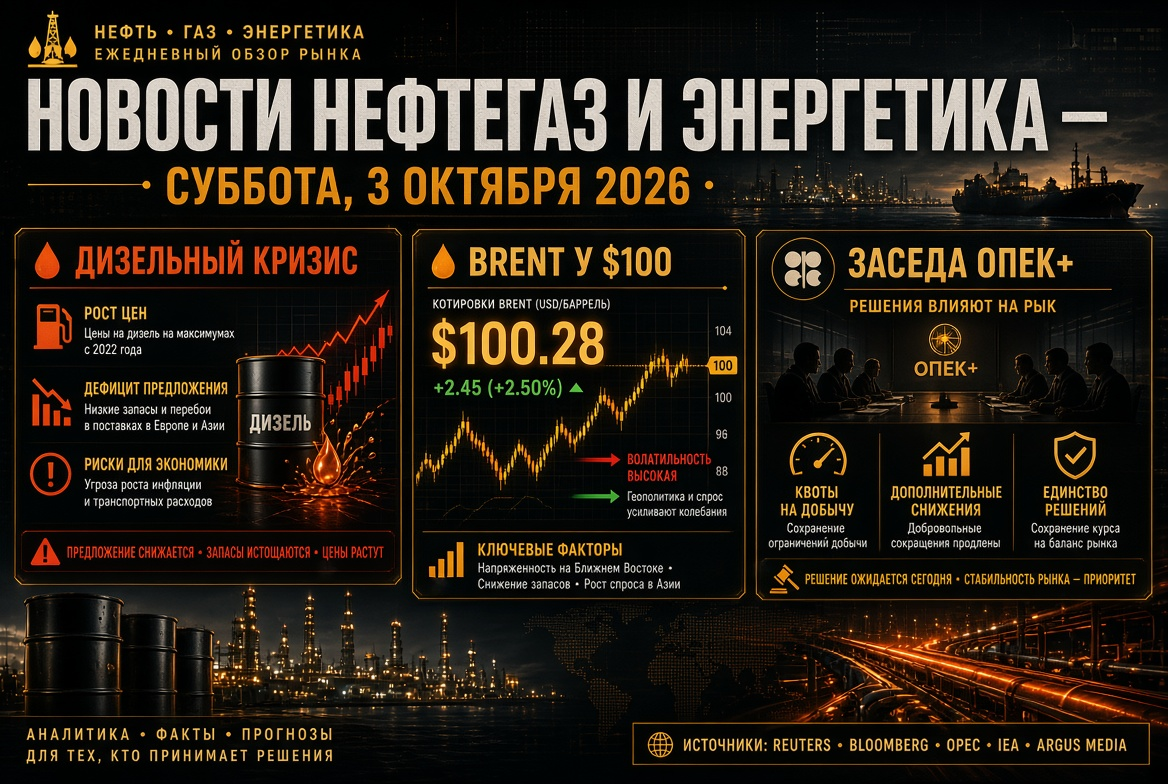
Current Oil, Gas, and Energy News for Thursday, 25 June 2026: The Situation in the Oil Market Following the Reduction of Risks Surrounding the Strait of Hormuz, Dynamics in LNG, Gas, Electricity, Coal, Renewables, Oil Products, and Refineries
The global energy sector is entering Thursday, 25 June 2026, in a state of sharp risk reassessment. After a period marked by geopolitical premiums in the oil market, investors are once again focusing on physical deliveries, refinery throughput, fuel balance, gas prices, electrical grid resilience, and coal's role in the global energy landscape. The main topic of the day is the alleviation of concerns surrounding supply routes through the Strait of Hormuz, alongside persistent structural tensions in the gas, electricity, and refining segments.
For investors, participants in the energy market, fuel companies, and oil companies, the current agenda appears heterogeneous. Oil prices are declining on expectations of a recovery in Middle Eastern flows, but inventories remain low. LNG is bolstered by demand from Europe and Asia. Electricity prices are increasing due to heatwaves, weak winds, and restrictions on nuclear generation. Coal is once again acting as a safe asset for major economies, despite the overarching renewable energy agenda.
Oil: The Market is Easing Off Geopolitical Premiums
A key signal for the oil market is the decline in Brent and WTI prices following signs of normalisation in tanker movements through the Strait of Hormuz. For the global commodity sector, this indicates that the market has begun transitioning from a "fear of shortage" mode to a more pragmatic assessment of actual supplies, inventories, and demand.
Three factors are coming to the fore:
- The return of some Middle Eastern oil to the global market;
- The softening of risk premiums in Brent and WTI quotations;
- The reassessment of demand for oil and oil products against the backdrop of high prices in previous months.
For oil companies, this creates a mixed effect. On one hand, declining prices diminish the extraordinary revenues of the upstream segment. On the other hand, the normalisation of maritime logistics reduces the risks of supply disruptions, insurance premiums, and force majeure events in contracts. Investors will closely monitor how sustainable the recovery in supplies proves to be and whether geopolitical premiums will return amid new diplomatic complications.
Physical Oil Market: Discounts are Shifting Global Trade Flows
Competition is intensifying between oil grades in the physical market. Middle Eastern suppliers are increasing their offerings, and certain grades are trading at significant discounts to benchmark prices. This is altering supply routes: some Middle Eastern oil is becoming more attractive to European buyers, while the arbitrage for Atlantic oil supplies to Asia is deteriorating.
This is a crucial moment for traders and refineries. Discounts on raw materials may enhance refining economics, particularly for plants capable of swiftly adjusting purchasing structures. However, the benefits are not equitably distributed:
- Asian refineries have already partially closed their needs for the coming months;
- European refiners have the opportunity to purchase cheaper raw materials;
- Exporters from the Atlantic Basin are facing pressure on differentials;
- The margins on oil products remain sensitive to logistics and raw material availability.
For fuel companies, this means that procurement strategy is becoming more crucial than merely following market quotations. In volatile conditions, companies with flexible contracts, access to multiple suppliers, and well-developed logistics infrastructure gain an advantage.
Oil Products and Refineries: Refining Remains a Bottleneck
Despite the correction in oil prices, the oil products market remains tense. Crude oil inventories in the US are declining, refinery utilisation is high, and there is a mixed picture for gasoline and distillates: some stocks are rebounding, but the seasonal balance remains vulnerable.
Diesel, jet fuel, and gasoline are particularly significant. These oil products directly impact transport, industry, agriculture, and inflationary expectations. Any accidents at major refineries, disruptions in electrical supply to plants, or storm risks in the Atlantic could quickly reinstate price premiums.
For investors in oil refining, the key indicators for the coming days are:
- Refinery utilisation rates in the US, Europe, Asia, and the Middle East;
- Spreads between crude oil and oil products;
- Trends in gasoline, diesel, and jet fuel inventories;
- The condition of logistics for maritime supplies and port infrastructure.
Gas and LNG: The Market Remains Expensive Due to Europe and Asia
The gas market is exhibiting a different dynamic. While oil is partly losing its geopolitical premium, LNG continues to be supported by demand from Europe and Asia. European buyers are preparing for the winter season, while Asian energy companies are assessing supply risks and electricity needs.
Liquefied natural gas remains a strategic resource for countries aiming to reduce dependence on pipeline supplies while maintaining flexibility within their energy systems. For Europe, a key question is the rate at which gas storage facilities are filled. For Asia, it is the competition between LNG, coal, and domestic generation.
The gas market is bolstered by the following supportive factors:
- Low comfort levels regarding European inventories ahead of winter;
- Demand from Japan, South Korea, China, and developing economies in Asia;
- Uncertainty surrounding long-term supplies from specific regions;
- Growing electricity consumption by data centres and industry.
For energy companies, this heightens interest in long-term contracts, hybrid supply schemes, proprietary terminals, and direct energy supply projects for large consumers.
Electricity: Heatwaves are Testing Energy System Resilience
European electricity systems are facing a new stress test. Heat in Western Europe has increased demand for cooling, reduced the availability of some nuclear generation in France, and raised wholesale electricity prices. Weak wind generation has intensified the energy systems' reliance on gas and coal during the evening hours when solar generation declines.
This factor is crucial not only for utility companies but for the entire economy. High electricity prices directly affect industry, metallurgy, chemicals, transport, data centres, and households. For investors, this signals that the energy transition requires not only renewable energy sources (RES) but also backup capacities, networks, storage, and flexible demand management.
The most sensitive risk areas include:
- Nuclear power stations reliant on water cooling;
- Regions with a high proportion of wind generation;
- Energy systems with insufficient reserve gas capacities;
- Countries with limited capacity on interconnections.
Coal: Asia is Once Again Using it as Insurance for Energy Balance
Despite the development of RES, coal continues to play a fundamental and backup role in the largest economies in Asia. China is increasing thermal generation usage, while India is expanding domestic coal application in power plants previously reliant on imported raw materials. This reflects the main paradox of the energy transition: the demand for electricity is growing faster than the capacity of clean generation to fully meet peak loads.
For the global coal market, this means demand support, especially during heatwaves, weak hydrogeneration, and high gas prices. For climate agendas, this is a negative signal, but for energy security, it remains a pragmatic tool.
Investors should bear in mind that the coal sector remains cyclical but is not disappearing from the global energy landscape. Its role is gradually changing: there is less long-term growth potential in developed countries, and more significance as a backup source in Asia and developing economies.
RES and Energy Transition: Growth Exists, but Infrastructure is Lagging
Renewable energy continues to be a key focus of global investments; however, events in June indicate that merely increasing capacity is insufficient. Solar and wind generation depend on weather conditions, while networks, storage, and balancing capacities are developing more slowly than RES installed capacity.
For companies operating in the RES sector, three investment themes are currently emerging:
- Building energy storage and storage systems;
- Modernising networks and international interconnections;
- Long-term contracts for electricity supply for data centres, industry, and infrastructure.
REs remain a vital component of the global energy mix, but the market is increasingly assessing not only megawatts of installed capacity but the actual manageability of energy systems. This enhances the value of companies that integrate generation, storage, digital load management, and backup capacities.
What is Important for Investors and Energy Companies on 25 June
The main takeaway for Thursday, 25 June 2026, is that the energy market is transitioning from a supply shock to a phase of complex balancing. Oil is under pressure due to expectations of a recovery in Middle Eastern supply, but low inventories and logistics risks prevent a return to a fully calm market. Gas and LNG remain expensive due to Europe's preparations for winter and sustained Asian demand. Electricity is increasingly weather-dependent, while coal retains its role as a backup fuel.
Investors, oil companies, fuel traders, refineries, and electricity market participants should pay attention to the following indicators:
- The dynamics of Brent and WTI following the arrival of additional tankers from the Strait of Hormuz;
- Discounts and premiums on physical grades of oil in Europe, Asia, and the Middle East;
- Refinery utilisation rates and refining margins for gasoline, diesel, and jet fuel;
- The rates at which European gas storage is filled and LNG prices in Asia;
- Wholesale electricity prices in Europe amid heat and weak winds;
- Coal demand in China and India;
- Investments in networks, storage, RES, and backup generation.
For the global energy sector, the current situation confirms that energy security has once again become as important as decarbonisation. Companies that can manage supplies of oil, gas, electricity, oil products, and backup capacities gain a strategic advantage. For investors, this is a market of not just simple growth but of selecting resilient business models capable of operating under conditions of high volatility, climate risks, and geopolitical uncertainty.