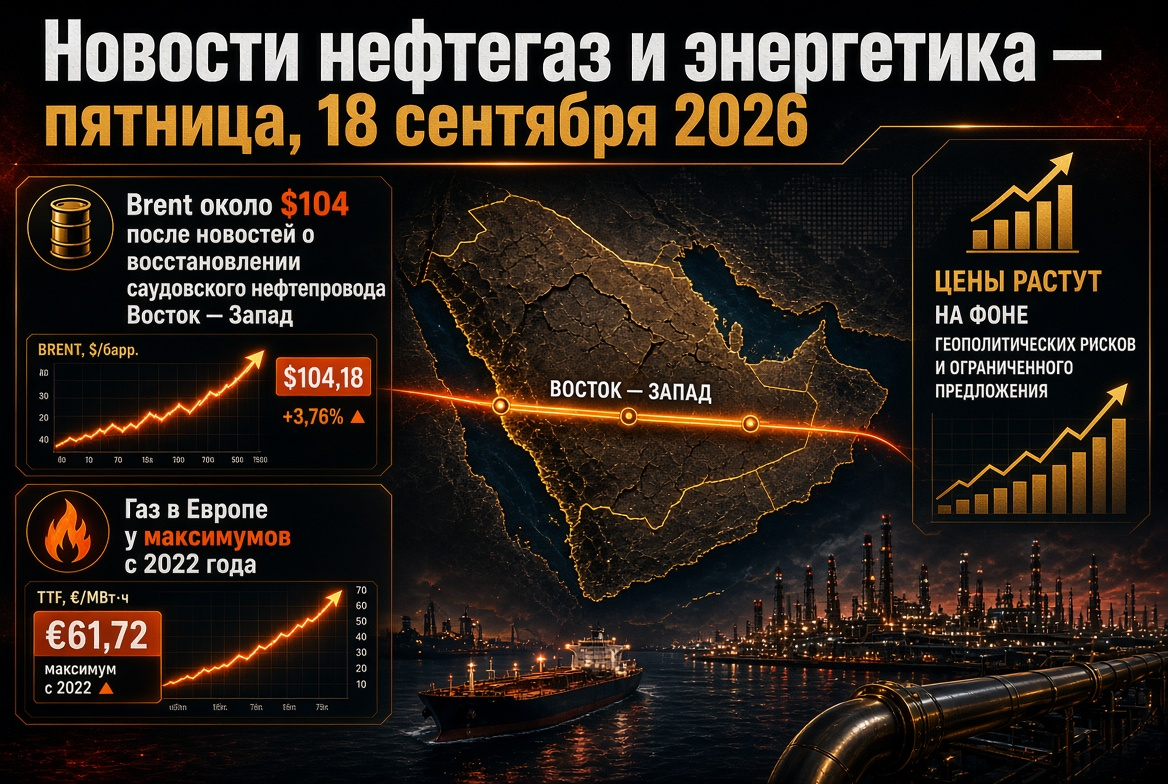
Current news in the oil, gas, and energy sector as of Saturday, December 20, 2025: oil, gas, electricity, renewable energy sources (RES), coal, refining (REF) and key trends in the global energy market.
By the end of December, significant changes are taking place in the global fuel and energy complex. Years-long lows in energy prices, combined with geopolitical shifts, create an ambiguous environment, capturing the attention of investors and market participants. On one hand, oil prices are trading close to the lowest levels in recent years amid expectations of an oversupply and positive signals regarding a peaceful resolution to the conflict in Eastern Europe. On the other hand, gas prices in Europe continue to decline, even with the onset of winter's cold, due to record inflows of liquefied natural gas (LNG). Simultaneously, global coal demand reached a record peak in 2025 and is likely to start a steady decline as the energy transition accelerates.
Against this backdrop, governments and major companies in the sector are adapting their strategies. Some are making efforts to alleviate the sanction-related confrontations and ensure stable fuel supplies, while others are increasing investments in both the traditional oil and gas sector and in green energy initiatives. Below is a detailed overview of the key events and trends in the oil, gas, power, and raw materials segments as of the current date.
Oil Market
The global oil market continues to face pressure, with prices holding around the lowest marks seen in recent years. The benchmark Brent crude is trading at around $60 per barrel (at times dipping below this psychologically significant threshold), while American WTI is around $55. These are the lowest levels since approximately 2020. Key factors contributing to the decline in oil prices include:
- Expected supply surplus: Forecasts for 2026 suggest that global production may exceed demand. Non-OPEC countries (primarily the US and Brazil) have ramped up production to record volumes. Simultaneously, global demand growth is slowing — industry estimates indicate an increase in oil consumption of about +0.7 million barrels per day in 2025 (compared to over +2 million bpd in 2023). This leads to stock accumulation and increases pressure on prices.
- Hopes for a truce in Ukraine: Progress in negotiations between Moscow and Kyiv has generated expectations for partial sanction relief and a return of some Russian oil exports to the market. The prospect of signing a peace agreement boosts forecasts for increased supply, further pushing oil prices down.
- OPEC+ Policy: After several months of gradual production quota increases, the OPEC+ alliance has decided to halt further increases in Q1 2026. The cartel is showing caution amid the risk of market oversupply and is expressing readiness to adjust production if necessary, although no official announcement of unscheduled actions has been made yet.
Collectively, these factors have led to oil prices being significantly lower than at the beginning of the year. There is a high likelihood that both Brent and WTI will finish 2025 at their lowest levels since mid-2020. The drop in raw material prices is already having a tangible impact on the petroleum products segment.
Petroleum Products and Refining Market
By year-end, prices for petroleum products have begun to decrease, following the decline in crude oil prices. Gasoline and diesel fuel have become cheaper in most regions of the world. In the United States, retail gasoline prices have dropped significantly across almost all states ahead of the holiday season, easing the financial burden on consumers. European refiners, having previously reoriented towards alternative feedstocks in place of Russian oil, have secured stable supplies. Global refineries are maintaining a high level of processing, benefiting from cheaper crude oil, although demand for fuel remains moderate. Overall, refining margins remain resilient, and there is no observed shortage of gasoline or diesel fuel in the global market.
In Russia, after a sharp spike in gasoline prices in early autumn, government measures (including temporary export restrictions) helped to cool the market. By December, wholesale and retail fuel prices stabilised within the country, reducing social tension and risks for the domestic petroleum products market.
Gas Market and LNG
The gas market is experiencing a paradoxical situation: despite an early and cold winter start, natural gas prices in Europe continue to decline. Prices at the Dutch TTF hub fell below €30 per MWh — the lowest level since spring 2024, approximately 90% lower than the peak values during the 2022 crisis and 45% lower than prices at the beginning of the current year. The main reason for this decline is the unprecedented inflow of liquefied natural gas, compensating for the reduction of pipeline supplies from Russia. Gas storage facilities in the EU are filled to about 75%. While this is below the average long-term levels for December, combined with record LNG imports, it is sufficient to maintain stable prices even in cold weather.
- Europe: Record levels of LNG imports have allowed gas prices to decrease, despite rising consumption during the heating season. In 2025, over half of Europe’s LNG imports came from suppliers in the US, redirecting tankers from Asian markets. Consequently, the spread between high European prices and lower American prices has significantly narrowed.
- USA: In North America, on the contrary, gas futures rose amid forecasts of abnormally cold weather. At the Henry Hub, prices rose above $5 per MMBtu due to the threat of polar vortex conditions and a spike in heating demand. Nevertheless, domestic gas production in the US remains at record high levels, which suppresses price increases as weather conditions normalise.
- Asia: By year-end, the Asian gas market appears relatively balanced. Demand in key countries in the region (China, South Korea, Japan) has been moderate, resulting in some additional LNG being redirected to Europe. Prices at Asian hubs, such as JKM, remained stable and avoided sharp fluctuations as competition between Europe and Asia for gas shipments has noticeably weakened compared to the situation in 2022.
Thus, the global gas market is entering winter with much more confidence than a year ago. Existing reserves and flexible supply channels are adequate to meet needs even during severe cold spells. The agility of the LNG market plays a crucial role: tankers are swiftly redirected to the required region, smoothing local imbalances. If the temperature conditions do not exceed the norm this season, the pricing situation for gas consumers will remain favourable.
Coal Sector
The traditional coal industry reached a historic high in consumption in 2025, but a slowdown is anticipated ahead. According to the International Energy Agency, global coal consumption has grown by approximately 0.5% — to a record 8.85 billion tonnes. Coal remains the largest source of electricity generation worldwide, but its share in the energy balance is expected to gradually decrease: analysts predict that global demand for coal will plateau, followed by a decline by 2030 due to the expansion of renewable energy sources and nuclear generation. Regional dynamics, however, vary:
- India: Coal consumption declined (only the third time in the last 50 years) due to an unusually strong monsoon season. Abundant rain increased hydroelectric generation and reduced demand for electricity from coal-fired power plants.
- USA: In the United States, on the contrary, coal use increased. This was facilitated by high natural gas prices in the first half of the year and political support for the coal industry. The new presidential administration in Washington has postponed the decommissioning of several coal-fired power plants, temporarily increasing demand for coal for electricity generation.
- China: The largest consumer of coal in the world has maintained its consumption levels similar to last year. China burns 30% more coal than the rest of the world combined. Nonetheless, a gradual decline in consumption is expected there by the end of the decade as enormous capacities in wind, solar, and nuclear energy come online.
Thus, 2025 is likely to mark the peak year for the global coal industry. Going forward, increased competition from gas (where feasible) and particularly from renewable sources will push coal out of the energy balance in many countries. However, in the short term, coal remains in demand in developing economies in Asia, where growth in energy consumption is currently outpacing the construction of new clean capacities.
Electricity and Renewable Energy Sources
The electricity sector continues to transform under the influence of climate agenda and fluctuations in fuel prices. In 2025, the share of renewable energy sources (RES) in global electricity generation reached new heights: many countries introduced record capacities of solar and wind power plants. For example, China substantially increased its solar generation, while new offshore wind farms and major photovoltaic projects were launched in Europe and the US, stimulated by government support and private investments. By year-end, global investments in green energy remain high, nearly equal to the investments in fossil fuels.
However, the rapid growth of RES poses challenges for ensuring the stability of energy systems. This winter in Europe witnessed the impact of variable weather: periods of low wind and short daylight hours increased the load on traditional generation. At the start of the season, EU countries were forced to temporarily increase gas and coal generation due to an anticyclone that caused a decline in output from wind farms, leading to price spikes for electricity in some regions. Nevertheless, thanks to the growth in RES capacity and a significant share of gas in the energy balance, serious issues with energy supply were avoided. Governments and energy companies are also actively investing in energy storage systems and modernising grids to smooth peak loads and integrate renewable energy.
The climate commitments of countries continue to shape the direction of the industry. At the recent global climate summit (COP30) in Brazil, calls were made to accelerate the energy transition. Several countries agreed to triple the deployment of RES capacities by 2030 and significantly enhance energy efficiency. Simultaneously, interest in nuclear energy is reviving in many regions: new nuclear power plants are being constructed, and the operational life of existing ones is being extended to provide baseload generation without carbon emissions. Overall, the electricity sector is progressing towards a cleaner and more sustainable future, although the transition period requires a delicate balance between supply reliability and environmental goals.
Geopolitics and Sanctions
Geopolitical factors continue to exert a substantial influence on global energy markets. The focus remains on the conflict in Eastern Europe and the associated restrictions:
- Peace negotiations: In December, significant progress began to emerge in peace negotiations regarding Ukraine since the start of the conflict. The US has expressed readiness to offer Kyiv security guarantees akin to those of NATO, and European mediators are noting a constructive shift in dialogue. Hopes for achieving a ceasefire have noticeably increased, although Moscow asserts that it will not agree to territorial concessions. Growing optimism regarding a possible cessation of hostilities has already sparked discussions about the prospects for partial lifting of oil and gas sanctions against Russia in the foreseeable future.
- Sanction pressure: Concurrently, Western countries have indicated their readiness to intensify pressure if the peace process stagnates. Washington has prepared another package of restrictions against the Russian energy sector that could be implemented should negotiations falter. Earlier in the autumn, the US and UK expanded sanctions against oil giants “Rosneft” and “Lukoil,” complicating their access to investments and technology. In Europe, there is also an escalation of legal measures against Russian energy infrastructure: in early December, a court in the Netherlands, at the behest of the Ukrainian side, seized the assets of the operator of the “Turkish Stream” pipeline, demonstrating a new level of sanction pressure on export routes.
- Infrastructure risks: Hostilities and sabotage continue to pose threats to energy facilities. The Ukrainian side has ramped up drone attacks on oil infrastructure deep within Russian territory in the past week. Specifically, there have been reports of fires at oil refineries in the Krasnodar region and along the Volga as a result of drone strikes. Although these incidents only slightly reduce total fuel supply, they highlight the ongoing military risks to the industry until a durable peace is achieved.
- Venezuela: In Latin America, geopolitics also affect the oil market. Following partial easing of sanctions against Venezuela in the autumn, the US has tightened oversight of compliance with deal conditions. In December, an incident occurred involving the detention of a tanker carrying Venezuelan oil under suspicion of violating licensing terms. The state company PDVSA found itself facing demands from buyers to increase discounts and reconsider supply terms. This has complicated Caracas’s efforts to boost exports, despite the recent US authorisation to temporarily increase production in exchange for political concessions from Venezuelan authorities.
Overall, the sanction standoff between Russia and the West, along with other international disagreements, continues to inject uncertainty into the global energy complex. Investors are closely monitoring political events, as any changes — from breakthroughs in peace dialogue to the imposition of new restrictions — can significantly affect oil, gas, and other energy prices.
Corporate News and Projects
The world’s largest energy companies and infrastructure projects are concluding the year with several important decisions and events:
- Aramco enters the Indian market: Saudi Aramco has renewed plans to invest in a major refining complex in India. The company is nearing the acquisition of a stake in the West Coast Refinery project, aiming to establish a foothold in the rapidly growing Indian market and to secure long-term sales channels for its oil.
- New project in Guyana: A consortium led by ExxonMobil has approved the development of another large offshore oil field in Guyana, targeting production start-up by 2028. Oil production in Guyana continues to rise rapidly, strengthening the country's position as one of the most dynamically developing new oil producers.
- Record wind farm in the North Sea: The largest offshore wind farm in the world, Dogger Bank, with a total capacity of 3.6 GW, has been completed in the North Sea. The project was realised by a consortium of European energy companies and has the capacity to provide electricity to up to 6 million households in the UK. This milestone demonstrates the potential for large-scale green projects and marks an important step in the development of renewable energy.
- Transnational oil transit: Russia's Transneft and Kazakhstan's KazTransOil have signed a contract for the transportation of Kazakh oil across Russian territory in 2026. The agreement ensures continued cooperation on hydrocarbon exports despite geopolitical challenges, utilising existing pipeline infrastructure.
Overall, players in the oil, gas, and energy sectors are adapting to a new market reality. Some are rethinking their asset portfolios in light of geopolitical risks and shifting market conditions (like Aramco, which is exploring new sales markets), while others are taking advantage of favourable circumstances to boost production and advance projects (such as ExxonMobil with partners in Guyana). Concurrently, investments are ongoing in both traditional oil and gas fields and in the energy transition — from wind energy to hydrogen technology. The industry is faced with the necessity of seeking a balance between short-term profitability and long-term decarbonisation goals, and this choice is shaping the key strategic decisions of companies as they approach 2026.