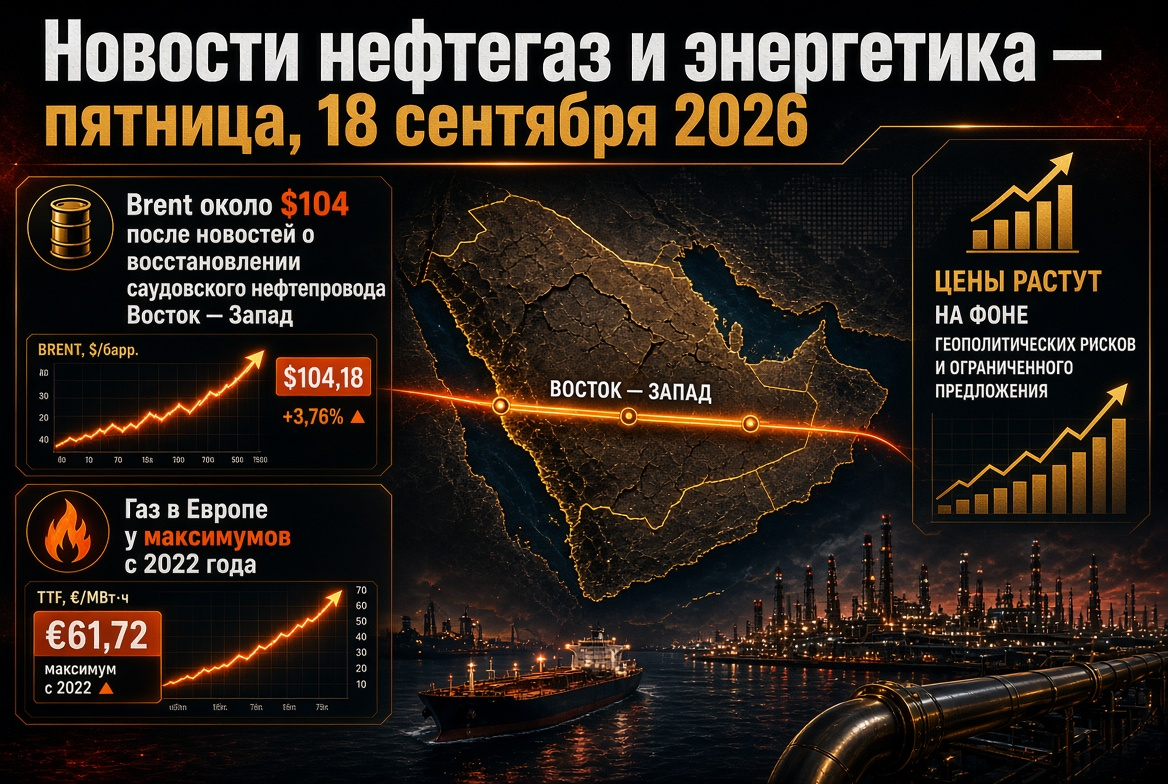
Current News in the Oil, Gas, and Energy Markets as of 19 November 2025: Decline in Oil Prices, Increase in Gas Demand Ahead of Cold Weather, Intensification of Sanctions, Dynamics of Renewable Energy Sources, Situation with Oil Products, and Refining. Analysis for Investors and Participants of the Fuel and Energy Sector.
The current events in the oil, gas, and energy sectors as of 19 November 2025 are influenced by contradictory factors. **Oil prices** remain under pressure due to oversupply: Brent quotes are hovering around local lows ($63–64 per barrel, with **WTI** around $59–60), reflecting a surplus in the market. Simultaneously, the European **gas market** has experienced a price lull amid full storage facilities and a mild autumn—gas prices fell to one-and-a-half-year lows (~$370 per thousand cubic meters), although the anticipated severe cold snap in Europe brings back volatility and sustains demand. On the geopolitical level, **sanction pressure** is intensifying: the West is preparing new restrictions against Russian energy exports, which are already altering global oil trade flows. Meanwhile, the **global energy transition** is gaining momentum—investments in renewable sources are hitting records, even as traditional resources continue to play a key role in meeting global demand. In Russia, emergency government measures have stabilised the domestic fuel market after a recent crisis, normalising supply to petrol stations. Below is a detailed overview of key segments of the industry—including oil, gas, geopolitics, electricity, the coal sector, renewables, as well as the market for oil products and refining.
Oil Market: Oversupply Pressures Prices
The global **oil market** is entering winter showing signs of saturation. After a brief rebound last week, prices have stagnated at lower levels once again: Brent is trading in the $60–64 per barrel range, significantly below the values from a month ago and approximately 10–15% lower than a year ago. The primary factor is the pre-emptive rise in supply against a backdrop of slow demand, creating an oil surplus that suppresses quotes. Global energy stocks remain high, and traders are factoring in a scenario where the oversupply persists in Q4.
- OPEC+ and Other Producers’ Output: The oil alliance OPEC+ has systematically increased production in 2025, returning previously restricted volumes to the market. Since the beginning of the year, combined global output has risen by around 5–6 million barrels per day, mainly due to OPEC+ countries and record output increases in the US and Brazil. While prices remain above critical sustainable levels (~$50), alliance members are in no rush to announce new cuts. However, OPEC+ representatives have indicated they are prepared to lower production again in 2026 if prices fall too low.
- Demand and Economic Situation: Global oil consumption growth has slowed due to weak macroeconomic dynamics. Economic slowdowns in China, high interest rates in the US and EU, and energy-saving measures—all these factors are restricting demand growth. It is forecasted that global oil consumption will increase by less than +0.8 million barrels per day in 2025 (for comparison: +2 million barrels per day in 2023). Nevertheless, certain segments remain resilient: the onset of the heating season is supporting demand for oil products (diesel, fuel oil), while air transport and road traffic are gradually increasing.
- Geopolitical Risks: Tensions arising from sanctions and conflicts are felt occasionally, though their impact tends to be short-lived. For example, last week’s drone attack on the Novorossiysk port temporarily interrupted exports, causing prices to spike by more than 2%. However, the prompt recovery of shipments returned the market to a downward trend. In general, acute incidents currently only provide short-term price support, yielding to the more significant fundamental factors that drive the market’s oversaturation.
Gas Market: Cold Weather in Europe and the Role of LNG
The **gas market** in the departing autumn has seen relative stability, but the approaching winter brings new adjustments. Europe heads into the heating season with considerable reserves: underground gas storage is filled to about 85–90% capacity, which provides a solid cushion. Due to mild weather in September and October, European gas prices fell to their lowest levels since spring 2024—TTF futures dipped below €31 per MWh (~$370 per 1,000 cubic meters). However, forecasts of a severe cold snap in Western Europe (5–7°C below normal) have led to price increases from the lows reached: as the cold weather approaches, demand for heating gas is rapidly increasing, driving the market upwards.
- Balance of Demand and Stock Levels: Meteorologists expect significant gas consumption increases in the coming weeks due to the cold weather. If winter proves harsh, even record reserves may only last until the end of the season—the accelerated draw from gas storage could trigger a new round of price increases and necessitate increased imports. Nevertheless, the current level of demand in the EU is still below pre-crisis levels: industries and households that experienced the energy crisis in 2022-2023 have implemented conservation measures. This provides hope that with a moderate winter, the existing reserves will be sufficient to meet peak demand without fuel shortages.
- Role of LNG and External Supplies: The key stability factor remains liquefied natural gas (LNG) imports. European companies continue to secure large volumes of LNG from various regions—from the USA and Qatar to Africa. Record LNG exports from the US and growing capacities in the Middle East have ensured high supply levels on the global market, keeping spot prices relatively low. Meanwhile, demand in Asia remains subdued: the economies of China and other regional countries are cooling, and storage in East Asia is full, hence no competition between Europe and Asia for LNG cargoes is currently observed. This situation has allowed additional tankers to be directed to the EU and smoothed seasonal fluctuations. Alternative pipeline supplies to Europe also remain stable: Norway, Algeria, and other exporters continue to cover a significant portion of the EU's needs, compensating for the absence of Russian gas.
International Landscape: Sanctions and the Reorientation of Energy Exports
**Geopolitical factors** continue to significantly impact the fuel and energy sector. In November, the West intensified sanction pressure on the Russian oil and gas sector. **The US** imposed strict restrictions on the largest Russian oil companies, including "Rosneft" and "Lukoil," setting a deadline of 21 November for completing any operations with them. Consequently, major Asian importers began to adjust their actions: several Indian refiners have suspended new purchases of Russian oil for December deliveries, while Chinese state-owned companies have temporarily reduced their purchases of seaborne cargoes. These steps from Russia’s two main customers are forcing Moscow to offer even larger discounts to sell volumes—the Urals discount reached approximately $4 to Brent (the highest in a year). **The European Union** has simultaneously prepared the 18th sanctions package, which provides for further restrictions: from tightening the price cap on oil (discussions are focused on lowering it to ~$47 per barrel) to sanctions against the tanker "shadow fleet" and specific foreign refineries related to processing Russian raw materials. Although the effectiveness of these new measures is limited (Russia is actively reorienting its exports to friendly countries and using alternative logistics), uncertainty regarding sanctions is diminishing investment activity and forcing companies to restructure supply chains.
Against this backdrop, there is a reorientation of global **energy flows**. Russian oil and oil products’ exports are increasingly shifting toward Asia, the Middle East, Africa, and Latin America, compensating for the fall in supplies to Europe. **India**, which previously increased its imports of Russian oil due to substantial discounts, is now under external pressure to diversify its sources and is striving to reduce dependency on a single supplier in the long term. The country has launched programmes to increase its domestic production—national companies are drilling new deep-water wells to strengthen energy security. **China** continues to be the largest buyer of Russian hydrocarbons, not joining western restrictions, but Beijing is also increasing domestic oil (+1-2% per year) and gas production (+5-6% per year) to reduce imports. At the same time, Chinese importers and the state are concluding long-term contracts for supplies from various countries (Middle East, Latin America, USA—via LNG) to diversify risks. Thus, global energy commodity trading is gradually being restructured: Russia is compelled to explore new markets, offering competitive terms, while major consumers balance between energy profitability and geopolitical considerations.
Positive signals for the markets have come from certain steps towards easing international relations. In the Middle East, a fragile truce persists in one of the protracted conflicts, reducing the risk of oil supply disruptions from the region. Moreover, the US and China reached a temporary trade truce during the recent summit, easing mutual tariffs—this improves forecasts for the global economy and energy demand. However, there are no fundamental breakthroughs in resolving the major geopolitical crises, meaning that sanctions and trade restrictions will continue to be significant factors for the fuel and energy sector in the near future.
Electricity: Strain on Grids and Record Generation
The global **electricity sector** in 2025 exhibits resilience in the face of increasing loads and changes in the generation structure. Many countries are setting new records for electricity consumption: an unusually hot summer has led to a surge in demand for air conditioning, while winter may bring peak loads during cold spells. Simultaneously, the rapid transition to low-carbon generation continues—the share of renewable sources (solar and wind power plants) is steadily increasing, setting historical maximum generation rates in the energy balances of several countries. In the first half of 2025, global generation from renewables is estimated to have, for the first time, exceeded generation from coal-fired power plants. In certain economies (EU, US, China), on some days, up to 80–100% of electricity comes from solar, wind, and other **renewables**. This reflects significant progress in the energy transition but presents new challenges in ensuring the stability of energy systems.
- Reliability and Capacity Reserves: The rapid growth of solar and wind generation requires infrastructure modernization. Due to the variable nature of renewables, particular attention is being paid to the development of energy storage systems (industrial batteries, pumped storage stations) and backup capacities. To cover peak loads during cold winter evenings and calm periods, gas and coal power plants continue to be engaged, although their role is gradually diminishing. Energy companies are investing in "smart" grids and demand management systems to avoid overloads. Despite extreme temperatures and record consumption, energy systems in developed countries generally passed the tests in 2025 without mass blackouts, instilling confidence ahead of the upcoming winter.
- Government Policy: Governments of leading economies are supporting the trend towards decarbonisation of the electricity sector. In the European Union, new targets for the share of renewable energy by 2030 have been set, stimulating the construction of wind farms and solar stations. In the US, subsidy and tax incentive programmes for clean energy continue to operate, although their parameters may be revised depending on the political situation. China and India are implementing large-scale state projects aimed at developing electricity grids and storage facilities while also increasing their generation from renewables and nuclear energy. There is a growing interest in innovative technologies—ranging from green hydrogen to new modular nuclear reactors—as promising elements of future energy systems.
Coal Sector: Demand Plateau and Pressure on Production
The global **coal sector** is at a turning point. Following several years of growth, coal consumption has reached a historically high level and is beginning to stabilise. By the end of 2024, global coal consumption reached a record of around 8.8 billion tonnes, but in 2025 this figure is no longer increasing—demand has effectively plateaued. Increased environmental policies and competition from cheap renewables are prompting many countries to abandon plans for expanding coal generation. International forecasts align in predicting that a gradual decline in coal consumption will begin in 2025-2026 as the energy transition accelerates.
- Oversupply and Prices: Despite the stagnation of demand, global coal production remains close to its maximum. Major producers (China, India, Indonesia, Australia) maintain high production levels, and some exporters have even increased volumes, trying to capitalise on last year's high prices. This has led to excessive stockpiling in the market, causing coal prices to drop to their lowest levels in recent years. Companies with high costs are particularly affected by this pressure. Many coal mines in the US and Europe are cutting production, while exporters in Russia are facing profit declines due to falling raw material prices and sanctions restrictions on supplies. The market situation is forcing players to reassess investment plans: new projects are being frozen, and existing capacities are being optimised to suit lower demand.
- Transition Period Strategy: Although coal remains an important part of the energy balance in several countries (especially in Asia), the industry is preparing for a long-term decline. Governments are imposing progressively stricter environmental standards, encouraging power plants to transition to gas and renewables, and implementing carbon taxes. Major energy companies are announcing goals to cease coal generation by 2030-2040. Meanwhile, some developing economies are seeking financial support to transition away from coal: investment programmes are being discussed at international forums to replace coal capacities with clean energy without compromising energy security. Thus, the coal sector is facing dual pressures—market and regulatory—and has already entered a phase of structural decline.
Renewable Energy: Record Investments and Climate Goals
**Renewable energy** continues to set new highs, becoming the main driver of industrial development. The year 2025 promises to be record-breaking in terms of the addition of **renewable energy** capacity: it is projected that around 600–700 GW of new generating capacity based on solar, wind, and other sources will be added globally—more than in the previous year 2024 (when around 580 GW were added). The solar and wind energy sectors are attracting significant investment worldwide as countries strive to meet their climate commitments. However, experts note that to achieve the Paris Agreement goals, the pace of "green" generation installation must accelerate—potentially tripling annual volumes by the end of the decade.
- International Climate Agenda: At the upcoming COP30 summit, world leaders will discuss further strengthening measures to combat climate change. Many countries are already reporting plans to increase the share of renewables in their energy balance by 2030 (the EU, China, India, and the USA are revising their goals upwards). An initiative to completely phase out coal generation is being discussed for the coming decades. Meanwhile, challenges remain—from the need to upgrade electricity grids to securing raw materials for the production of solar panels and batteries. Despite certain obstacles (e.g., cuts in subsidies in some jurisdictions), the global trend towards the transition to clean energy is considered irreversible: **renewable technologies** are becoming cheaper, attracting interest from investors.
- Records and Technologies: 2025 has marked significant achievements in the sphere of renewables. In certain regions (for instance, in South Australia and parts of Europe), wind and solar stations supplied 100% of electricity demand for several hours, showcasing the potential of a decarbonised system. Innovation continues to be implemented: the largest energy storage systems in the world are being built to smooth out generation fluctuations, and projects for "green" hydrogen for storing excess electricity are being developed. Offshore wind, floating solar, and geothermal sources are all broadening the arsenal of renewable energy options. Collectively, the share of renewable energy in global electricity generation is closely approaching 35–40%. It is anticipated that within a few years, more than half of the increase in energy consumption will be covered precisely through renewables, thereby reducing economic dependence on fossil fuels.
Refining and Fuel Market: Stabilisation After the Crisis
Following the volatility at the start of autumn, the global **oil product** market is showing signs of stabilisation. The decline in oil prices and the end of the summer holiday season have allowed refineries to increase fuel output and replenish gasoline and diesel stocks. In Europe and the USA, wholesale fuel prices have declined from their peaks in September, reflecting down to the consumer level—the retail prices for gasoline and diesel have moderately decreased compared to early autumn. Thus, ahead of winter, the situation on external fuel markets is more balanced than it was a couple of months ago.
- Global Refining: During the autumn, refiners worldwide increased their capacity utilisation, benefiting from a respite in price hikes. The export of oil products from Middle Eastern and Asian countries partially compensated for lost volumes from Russia, where restrictions were in place. Additionally, the seasonal factor has taken effect: the conclusion of the peak summer gasoline demand has enabled the accumulation of reserve volumes. As a result, in key markets (North America, Europe), wholesale prices for gasoline and diesel have reverted to early summer 2025 levels. It is expected that winter consumption of distillates (diesel, fuel oil) will increase for heating purposes, but without sharp price increases for fuel if oil prices remain stable.
- Russian Fuel Market: Internally, the situation was stabilised after the September gasoline crisis. The Russian government implemented emergency measures: a ban on gasoline exports was introduced, and diesel fuel exports were sharply restricted, with oil companies ordered to prioritise the domestic market. These steps yielded swift results—as of November, wholesale market prices had significantly decreased from their peaks, while retail prices at petrol stations ceased to rise. The shortage of gasoline grades A-92 and A-95 in affected regions has been eliminated, and stations are replenished with the necessary resources. Authorities extended the gasoline export ban until the end of December to ensure stability, while simultaneously developing long-term mechanisms to prevent similar crises (adjustment of the damping mechanism, encouraging refineries to increase fuel output in the inter-season, etc.). In general, refining in Russia has restored its previous levels, allowing for confidence in navigating the winter period without supply interruptions to consumers.
Thus, as of 19 November 2025, the oil and gas and energy markets are characterised by relatively moderate prices and stable supplies, despite the ongoing risks of sanctions and weather challenges. Investors and market participants in the fuel and energy sector are closely monitoring the developments—from OPEC+ decisions and winter weather forecasts to the outcomes of international negotiations and climate summits—as these factors will determine the dynamics of energy prices and the state of the industry in the coming months.