News on Oil and Gas and Energy as of 23 July 2026: Brent over $94 Amid the Blockade of the Strait of Hormuz, Gas TTF Exceeds €60/MWh, OPEC+ Quotas for August, Stabilisation of the Russian Fuel Market, LNG, Refineries, Electricity, Renewables, and Coal. Overview for Investors and Energy Market Participants
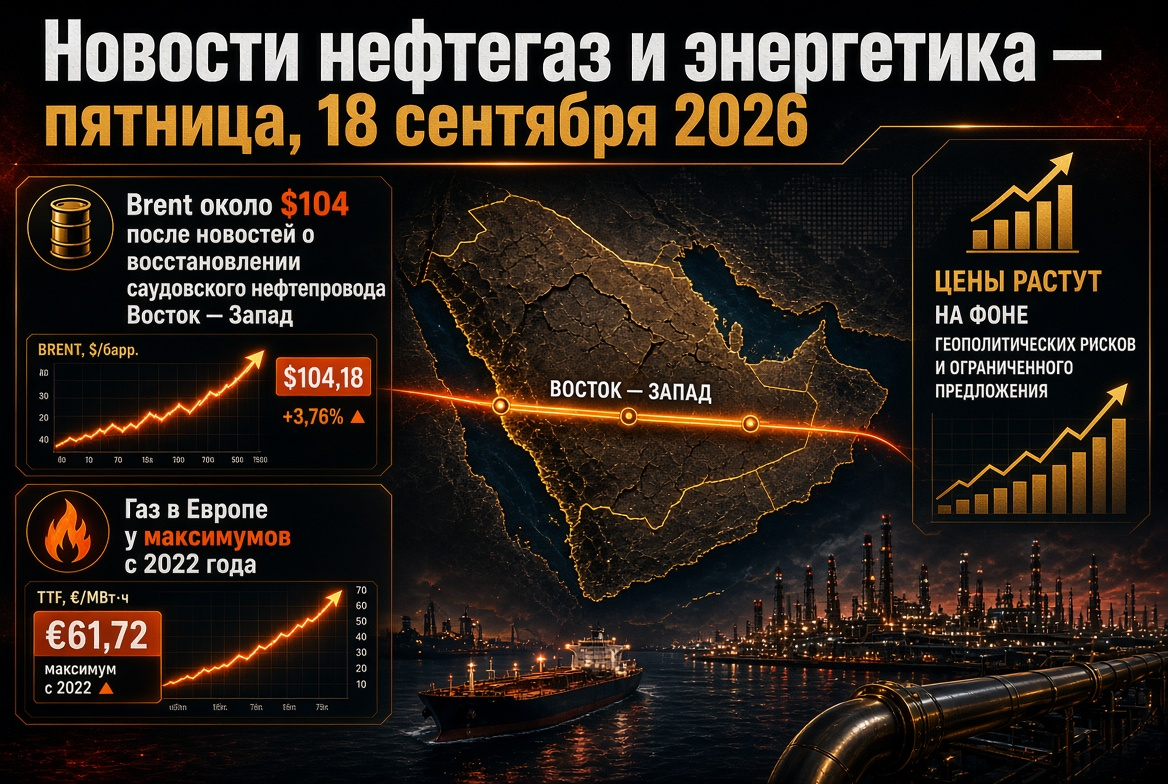
The global energy market has entered the end of July 2026 in a state not seen by traders since spring: the geopolitical risk premium has returned to prices in full force. The escalation of the US-Iran conflict, the effective halting of shipping through the Strait of Hormuz, and the maritime embargo by the Houthis against Saudi Arabia have pushed Brent crude above $94 per barrel—a six-week high. European gas prices at the TTF hub have exceeded €60 per MWh for the first time since March, with injections into underground storage lagging behind last year's schedule. Against this backdrop, OPEC+ is maintaining a cautious strategy of increasing quotas, the Russian fuel market is gradually emerging from a critical gasoline shortage phase, and the global energy transition is facing a new reality: expensive LNG is restoring coal's place in the energy balance of Asia. Below is a detailed overview of key developments in the oil, gas, electricity, coal, and raw materials markets for investors and energy sector participants.
Oil Market: The Geopolitical Premium Returns to Prices
Oil prices are demonstrating their most aggressive upward movement since early summer. On 22 July, the cost of September futures for Brent crude on the London ICE exchange rose by more than 3%, reaching $94.14 per barrel—marking the first time since 11 June. WTI also rose by over 3%, approaching $87 per barrel. For comparison, on 2 July Brent was trading below $71, and in mid-June, it was around $80.5. Thus, in three weeks, the market has recovered over 30% of its value.
Drivers of the current oil rally:
- Blockade of the Strait of Hormuz. According to shipping traffic data, there were days last week when no vessel crossed the strait, through which approximately one-fifth of global maritime oil trade and a significant portion of LNG passes.
- Direct attacks on tanker fleets. Incidents of fires and immobilisation of oil tankers have been recorded during attempts to transit via southern routes, along with an instance where the crew was forced to abandon the vessel.
- Maritime embargo by Houthis. Yemeni forces have announced a blockade on supplies from Saudi Arabia, jeopardising the export flows of the largest OPEC producer.
- Widening front. The US is increasing its military presence in the region by deploying additional aircraft at bases in Israel; the market is factoring in the risk of Washington's full-scale involvement in the conflict.
- Declining inventories. The IEA has reported a decrease in global commercial oil inventories, which increases price sensitivity to any supply disruptions.
What This Means for Investors
The widening Brent-WTI spread to $7–9 per barrel is a classic indicator that the market is assessing the risk of disruption specifically to Middle Eastern logistics, rather than a global supply deficit as such. For oil companies with a diversified resource base outside the Persian Gulf, this signifies a temporary margin expansion. For oil traders and fuel companies, there is a sharp rise in freight and insurance rates, which are already eroding part of the price gains.
OPEC+: Cautious Quota Increases Instead of a Price War
The OPEC+ alliance is maintaining a conservative stance. Following a videoconference on 5 July, seven countries voluntarily cutting production beyond the overall quotas—Saudi Arabia, Russia, Iraq, Kuwait, Kazakhstan, Algeria, and Oman—agreed to increase quotas for August by 188,000 barrels per day. The total quota for the alliance in August will be 36.019 million b/d. Saudi Arabia and Russia will receive an increase of 62,000 b/d each.
Key parameters of the agreement at present:
- From February to August 2026, the cumulative quota has risen by approximately 940,000 b/d—a volume comparable to the output of an average-sized member country.
- The “seven” is returning to the market limitations amounting to 1.65 million b/d considering the UAE's departure from the alliance in May due to dissatisfaction with quota distribution.
- To fully phase out voluntary restrictions, September quotas need to be raised by another 188,000 b/d. The next meeting is scheduled for 2 August.
- Iraq has publicly indicated it may withdraw from the agreement if there is a refusal to raise its production limit—a factor reflecting the internal fragility of the alliance.
The dilemma for OPEC+ in the second half of the year is evident: analysts predict a return to a structural surplus of supply following the normalisation of the situation in the Persian Gulf. The alliance will have to choose between withholding production for price stability and fighting for market share. Thus far, the current geopolitical premium has masked this choice.
Gas Market: Europe Paying a Premium and Lagging in Injection Rates
The European gas market is under double pressure. Prices at the Dutch TTF hub exceeded €60 per MWh for the first time since mid-March on 20 July before correcting to €59 on Tuesday. In dollar terms, the price approached $700 per thousand cubic meters. Since early July, the European gas benchmark has risen by about 35%, while the Asian JKM Platts index has increased by around 25%.
The primary issue for the European Union is not so much price as the pace of filling underground gas storage:
- The heating season 2025–2026 ended with extremely low reserves: as of 1 April, UGS were filled to 27.66%—13.4 percentage points below the average over the previous five years.
- As of 19 July, the fill level had only reached 53.7%, 15.7 percentage points below the five-year average. The gap is not closing but rather expanding.
- Daily injections in July decreased to 270 million cubic meters from 308 million in June. A year ago, during the summer, the average daily replenishment was 338 million cubic meters—25% higher.
- Competition for LNG cargoes is shifting in favour of Asia, where liquefied gas is needed for current consumption rather than for replenishing reserves.
Risk Scenario for Autumn
Industry experts do not expect a repeat of the peaks seen in 2022–2023; however, they do acknowledge that if the conflict in the Persian Gulf persists, prices could exceed $1000 per thousand cubic meters. An additional risk factor is the anticipated peak of El Niño in December, which could alter the heating season profile. For European industry, energy sectors, and fertiliser producers, this means the necessity for hedging now.
LNG: Record Spike in New Capacities on the Horizon for 2026–2028
Despite the current tensions, the medium-term outlook for the liquefied natural gas market looks fundamentally different. According to the IEA, from 2026 to 2028, the global LNG market is expected to witness the largest capacity increase in history. Projects in the USA, Qatar, Canada, and several other jurisdictions are nearing launch. Investments in LNG infrastructure are on a stable upward trajectory—unlike investments in oil production, where an annual decline of about 6% has been recorded for the first time since 2020, predominantly due to decreased spending in the American shale industry.
The practical takeaway for market participants is that the current price surge is predominantly logistical and geopolitical in nature. Structurally, the gas market is moving towards a supply surplus in the latter half of the decade, creating asymmetry between spot prices and long-term contractual expectations.
Gas Demand: IEA Forecasts a Decline in 2026
The International Energy Agency has revised its forecast for global natural gas demand downwards. The regional picture has shown mixed trends:
- Asia: demand is expected to decrease by approximately 0.5%. Expensive LNG is encouraging a switch back to coal generation and weakening activity in energy-intensive industries.
- The Middle East: the sharpest decline of around 4% due to the direct impact of conflict on infrastructure and production.
- Eurasia: a growth of approximately 3%.
- Central and South America: an increase of about 3% amid decreasing hydropower production.
Price elasticity of gas demand has proven to be higher than anticipated: at elevated prices, consumers in developing economies are quickly reverting to coal. This is a key factor constraining the ceiling on gas prices even under geopolitical stress.
Russian Fuel Market: Exiting the Acute Phase of the Fuel Crisis
The domestic market for petroleum products in Russia is undergoing one of its most challenging periods in recent years. The cause is the reduction in primary processing: in June and July, the operations of several major plants, including the Omsk and Saratov refineries, as well as the NORSI complex, have been suspended or limited due to infrastructure damage and unscheduled shutdowns.
Consequences for the fuel market:
- Wholesale exchange prices for diesel fuel on the SPbMTSB have surpassed historical highs, while trading volumes for AI-95 during certain periods have dropped to 43%.
- Several regions have introduced restrictive mechanisms for fuel sales, including an odd-even scheme; in resort regions like Krasnodar Krai, Crimea, and the Caucasus, seasonal demand has intensified the imbalance.
- Retail prices at major petrol station networks have remained within inflation limits, while independent filling stations have charged considerably higher prices.
Regulator Measures and Early Signs of Stabilisation
- Export Ban: the export of gasoline and diesel has been banned until 31 July, with discussions ongoing regarding an extension.
- Exchange Sale Normative: the mandatory share of sales through the exchange has been reduced from 15% to 10% to increase the flexibility of direct supplies.
- Import Substitution: Belarus has redirected volumes of gasoline to the Russian market—during 1–25 June, imports reached a historical maximum of 141,000 tonnes. Kazakhstan, which processes 15–17 million tonnes of oil per year, is also being considered as a potential supplier.
- Resumption of Exchange Sales: some refineries have returned to fuel sales on the exchange, wholesale trading volumes are increasing, unmet demand is declining, and the situation at some petrol stations is stabilising.
The priority for ensuring the domestic market remains at the level of the relevant Deputy Prime Minister. Official estimates suggest that normalisation will occur by August as repairs at refineries are completed. Industry experts are more cautious and allow for a shift in timelines, noting that the supply constraint is of a temporary nature: price reductions are possible in two to three months after addressing processing issues.
Electricity and Renewables: Record Investments Amid Increasing Flexibility Requirements
The global electricity sector is undergoing a structural transformation. Total global investments in energy have exceeded $3.3 trillion, with investments in clean technologies—renewable energy, networks, storage, and nuclear generation—doubling investments in fossil fuels, which account for approximately $1.1 trillion. Solar photovoltaic energy is attracting more capital than any other technology in the energy sector. Investments in the energy transition reached $2.3 trillion in 2025.
Key trends in the electricity sector:
- Renewables and nuclear are overtaking coal in the global generation energy balance—a pivotal moment acknowledged in the IEA forecasts.
- Data centres as a new driver of demand: in North America, electricity consumption is growing at around 2%, primarily driven by computing infrastructure and AI workloads.
- Asia sets the pace: India is demonstrating an electricity demand increase of approximately 6.6%—the largest contribution to global dynamics.
- Nuclear renaissance: more than a hundred reactors in France and the US are delivering record nuclear generation volumes, while Japan is steadily returning decommissioned units to operation.
- Flexibility deficit: the rising share of variable generation necessitates proactive investments in energy storage systems and network upgrades—without these, supply reliability declines.
Coal: The Fuel of Last Resort Returns to the Game
Despite the long-term trend towards decarbonisation, the coal market has received short-term support from the gas crisis. The mechanism is direct: expensive LNG in Asia is making coal generation economically preferable, as evidenced by the reduction in regional gas demand. Developing economies in the Asia-Pacific region continue to rely on coal as a means of ensuring baseload and energy security.
For investors, this creates a characteristic asymmetry: coal assets demonstrate strong cash flows during periods of energy stress but remain under structural pressure from climate regulation and capital costs. The largest exporters—Indonesia, Australia, Russia, and South Africa—maintain their ability to quickly ramp up supplies, limiting the potential for a price rally in the coal market.
Raw Materials Sector and Logistics: Insurance Premiums as a Hidden Tax
Market participants should pay particular attention to the transformation of transport and logistics costs. Military dangers in the Strait of Hormuz are being transmitted to the market through several channels:
- Freight rates for VLCC tankers are rising as the number of shipowners willing to operate in risky areas decreases.
- Insurance premiums for war risks are being revised upwards, effectively creating an additional tax on every barrel of Middle Eastern oil.
- Route elongation and the redirection of flows are increasing fleet turnover times, thereby reducing the effective supply of tonnage.
- Reassessment of delivery premiums in favour of producers outside the Persian Gulf—West Africa, Latin America, the North Sea.
Governments in several countries are already preparing for potential disruptions in energy resource supplies by reassessing strategic reserves parameters. Simultaneously, regional intermediaries are making attempts to negotiate a ten-day ceasefire between Washington and Tehran, which could provide a basis for new negotiations. Tehran is considering the proposal, but final agreement has yet to be reached.
Forecast and Conclusions for Energy Market Participants
The current configuration of the global energy market is characterised by the overlay of a short-term geopolitical shock on a medium-term trend towards a supply surplus. Practical guidelines:
- Oil: the Brent price range of $85–95 per barrel will persist until clarity on shipping conditions in the Strait of Hormuz is achieved. A ceasefire agreement can swiftly strip $10–15 off the premium.
- Gas: TTF quotes are expected in the range of €55–65 per MWh, with the risk of moving higher under an adverse autumn scenario. A key indicator for monitoring will be the daily injection rates into European UGS.
- Oil Products in Russia: a gradual restoration of balance as repairs at refineries are completed; the issue of extending the export ban beyond 31 July remains the main regulatory risk.
- Electricity Sector: investment focus is shifting from generation to networks, storage, and flexibility sources—this is where the deficit is forming.
- Coal: tactical support from expensive gas while maintaining long-term structural pressure.
For investors, fuel and oil companies, the key skill in the current conditions becomes not predicting the price direction but managing volatility: revising hedging strategies, stress-testing logistics chains, and reassessing counterparty risks in areas of heightened military danger. The energy market has entered a phase where speed of response is more important than accuracy of forecast.