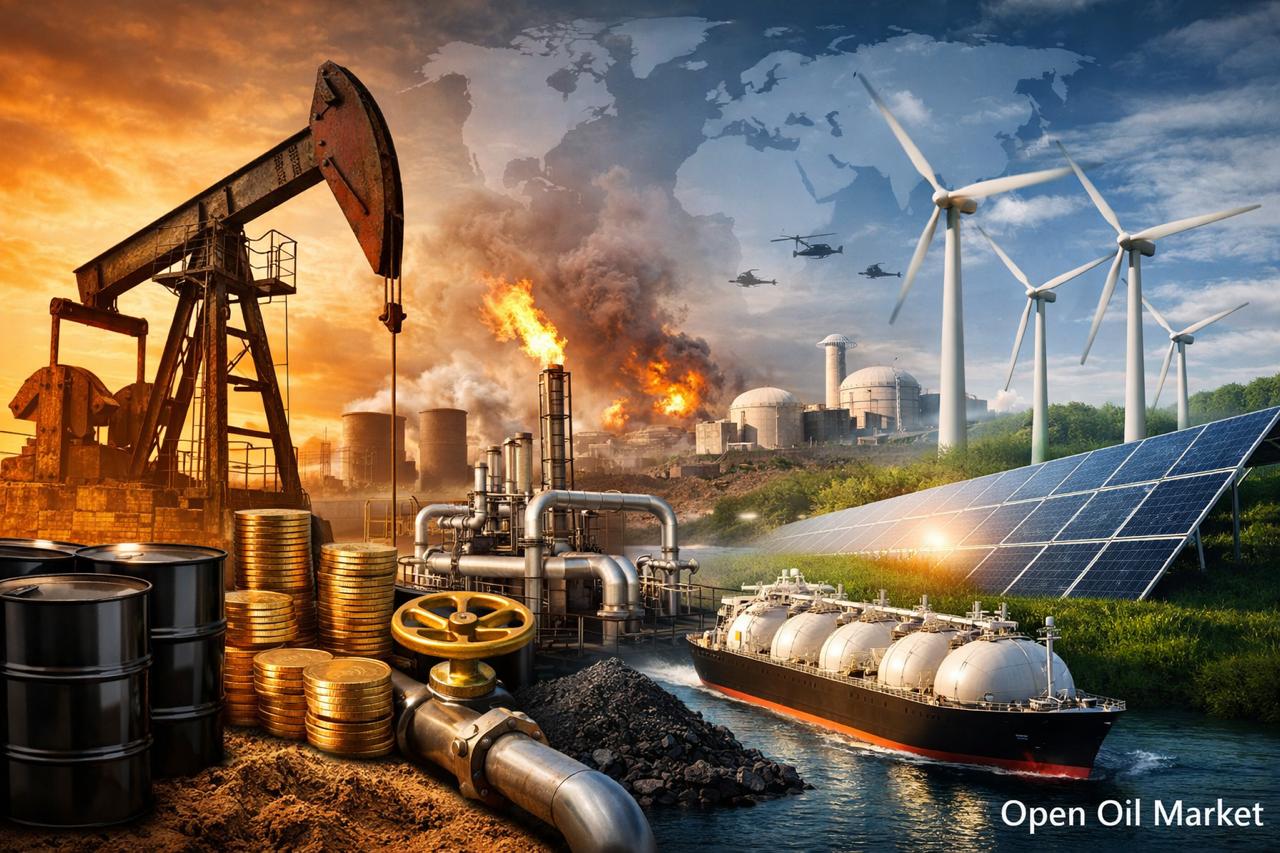
Current News in the Oil, Gas and Energy Sector for Thursday, 25 December 2025. Oil, Gas, Electricity, Renewable Energy, Coal, Refineries, and Key Events in the Global Energy Sector — An Overview and Analysis for Investors and Market Participants.
Today's review covers the key events in the global fuel and energy complex. Oil markets are closing the year relatively stable, supported by OPEC+'s measured actions and an increase in supply, while geopolitical factors—from sanctions to attempts at peaceful resolution—continue to impact deliveries. The energy sector has seen record achievements in renewable and nuclear energy, while global coal demand is hitting a historical peak ahead of an anticipated decline.
OPEC+ Maintains Production to Stabilise the Market
- It has been decided to maintain current oil production quotas for the first quarter of 2026 to prevent a potential market oversupply.
- OPEC+ countries have already returned about 2.9 million barrels per day to the market from previously reduced volumes, but a collective production cut of approximately 3.2 million barrels per day is still in effect until the end of 2026.
- The meeting took place against the backdrop of a new attempt by the US to reach a peaceful agreement between Russia and Ukraine. OPEC+ is aware that successful negotiations and a potential easing of sanctions could add additional oil volumes to the market, whereas failure would reinforce sanctions pressure and limit Russian exports.
Oil Prices Remain Stable
Global oil prices are closing the year without sharp fluctuations, stabilising in an average range. Brent remains around $62–63 per barrel, while WTI is around $58–59, reflecting a balance between robust demand and sufficient supply.
- At the beginning of the week, quotes rose by approximately 2% amid strong macroeconomic data from the US: GDP growth in Q3 exceeded expectations, fuelling demand for fuel.
- Additional support for prices has come from concerns over supply disruptions. New US sanctions against the Venezuelan oil sector and strikes on oil export infrastructure in the Black Sea have heightened market fears.
- Nonetheless, by the end of 2025, Brent had fallen by approximately 15%. The oil market demonstrated an unusually narrow trading range ($60–80) even amidst geopolitical upheavals, thanks to record production in the US (over 13.5 million barrels per day) and increased supplies from non-OPEC countries that offset the shocks.
- Refineries have ramped up the production of petroleum products, and commercial crude oil and fuel inventories in the US have been growing in December. This has kept gasoline and diesel prices from spiking at year-end.
Natural Gas: Comfortable Stocks and Moderate Prices
The natural gas market has entered winter relatively calmly. In Europe, wholesale gas prices have stabilised around €27 per MWh—its lowest level since spring 2024—thanks to high inventories and stable LNG inflows.
- Gas underground storage in the EU is over 70% full at the beginning of winter, well above multi-year averages, reducing the risk of shortages even in cold weather.
- Liquefied natural gas imports remain high, compensating for the halt of pipeline supplies from Russia. Major consumers (Germany, Italy, etc.) are actively purchasing LNG on the spot market, diversifying their sources.
- In the US, natural gas prices (Henry Hub) remain around $5 per million BTU. Record production levels and high LNG export volumes keep the American market balanced, although periods of extreme cold can lead to short-term price spikes.
Geopolitics and Sanctions: Impact on Energy Supplies
Political conflicts and sanctions continue to influence global energy markets, creating both threats of supply disruptions and expectations for future improvement.
- The US administration has tightened measures against Venezuela's oil sector: tankers carrying Venezuelan oil have been sanctioned. In December, several vessels were intercepted and forced to return, threatening to overflow local storage and reduce production in the country.
- Amid the ongoing conflict in Ukraine, strikes on energy infrastructure have increased. In November, a Ukrainian drone damaged the CPC pipeline terminal near Novorossiysk, cutting Kazakhstan's CPC Blend oil exports in December by a third (to approximately 1.14 million barrels per day) and forcing rerouting of some volumes away from the Black Sea.
- Despite the intensification of US sanctions in the autumn against leading Russian oil companies ("Rosneft" and "LUKOIL"), their effect on the global market has been limited. Russian oil exports remain close to multi-month highs due to alternative logistics, although Urals crude is trading at a significant discount to Brent.
Renewable Energy Sources: Wind and Investment Records
The renewable energy sector continues to gain traction globally, setting new capacity records and attracting substantial investments—despite political risks.
- The UK achieved a record peak in wind power generation on 5 December, producing 23,825 MW, accounting for more than half of the country's needs at that time. This record was achieved through strong winter winds and the expansion of offshore wind farms.
- According to BloombergNEF, global investments in new renewable energy projects reached a record $386 billion in the first half of 2025. The majority of the funds have been directed toward the development of solar and wind generation, along with energy storage systems for integrating renewables.
- In the US, a federal court lifted the ban on constructing new wind energy projects on federal lands and the outer shelf, imposed earlier this year. This decision paves the way for large offshore wind farms and supports state plans to increase the share of clean energy.
- China maintains its global leadership in renewables: the total capacity of renewable sources in the country has exceeded 1.88 TW (approximately 56% of total capacity). The large-scale deployment of solar and wind stations, along with storage systems, has allowed China to keep CO2 emissions stable despite economic growth.
Nuclear Energy: The Return of Major Capacity
After a prolonged downturn in the global nuclear sector, a revival is underway. Countries are reassessing the role of nuclear generation as a stable low-carbon energy source, aiming to reduce dependence on fossil fuels.
- Japan is preparing for the partial restart of the largest nuclear power plant, Kashiwazaki-Kariwa. TEPCO has received approval from the Niigata prefectural government and plans to launch unit 6 with a capacity of 1360 MW on 20 January 2026—the first reactor commissioned by the company since 2011. The full restoration of the 8.2-gigawatt station will be phased and take several years.
- The Japanese government has announced support measures for the nuclear sector aimed at doubling the contribution of nuclear energy to the energy mix. A system of state loans and guarantees for reactor refurbishment is being introduced; currently, 14 out of 33 reactors remaining post-Fukushima have resumed operations.
- A return to nuclear energy is also happening in other countries. In Europe, Finland has launched the Olkiluoto-3 reactor, France and the UK are investing in new nuclear plants, and the US is considering extending the lifespan of existing units and funding modular reactors.
Coal Sector: Peak Consumption and Gradual Decline
The global coal market reached a historic peak in 2025, but a trend reversal is expected ahead. According to the International Energy Agency, global coal consumption increased by 0.5%, reaching 8.85 billion tonnes in 2025. A slow decline in coal demand is expected by the end of the decade as renewable energy, nuclear energy, and natural gas displace it from generation.
- In the US, coal consumption for electricity generation increased in 2025. This was due to last year’s spike in gas prices and the president's directive to prolong the operation of coal-fired power plants that were scheduled for closure.
- China remains the largest consumer of coal, accounting for approximately 60% of the country's electricity generation. In 2025, coal demand in China stabilised; a gradual decline is expected by 2030 due to the massive introduction of renewable capacities. Beijing's policy aims to peak emissions by 2030, implying a reduced role for coal.
Corporate News: Deals and Strategies of Energy Companies
The end of the year has been marked by significant corporate moves in the energy sector, reflecting companies' efforts to optimise portfolios and adapt to new conditions.
- BP is selling 65% of its subsidiary Castrol (lubricants) to the American investment fund Stonepeak for $6 billion. The deal values the Castrol business at $10.1 billion; BP will retain a 35% stake in the new joint venture. The proceeds will be used to reduce debt and pay dividends, following the strategy of enhancing returns from traditional segments.
- In Russia, foreign partners are showing interest in returning to the market despite sanctions. India's ONGC and Japan's SODECO have maintained their stakes in Sakhalin-1, while a preliminary agreement between ExxonMobil and Rosneft regarding compensation for losses signals major players' readiness to resume cooperation once the political situation improves.
- In the electricity and infrastructure sector, technological deals are taking place. For instance, American Alphabet (the parent company of Google) announced in December the acquisition of Intersect Power, which develops renewable energy and data centre projects, for $4.7 billion. This will allow Alphabet to accelerate its own generation development based on renewable sources and reduce dependence on overloaded power grids.




