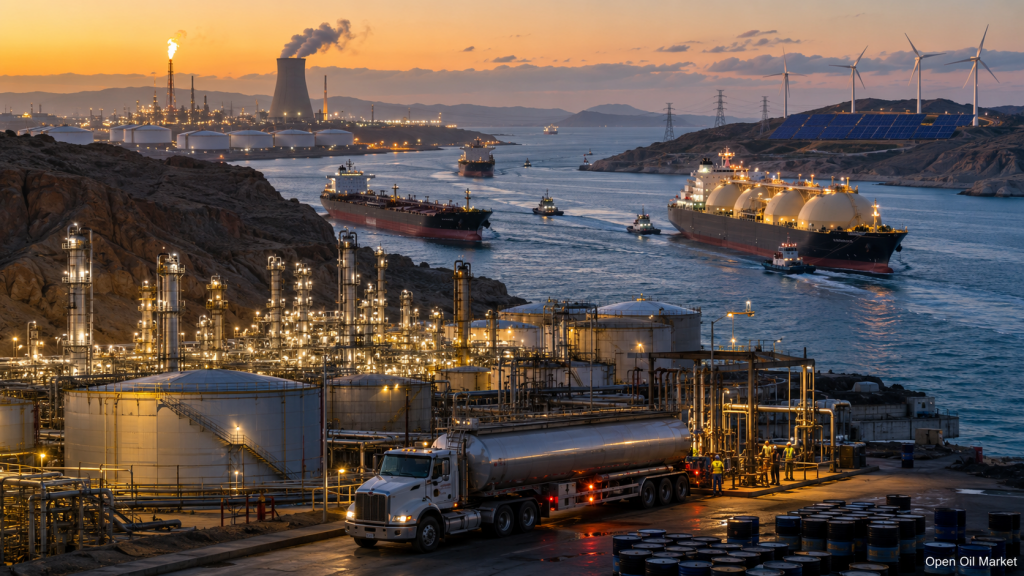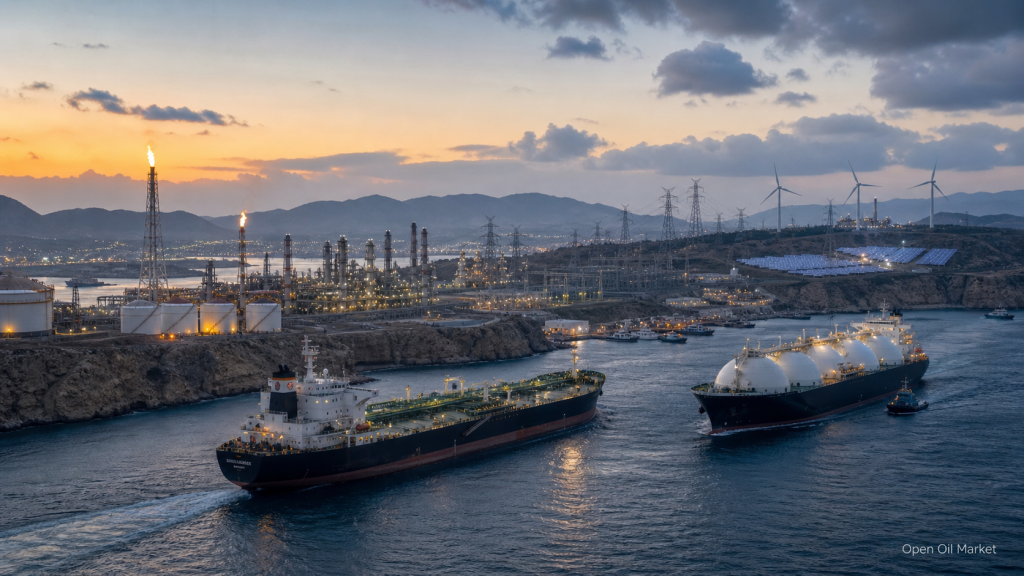
News on Oil, Gas and Energy for Tuesday, 5 May 2026: Hormuz Premium, High LNG Prices, Oil Volatility, Refinery Load, Rising Role of Renewable Energy, Coal and Electricity in the Global Energy Sector
On Tuesday, 5 May 2026, the global energy sector enters the trading session under heightened geopolitical risk. The primary concern for investors, oil companies, refineries, fuel traders, gas players, the electricity sector, coal, and renewables is the sustainability of global supply chains amidst restricted shipping through the Strait of Hormuz. This situation is no longer just a local risk for the Middle East but a systemic factor influencing prices of Brent, WTI, LNG, diesel, jet fuel, coal, and wholesale electricity.
The Day's Big Picture: The Energy Market Trades Risk Again
The key context for the global energy market is the sustained tension surrounding the Strait of Hormuz, through which a significant portion of global oil and LNG flows passed prior to the escalation. Even a partial restoration of shipping does not alleviate the risk premium, as insurance, freight, tanker routing, and availability of crude for Asian refineries remain under pressure.
For investors, this means that the news on oil, gas and energy for 5 May 2026 should be viewed not only through the price of a barrel but also through a broader set of indicators:
- dynamics of Brent and WTI above psychologically significant levels;
- availability of crude for refineries in Asia and Europe;
- cost of LNG in Asia and Europe;
- increasing demand for coal in countries sensitive to electricity prices;
- role of renewables and energy storage in reducing dependence on gas.
Oil: Brent Remains in a High Volatility Zone
The oil market continues to assess not so much the current supply-demand balance but the likelihood of further supply disruptions. Brent remains above $100 per barrel, with intra-day movements remaining sharp: any signal regarding shipping, military activity, or diplomatic contact is swiftly reflected in quotes.
For oil companies, this situation creates a dual effect. On one hand, high prices support the cash flow of production assets. On the other, operational and logistical risks are rising, especially for suppliers connected to routes through the Middle East. For refineries and fuel traders, the situation is more complex: expensive oil increases raw material costs, but the shortage of diesel, gasoline, and jet fuel may sustain margins in certain regions.
OPEC+: Production Increase More of a Political Signal
OPEC+ countries' decision to raise target production levels by 188,000 barrels per day from June formally appears as an attempt to stabilise the market. However, under current conditions, this move is perceived by the market more as a coordination signal than an immediate source of additional physical supply.
The issue is not only about production volumes but also access to export infrastructure. If shipments through key maritime routes remain limited, additional quotas do not automatically translate into available oil for refineries. Therefore, for investors, the main question is not "how much is OPEC+ willing to produce," but rather "how much can actually reach buyers."
Asia: Refineries Face Crude Shortages and Increased Dependence on the US
The Asian market remains the most vulnerable segment of the global energy sector. Prior to the escalation, a significant portion of Middle Eastern oil and LNG flows was directed to Asia. Now, Japan, South Korea, China, India, and other importers are forced to reshape their procurement strategies, increasing their share of American oil while competing for alternative cargoes.
For refineries, this indicates several risks:
- reduced utilisation rates due to a shortage of the suitable crude;
- increased logistics and insurance costs;
- intensifying competition for supplies from the US, Africa, and Latin America;
- potential rise in fuel products prices as output decreases.
If restrictions persist, the market could see a tighter balance for diesel, jet fuel, and gasoline. This is particularly significant for the aviation, industrial, maritime, and agricultural sectors.
Gas and LNG: Asia's Premium Heightens Competition with Europe
The gas market is also under increased strain. LNG has become one of the main indicators of energy security: Asia is actively ramping up purchases of American LNG, while Europe remains the largest destination for US supplies. Meanwhile, the Asian LNG price remains above European benchmarks, intensifying competition between the regions.
For gas companies and LNG infrastructure investors, this confirms a strategic trend: supply flexibility has become a value in itself. Liquefaction terminals, regasification plants, LNG tanker fleets, long-term contracts, and access to storage facilities are gaining additional investment significance.
In the short term, high gas prices support demand for coal and fuel oil within specific power systems. Long-term, it accelerates interest in renewables, energy storage, grid infrastructure, and demand management.
Electricity: Heat, Data Centres, and Expensive Gas Shift the Balance
The electricity sector is becoming a central link in the raw material and energy landscape. Amid the heatwave in Asia, peak electricity demand is rising, particularly in India, where generation has already reached recent maximum levels. For power systems, this signifies increased load on coal plants, hydropower, gas peaking capacity, and solar generation.
In developed economies, additional factors include demand from data centres, artificial intelligence, industrial electrification, and transportation. This shifts the investment model of the electricity sector: formerly, the key theme was fuel cost, but now, network stability, balancing, storage, and peak capacity availability are becoming increasingly significant.
Coal: Temporary Beneficiary of High Gas Prices
The coal market is being supported by expensive LNG and increasing electricity demand in Asia. For countries where electricity prices are sensitive to industry and populations, coal remains a backup tool for energy security. This is particularly noticeable during heatwaves when gas becomes costly, and solar generation fails to meet evening peaks.
However, the investment profile of the coal sector remains contentious. On one hand, high gas prices and logistics disruptions raise demand for thermal coal. On the other hand, climate policies, funding restrictions, and the development of renewables continue to weigh on the long-term valuation of coal assets.
Renewables and Storage: Energy Independence Becomes a Market Premium
The current crisis enhances the investment case for renewables. Solar and wind generation may not fully resolve the problem, but they reduce dependence on imported gas and oil. The markets that appear most resilient are those where renewables are complemented by hydropower, energy storage, flexible generation, and advanced grids.
For investors, the focus should not only be on the increase in installed capacity but also on the quality of the energy system. Solar generation helps to meet daytime peaks, but without storage and grid modernization, evening demand still requires gas, coal, or hydropower. Thus, the next stage of investment in renewables will involve not just panels and turbines, but also batteries, transformers, digital grid management, and long-term capacity contracts.
What Investors Should Watch for on 5 May 2026
For energy sector participants, Tuesday may be a day when prices respond not to a single indicator but to a combination of geopolitical, logistical, and fundamental factors. Key reference points for investors:
- oil: stability of Brent above $100 and market reaction to news regarding the Strait of Hormuz;
- gas: the spread between Asian LNG and European TTF;
- refineries: utilisation rates in Asia and margins for diesel and jet fuel;
- electricity: peak demand in Asia and the US, especially amid heat and rising data centres;
- coal: demand from power systems where gas has become too expensive;
- renewables: investments in storage, grids, and balancing capacities.
The main takeaway for the global energy market: the news on oil, gas and energy for 5 May 2026 indicates that the sector is shifting from a model of cheap globalisation to one of energy resilience. For oil, gas, electricity, renewables, coal, fuel products, and refineries, the key factor is not just the price of the resource but the ability to deliver it to the right region, at the right time, and with an acceptable level of risk.