Current News in the Oil, Gas, and Energy Sector for Wednesday, 31 December 2025: Global Oil and Gas Market, LNG, Renewables, Power Generation, Coal, Refineries, and Key Trends for Investors and Energy Sector Participants.
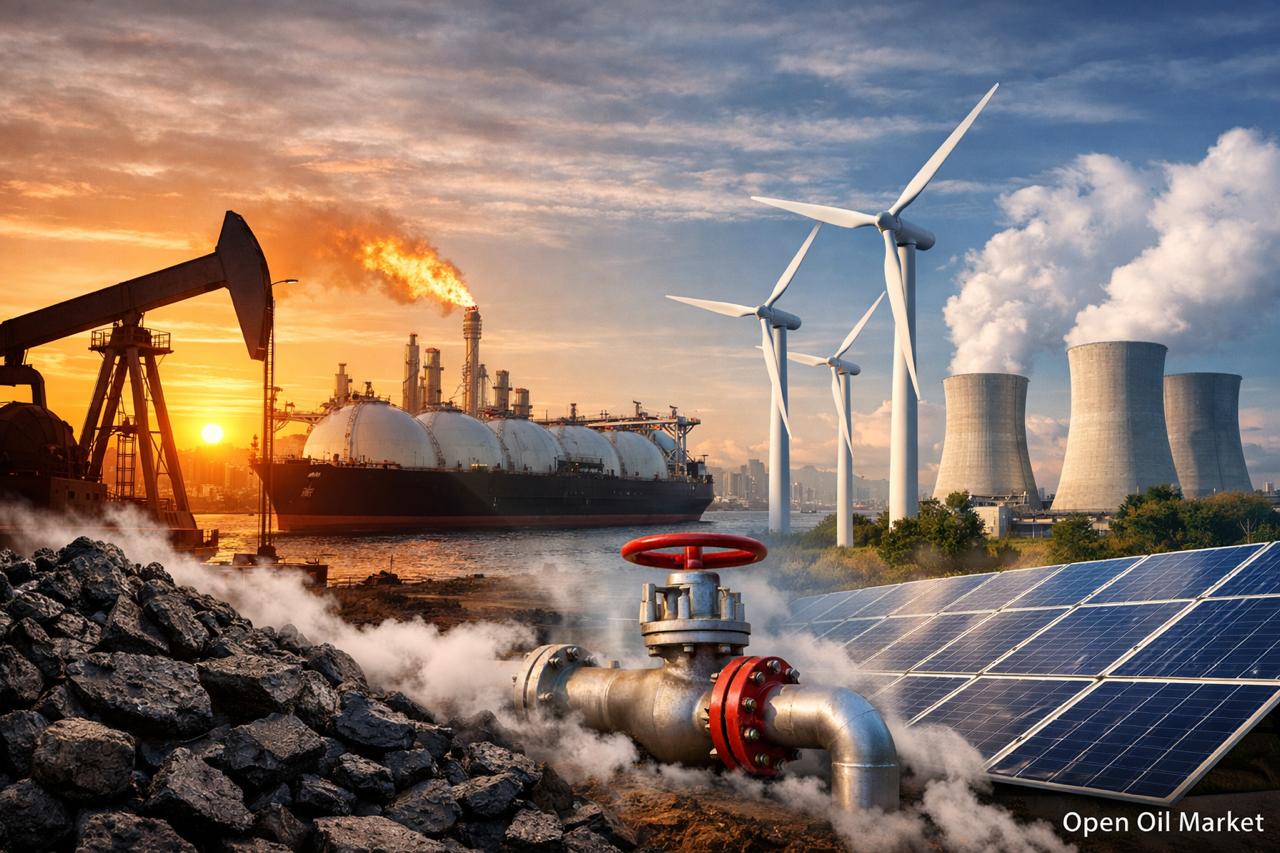
At the close of 2025, the condition of the fuel and energy complex is characterised by an oversupply of oil and gas, keeping prices at minimal levels. For instance, Brent crude is trading at approximately $60 per barrel, and in the US, retail gasoline prices have dipped below $3 per gallon, reaching levels unseen since 2021. In Europe, gas storage facilities are nearly 90% full, which means that prices for the 'blue fuel' remain moderate even with the onset of colder weather. At the same time, the global energy transition is gaining momentum: renewable energy sources (RES) are achieving record levels of generation, and many countries are expanding their capacities in wind, solar, and other clean technologies. Presenting an overview of key news in the commodity and energy sectors that are impacting global markets.
Global Oil Market: Oversupply and Stable Prices
The global oil market is entering a new "supply race". OPEC+ has agreed to suspend production increases at its autumn meetings, effective from early 2026; however, total supply remains high. Saudi Aramco has been lowering its official selling prices for oil in the Asian market for several months, reflecting the surplus of crude. American shale producers have achieved unprecedented production growth—25% in 2025—and output in Brazil and Canada has also reached record levels. Meanwhile, China has ramped up its oil purchasing programme for 2026, while demand in most major markets remains subdued due to economic slowdown. Collectively, these factors are suppressing price growth: Brent stays roughly in the $60–65 per barrel range, while WTI holds around $58–62.
- Oil prices remain relatively stable. Brent trades around $62, and WTI is approximately $58–60. This is 10–15% lower than levels a year ago. The suppressive factor is the "oversupply" amidst falling demand.
- OPEC+ has decided to suspend production quota increases for the first half of 2026. The group continues to maintain total production cuts of about 3.2 million barrels per day (approximately 3% of global demand).
- Saudi Aramco once again lowered the selling prices of its oil for Asian buyers for February, bringing the Arab Light premium down to its lowest level in five years—around $0.40 above the average Oman/Dubai prices.
- Venezuela continues to face challenges. Due to US sanctions, crude oil exports in December fell by about half compared to November. However, PDVSA is expanding its use of tankers for floating storage and oil shipments to China as part of its debt payment.
- A new Chevron oil and gas project off the coast of Angola yielded its first oil in 2025. The company plans to ramp up production to approximately 25,000 barrels per day and 50 million cubic feet per day of gas at the South N’Dola field at peak development.
Gas Sector and LNG: Record Supply and Price Pressure
2025 has been a landmark year for the gas market: new records for LNG (liquefied natural gas) exports have been set. Leading exporters, primarily the US and Canada, have significantly increased their shipments. In November, the US exported over 10.9 million tonnes of LNG—marking the third consecutive record month—mainly due to cold weather on the coast and high load factors at Cheniere and Venture Global plants. For the year, global LNG supplies increased by approximately 4%, exceeding 425 million tonnes (a significant rise for the first time since 2022), partially due to new terminals coming online in the US, Canada, and Qatar. However, competition in the market is intensifying: new export capacities are expected to increase by another 50% by 2030, potentially leading to a temporary oversupply of gas and reduced prices. Europe remains a key market: in November, it received up to 70% of American LNG. Meanwhile, demand in Asia slowed, with Asian prices at JKM holding around $11–12 per MMBtu. Due to moderate temperatures and full natural gas reserves, European quotations (TTF) stood at around $10 per MMBtu at year-end.
- LNG export levels have risen to record highs. The US has achieved export volumes averaging ~15 billion cubic feet per day in 2025 (+25% compared to 2024), supplying the bulk of gas to Europe. Canada has also initiated regular LNG shipments from the new LNG Canada terminal.
- Gas prices are experiencing moderate increases. In the US, the average Henry Hub price at the end of November was around $4.5/MMBtu (up from $3.4 in October) due to rising liquefaction demand. Europe and Asia are holding above $10/MMBtu, but below peak levels from winter 2022–2023. The oversupply from the US has mitigated sharp price spikes.
- New infrastructure projects. In the US, over $50 billion is expected to be invested in pipeline construction by 2030 to meet growing domestic and external demand. The commissioning of several large-scale LNG projects in Asia (Qatar, Australia) is anticipated, and discussions regarding an expansion of the pipeline from East Africa are underway.
- Regional specifics. In 2026, China received import quotas for oil and gas with an approximate increase of 8% from the previous year, supporting its demand. India, meanwhile, is limiting its import dependency by actively developing local gas production and seeking compensations from foreign companies for shortfalls in oil deliveries by gas.
Coal Sector: Record Demand and Long-term Decline
Despite the rapid development of "clean" technologies, global coal demand also reached record levels in 2025, driven by several factors. According to the IEA, global demand for coal grew by approximately 0.5% to 8.85 billion tonnes—primarily due to a cold winter and increased consumption in power plants. In China, the largest consumer, coal consumption remained stable overall, although a decline is expected as RES are expanded. India reduced coal consumption for the first time in five years due to record rainfall and a surge in hydropower generation. The US experienced a rise in coal consumption: high gas prices and government measures (regulations extending the operation of coal-fired power plants) have supported demand. However, long-term trends clearly indicate a decline: by 2030, coal's share in the energy balance is expected to decrease significantly under the influence of renewables, gas, and nuclear energy.
- Increased consumption. According to the International Energy Agency, global coal demand has reached a new record (8.85 billion tonnes). The highest growth was seen in CIS countries and the US (primarily due to high gas prices), despite declines in India and stagnation in China.
- India and China. In 2025, India reduced imports and coal consumption due to record rainfall and successful hydropower projects. In China, despite the expansion of RES, coal still accounts for over 50% of generation; however, Beijing plans a gradual reduction in the coal share by 2030 as RES and nuclear energy expand.
- Long-term trend. IEA experts note that under the influence of decarbonisation policy and economic factors, demand for coal has reached a plateau and will gradually begin to decline in the latter half of the decade. Previously stated environmental targets are encouraging the transition of power plants to gas and the installation of additional solar and wind stations.
Power Generation and Renewables: Record Growth and New Challenges
In 2025–2026, a historic turning point has emerged: total electricity generation from RES has, for the first time, surpassed coal's share in the global energy balance. The increase in electricity consumption of 2–3% in 2025 was entirely met by growth in generation from wind and solar capacity (over 30% and 8% respectively), while coal generation declined. The global share of RES in generation exceeded 34%, while coal fell to approximately 33%. Simultaneously, hydropower and nuclear energy capacities are increasing: it is expected that by the end of 2026, total nuclear generation will reach record levels, mainly due to new reactors in China, India, and Korea. According to an IEA report, by 2030, about 80% of the new increase in renewable sources will come from solar energy, which demands extraordinary investments in networks and storage to smooth volatility. Many countries have already announced large-scale projects: for example, Indonesia plans to increase installed RES capacity by 30% over the next five years, while the EU is expanding funding for electrical grids and data centres powered by RES.
- New RES records. According to industry agencies, in the first half of 2025 alone, solar and wind installations contributed over 300 TWh to global generation. This roughly corresponds to the annual electricity consumption of a country like Italy. The transition to RES alleviates the pace of demand growth but necessitates network upgrades.
- Investment in networks and flexibility. The growth of RES share presents challenges for the energy sector in terms of balancing supply and demand: energy storage (batteries, hydrogen), robust grids, and controllable generators are needed. International institutions are urging governments to accelerate the construction of "smart grids" and substations and to implement demand management systems.
- Hydro and nuclear. While RES lead the way, hydropower remains an important reserve—especially in Asia. Nuclear generation is also strengthening: new reactors are set to enter service in 2025–26 in China, India, and the UAE, which will contribute to reducing dependencies on coal in the region.
International Geopolitics: Conflicts and Sanctions
Global political events continue to be a significant driver for energy prices. The escalation of the conflict in Yemen (involving the UAE and Saudi Arabia) has added uncertainty: threats of an explosion at the Red Sea blockade and disruptions to oil supplies are causing support for risk premiums. Concurrently, negotiations for peace in Ukraine have made little progress, and a reassessment of positions by the Russian leadership in December has heightened concerns regarding future gas flows. Against this backdrop, oil prices are remaining above August levels despite the "oversaturation" of the market. Sanctions also play an important role: the US has continued its blockade on Venezuelan oil supplies, cutting PDVSA's exports by approximately half in December. However, some sanctioned tankers are heading to Venezuela's shores as Maduro makes payments in oil to settle debts with China. Additionally, Russia has extended its ban on exporting gasoline and diesel until February 2026 due to energy deficit risks.
- The conflict in Yemen. After tense clashes in December, the UAE announced a troop withdrawal, but the situation remains strained. The military crisis adds fears to oil markets, as it potentially threatens major supply routes through the Red Sea.
- Russia-Ukraine. Peace negotiations are stalled: Russia is declaring a "reconsideration" of its approach, while Ukrainian leadership is refusing concessions. This maintains risks for gas supplies (through Gazprom) and oil (given potential changes in sanctions).
- Venezuela blockade. The US has intensified pressure on Venezuelan oil exports: a tanker blockade has been implemented. PDVSA's exports have fallen by about 50% at the end of December. However, some oil continues to be directed to China through barter schemes. Maduro is negotiating with consuming countries, offering significant discounts to avoid a complete halt in sales.
- The Middle East and Iran. Tension surrounding Iran's nuclear programme remains a factor of volatility. Informal signals regarding the resumption of Iranian gas and oil exports could impact supply balances in the region by mid-2026.
Refining and Oil Products: Margins and New Trends
The growing global surplus of crude oil does not automatically translate into lower fuel product prices. Diesel market overheating remains high due to structural supply constraints: European refineries are reducing processing of Russian oil under the pressure of sanctions, and drone strikes on Russian oil fields are intensifying diesel shortages. As a result, diesel margins in the European market increased by approximately 30% in 2025, despite falling raw material prices. In the US, gasoline traditionally becomes cheaper during the Christmas period: at the beginning of December, retail prices fell to levels consistent with 2021 (approximately $2.9 per gallon). In Asia, major fuel importers confirm moderate consumption growth. European refiners are responding by pivoting towards the production of biofuels and sustainable aviation fuels (SAF) to diversify their businesses. Several countries are also discussing the introduction of new standards for environmental components of fuel, stimulating refinery upgrades.
- Increased diesel margins. Due to a decline in Russian exports and limited inventory replenishment in Europe, diesel prices in November–December exceeded those of crude oil. It is expected that in 2026, diesel demand will remain strong (construction, agriculture), supporting margins at an average of $10–15 per barrel.
- The Euro has depreciated. As fuels become cheaper in Asian markets, European traders expect a decline in prices for gasoline and aviation kerosene. According to agencies, in December, gasoline futures in Amsterdam dropped below the November level by 15%. This provides a short-term breather for consumers.
- Transition to SAF and biofuels. Under pressure from the EU and the US, refiners are beginning to build installations for the production of biodiesel and SAF. Subsidy programmes for the aviation sector are boosting demand: for example, in Europe, total SAF production is planned to reach 3 million tonnes by 2026.
- Stabilisation in the domestic fuel market. Emergency measures have been adopted in several countries. In Russia, where there was a sharp rise in gasoline prices in the first half of the year, the export ban on fuel has been extended. Conversely, in the US, drilling activity has increased—companies are enhancing the number of wells to take advantage of low oil prices.
Major Projects and Investments: Deals and Future Ambitions
Despite the short-term challenges, oil and gas companies are preparing for long-term growth. In 2025, several landmark agreements were reached. Woodside Energy signed a long-term contract for the supply of approximately 5.8 billion cubic metres of LNG from new US projects (Louisiana) with deliveries starting in 2030. International oil companies continue to implement large-scale developments: for instance, Saudi Aramco and the UAE plan to increase investments in traditional oil production from 2026 to 2030 following a pause. In the Asian direction, Shell and partners in Canada are facing challenges in launching the LNG Canada plant: both lines were idle for several weeks in December due to technical failures. The Sakhalin-1 field in Russia has remained in the spotlight: the government has extended the timeline for the sale of a 30% stake of ExxonMobil until the end of 2026, providing a chance for the integration of a foreign company after sanctions are lifted.
- Major LNG deals. A series of 10–15-year contracts for LNG supplies to Asia and Europe have been announced in the US. Besides Woodside, similar agreements have been joined by Kazakhstan's Tengiz (expansion project) and Russian projects (Lakhta LNG, Arctic LNG).
- New oil and gas projects. Chevron has commenced production at a field off the coast of Angola (first oil was achieved in summer 2025), while the Italian company Eni is considering similar steps in Mozambique and Nigeria. Development ministries in BRICS countries have announced plans to increase oil production from depleted fields using Enhanced Oil Recovery technologies.
- Investments in RES. Among the strategies of major companies is diversification. For instance, Swedish Vattenfall is seeking state funding for the construction of new nuclear reactors as part of its "green" strategy; Chinese CATL is investing in European battery production plants. In Asia, the number of joint ventures in renewable energy is increasing.
- Preparations for 2026. Many research organisations and financial players anticipate that in 2026, oil and gas reserves will continue to grow, necessitating tighter control. Experts predict potential decreases in capital investments from Western companies by 10–15% by the end of 2026—focused on new technologies (E&P in Arctic, deepwater) and the digitalisation of extraction.