Current Oil and Gas and Energy News as of 12 March 2026: Brent Oil, LNG Market, Refinery Situation, Power Generation, Renewables and Key Global Energy Events for Investors and Energy Market Participants
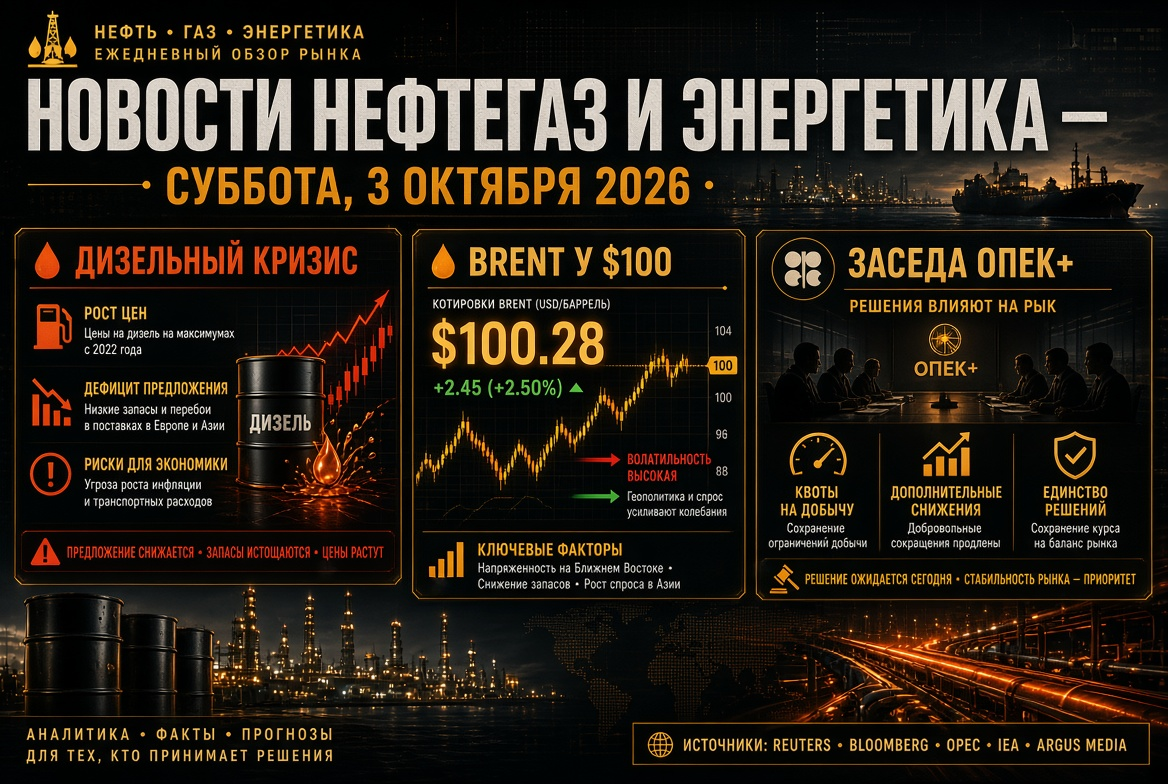
The oil market remains tense. The focus is not only on the current Brent price but also on the structure of expectations for the coming months. Market participants perceive two conflicting signals: on one hand, supply disruptions and shipping restrictions support prices; on the other hand, the medium-term forecast once again indicates a risk of returning to a softer price scenario if physical flows are restored.
- The geopolitical premium keeps oil above fundamentally comfortable levels;
- The market is pricing in the risk of a short-term physical crude oil deficit;
- The normalisation of logistics is likely to weaken price pressure in the second half of the year.
For investors in the oil and gas and commodities sector, this is an important signal: the current rise in oil prices appears more as a stress reaction from the market than the beginning of a sustainable multi-quarter supercycle.
Middle East and Hormuz: Logistics Again Become the Main Market Driver
A key theme for the global energy sector remains the restrictions on transit through the Strait of Hormuz. It is logistics, rather than simply production, that currently dictates the behaviour of the oil market. For oil companies, traders, and major oil consumers, this translates into increased transportation risks, insurance premiums, and delivery times.
What This Means for the Market
- Some flows of crude oil and petroleum products are being redirected to alternative routes.
- Exporters with access to pipelines and ports outside the risk zone gain a strategic advantage.
- Asia faces greater sensitivity to any disruptions in the supply of crude and fuel.
In practice, this intensifies regional price differentiation. Some markets face shortages of premium grades and fuels, while others enjoy relatively stable supply due to the re-routing of flows.
Refineries and Petroleum Products: The Refining Market Transitions to a Tight Margins Regime
For the refining and petroleum products segment, the current situation is as critical as for upstream. Any disruptions in refining capacity immediately impact the prices of diesel, fuel oil, marine fuel, and jet fuel. While the key issue for the oil market is raw materials, the focal point for petroleum products is the availability of refining capacity and the resilience of supply chains.
Against this backdrop, refining margins receive additional support, especially in regions where refineries operate reliably and have access to alternative feedstocks. For petroleum product traders, this signifies an increased value of logistical arbitrage, and for industrial consumers, a risk of rising fuel costs even with subsequent corrections in oil prices.
- Diesel and marine fuel remain in a zone of heightened volatility;
- The Asian market reacts more strongly to disruptions than the European market;
- The demand for reliable export hubs and independent routes is increasing.
Gas and LNG: Competition for Molecules Intensifies
The gas market is entering a new phase, with LNG becoming the primary balancing tool. Europe strives to maintain energy security, while Asia remains a region heavily dependent on imports. This makes the LNG market even more sensitive to any shocks in shipping and changes in tanker flow directions.
For the global gas market, three trends are significant:
- The premium for fast LNG delivery is rising again;
- Europe is intensifying its focus on diversification and a long-term contract base;
- The United States is strengthening its position as a systemic supplier of gas to the global market.
For gas consumers, the power industry, and the chemical sector, this indicates sustained sensitivity to geopolitical events. Gas is no longer considered a local regional commodity: it is a global asset, with price increasingly determined by marine logistics and the availability of flexible volumes.
Power Generation: Growing Demand Increases the Value of Reliable Generation
In the power sector, the main narrative is not only about the energy transition but also about the physical growth in demand. Data centres, digital infrastructure, industry, and the electrification of transport create additional pressure on the system. This means that the market increasingly values not just installed capacity but guaranteed electricity supply during peak hours.
For the global energy sector, this creates a new asset hierarchy:
- Gas generation retains its role as balancing power;
- Nuclear power and hydropower enhance their significance as stable base sources;
- Renewables continue to expand their share, but require accelerated network, storage, and reserve developments.
For investors, this signifies a growing interest not only in power producers but also in network companies, equipment suppliers, storage projects, and gas infrastructure.
Renewables and the Energy Transition: Growth Continues, but the Focus Shifts Towards System Resilience
Renewable energy sources continue to strengthen their position in the global energy balance. However, the market increasingly recognises that the rapid deployment of solar and wind generation alone does not address the issue of energy supply security. The primary concern now is the integration of renewables into the grid without compromising reliability.
In the upcoming quarters, this will mean accelerating investments in:
- Grid networks and intersystem connections;
- Energy storage systems;
- Flexible gas generation as a complement to renewables;
- Digital load and demand management.
Thus, the energy transition does not eliminate demand for traditional resources. On the contrary, during the transition phase, oil, gas, coal, electricity, and renewables are increasingly operating within the same system, where the cost of planning errors sharply escalates.
Coal and Asia: Traditional Generation Remains a Safety Net
Despite the acceleration of the green agenda, coal retains its significance as a source of energy resilience in several Asian economies. For electricity markets, this is an uncomfortable but realistic fact: amidst rising demand and instability in gas supplies, many countries are not ready to eliminate traditional generation too quickly.
For participants in the commodities market, this indicates that the coal segment will not disappear from the investment landscape. It remains a part of energy security strategies, especially where the issue of electricity prices is more critical than climate targets in the short term.
What Is Important for Investors and Energy Sector Market Participants as of 12 March
In the upcoming session and weeks ahead, investors, oil companies, fuel firms, refineries, and power market participants should monitor several indicators:
- The dynamics of Brent oil prices and the market's reaction to supply risks;
- News on shipping and export logistics in the Middle East;
- Changes in gas and LNG prices in Europe and Asia;
- The status of refining and margins in the petroleum product market;
- Signals regarding new measures to support energy security in Europe and Asia;
- Growth rates of electricity demand and investments in new capacity.
The conclusion for the global energy sector as of 12 March 2026 appears as follows: in the short term, the market is governed by oil, logistics, and risk, while in the medium term, it is driven by supply efficiency, the flexibility of the gas market, the resilience of power generation, and the quality of infrastructure. For global investors, this is a period when it is especially important to separate price noise from structural trends. A new configuration of the global energy market is being formed—more expensive in terms of security but also more attractive in terms of investment opportunities.