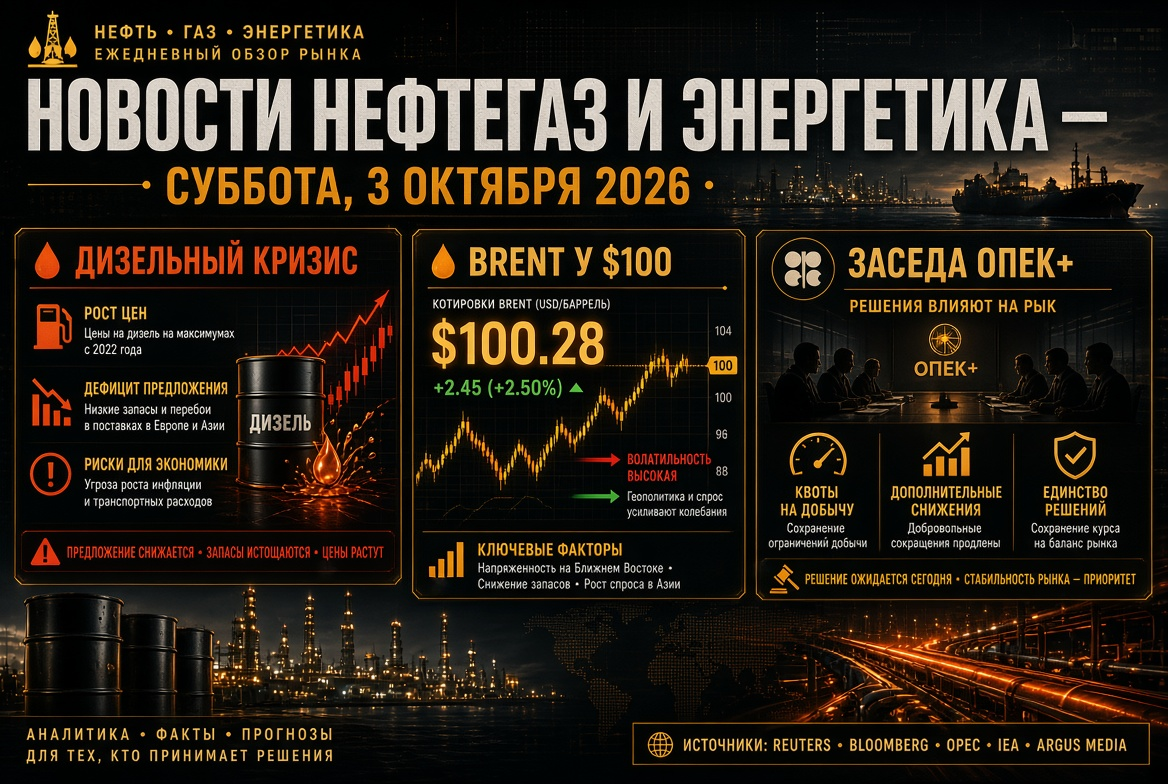
Latest Oil and Gas and Energy News for Sunday, 14 June 2026: The Situation in the Strait of Hormuz, Brent and WTI Oil Dynamics, LNG Market, Gas, Refineries, Oil Products, Electricity, Renewables, and Coal. An Overview for Investors and Participants in the Global Energy Sector
Sunday, 14 June 2026, sees the global energy sector experiencing a state of cautious stabilisation following a period of heightened geopolitical volatility. The primary concern for investors, oil companies, petroleum product traders, the gas market, refineries, and the electricity sector is not only the dynamics of oil prices but also how swiftly global logistics can rebound after the tensions surrounding the Middle East and routes through the Strait of Hormuz.
For the global energy market, the current situation appears contradictory. On one hand, both Brent and WTI have seen declines amid expectations of a diplomatic thaw and potential improvements in supply. Conversely, the physical market continues to evaluate the risks of disruptions, low stock levels, high transportation insurance costs, increased demand for LNG, pressures on refineries, and accelerated investments in electricity, renewables, networks, and energy storage.
Oil: The Market Prices in a Reduction of Geopolitical Premiums
A key development in the oil and gas market is the decline in oil prices following expectations of a partial normalisation of the situation in the Persian Gulf. Brent has dropped to its lowest levels in several months, with WTI also falling. However, for investors, the critical aspect is not merely the price movement but its underlying cause: the market is beginning to partially unwind the geopolitical premium embedded in oil prices due to the risk of supply disruptions through Hormuz.
That said, the oil market remains highly sensitive to any news regarding shipping, sanctions, tanker insurance, and the export discipline of producers. Even if the diplomatic landscape evolves positively, oil companies and traders will assess not only statements but also actual recoveries in crude oil and petroleum product flows.
For participants in the energy market, three indicators are now particularly crucial:
- the actual volume of tanker traffic through key Middle Eastern routes;
- the dynamics of commercial oil and petroleum product inventories in the USA, Europe, and Asia;
- the refining margin at refineries, particularly for diesel, gasoline, and jet fuel.
OPEC and Demand Forecasts: The Oil Market Enters a Phase of Expectation Revision
Fresh forecasts for global oil demand indicate a shift from a scenario of sustainable growth to a more complex model: demand remains high in absolute terms, but growth rates are slowing. OPEC continues to view demand prospects more optimistically than some Western energy agencies; however, even within the industry, there is an increasing discussion about the impact of high prices, weak industrial activity, electric vehicles, energy efficiency, and the structural substitution of oil fuels.
For oil companies, this means that the strategy for 2026 must consider not only the price per barrel but also the quality of demand. The most resilient segments remain petrochemicals, diesel, marine fuel, jet fuel, and markets in developing countries. Conversely, segments where consumers respond rapidly to price increases or have alternatives in gas, electricity, and renewables are becoming more vulnerable.
Gas and LNG: Europe and Asia Compete for Long-term Supply Security
The gas market remains a central element of the global energy agenda. The USA is bolstering its role as the largest LNG supplier, and Europe continues to structure long-term contracts to reduce dependence on the volatile spot market. New agreements for the supply of American LNG to Southern and Central Europe indicate that buyers increasingly favour long-term contracts over short-term price flexibility.
For Europe, the key question is the price of energy security. Even with a decrease in some gas indicators, the market remains above comfortable levels for industry. For Asia, the situation is equally complex: LNG is needed by China, India, Japan, South Korea, and emerging economies, but high prices are limiting demand from price-sensitive consumers.
In 2026, LNG is becoming not merely a commodity but a strategic asset. For investors, this heightens interest in:
- export LNG projects in the USA and the Middle East;
- regasification terminals in Europe and Asia;
- gas transport infrastructure and storage facilities;
- companies operating at the intersection of gas, electricity, and industrial demand.
Refineries and Oil Products: Refining Margins as an Indicator of Actual Demand
The refining and oil products sector remains one of the most significant for assessing the state of the global economy. While oil prices react to geopolitics instantaneously, the markets for gasoline, diesel, jet fuel, and fuel oil reveal a deeper picture: how sustainable transportation demand is, how industry is performing, and how solvent end consumers are.
For refiners, 2026 remains a year of challenging balance. High raw material costs are pressuring margins, but limited supplies of specific fuels are sustaining premiums on oil products. Diesel and jet fuel are particularly crucial: they are sensitive to logistics, construction, industry, freight transport, and the recovery of international air services.
Electricity: Data Centres and Artificial Intelligence Creating New Demand
One of the strongest long-term themes in energy is the rise in electricity consumption due to data centres, artificial intelligence, electrification of industry, and transport. The USA is forecasted to surpass historical maximums in electricity consumption in 2026 and 2027. For the global market, this signals that the electricity sector is becoming not merely a supportive sector but a central infrastructure of the new economy.
Increasing load is changing investment logic. Not only electricity producers but also network owners, equipment suppliers, storage operators, gas generators, nuclear power, and renewables will benefit. However, the shortage of network capacity may become a limiting factor for technology companies and industries.
Renewables and Energy Storage: Green Energy as Part of Energy Security
By 2026, renewable energy is increasingly viewed not just as a climate issue. Solar and wind generation, battery storage systems, and hybrid projects are often regarded as tools for energy security. Investments in electricity infrastructure, networks, and end-use consumption continue to grow, and major projects in solar generation and storage are securing multibillion-dollar financing.
For investors, it is essential to transition from simple capacity expansion to project quality. The most promising projects will have long-term power purchase agreements, access to networks, support from industrial consumers, and the ability to smooth peak loads. In light of rising demand from data centres, such projects gain additional investment appeal.
Coal: The Market Remains Under Pressure but Retains its Role as Back-up Fuel
The coal market finds itself caught between two forces. On one hand, the long-term trend is towards reducing the share of coal in electricity generation, especially in developed economies. On the other hand, during periods of high gas prices, unpredictable LNG markets, and peak electricity demand, coal remains a back-up fuel for several Asian countries.
The decrease in coal imports to China on an annual basis indicates that domestic production, pricing, and energy transition policies continue to influence maritime coal trade. However, it would be premature to write off coal entirely: India, China, and Southeast Asia still utilise it as part of their energy mix and as a safeguarding mechanism against gas supply disruptions.
What is Important for Investors and Energy Sector Participants on 14 June 2026
The primary takeaway for investors is that the global energy sector is entering a phase where oil prices are no longer the sole indicator of the state of the energy market. Oil, gas, LNG, electricity, renewables, coal, refineries, and petroleum products are increasingly interconnected through logistics, geopolitics, infrastructure, and capital costs.
In the coming days, market participants should pay attention to the following factors:
- confirmation or refutation of supply recovery through key Middle Eastern routes;
- dynamics of Brent and WTI following the unwinding of part of the geopolitical premium;
- demand forecasts from OPEC, EIA, and other energy agencies;
- gas prices in Europe and Asia, as well as new long-term LNG contracts;
- refinery utilisation and refining margins for diesel, gasoline, and jet fuel;
- growth in electricity demand from data centres and industry;
- investments in networks, renewables, energy storage, and gas generation.
For oil companies and fuel traders, the priority remains managing supply risks and price volatility. For the gas market, it is the long-term contract base and LNG infrastructure. For electricity, it is networks, generation, and load balancing. For investors, it is about identifying companies that benefit not only from high commodity prices but also from the structural growth of energy demand in the global economy.