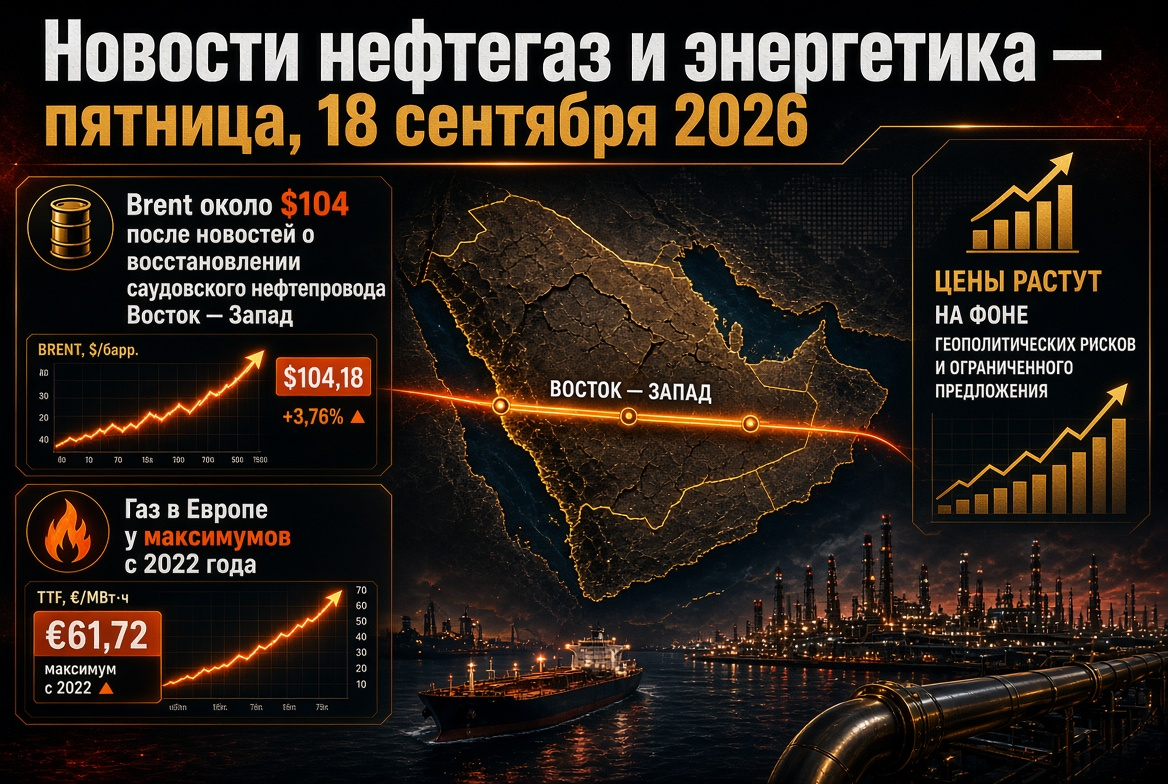
Global Oil, Gas and Energy Sector News - 20 November 2025: Price Dynamics for Oil and Gas, Sanctions, Production, Renewable Energy, Coal, and Key Trends in the Global Fuel and Energy Complex.
Global Oil Prices: Decline Amid Peace Prospects
The global oil market is experiencing a price decline following reports of potential progress in peace negotiations surrounding the armed conflict in Ukraine. On 19 November, Brent crude prices fell approximately 2.8% (to ~$63 per barrel), while US WTI dropped by 2.9% (to ~$59 per barrel) by midday. Investors responded to news of a US peace initiative, rekindling hopes for an end to hostilities. The prospect of agreements reduces the geopolitical premium in oil prices and shifts the market's focus to fundamental supply and demand factors, which currently indicate a surplus.
Oil prices had already been under pressure prior to this news due to concerns over overproduction. Last week, Brent and WTI lost around 4% amid signals of impending market surpluses. A brief price increase on Tuesday was followed by another drop on Wednesday, reinforcing the downward trend. Analysts note that if military risks to oil supplies diminish, the market will concentrate on the current demand and supply balance, which points to an oversupply.
Risks of Oil Oversupply and OPEC+ Actions
Fundamental indicators of the oil market indicate a likely supply surplus in the coming months. Several industry organisations have revised forecasts, signalling a possible oversaturation of the oil market by 2025–2026:
- OPEC and IEA Estimates: In OPEC's November report, it is noted that the global oil market could face a supply surplus by 2026 (previously a deficit was expected). The International Energy Agency also pointed to accelerated production growth that could lead to an oversupply of crude oil.
- US Production: The US Energy Information Administration (EIA) predicts that by the end of 2025, US oil production will reach a historical maximum, further strengthening global supply.
Against this backdrop, the OPEC+ alliance is gradually increasing production after a long period of restrictions. Since April 2025, the cartel has shifted its strategy from output cuts to a phased increase, aiming to regain lost market positions and prevent price spikes. This autumn, OPEC+ countries raised their collective quota by approximately +137 thousand barrels per day in October and again by the same amount in November, lifting previously voluntarily held volumes. However, many participants in the agreement are already operating at full capacity, so the actual increase in supply lags behind what was announced.
Nevertheless, OPEC+'s current policy aims at market softening — largely influenced by pressure from the administration of Donald Trump, which is demanding lower energy prices.
Sanctions and Restructuring of the Oil Market
Geopolitical factors continue to affect the oil industry. New US sanctions imposed in October against major Russian oil companies, "Rosneft" and "Lukoil", will take effect on 21 November, ultimately expected to reduce Russian oil export volumes. A number of buyers in China and India have already begun to reject crude from these companies, turning to alternative suppliers.
Russian authorities claim that the sanctions have not yet had a significant impact on production levels. According to Deputy Prime Minister Alexander Novak, oil production in Russia remains stable, and the new restrictions have not curtailed output volumes. He also emphasised that Russia has compensated for previous quota overages under the OPEC+ agreement and does not plan to voluntarily reduce production beyond the established agreements.
Experts note that the upcoming peace negotiations could potentially open the pathway to easing sanctions pressure. The US has already signalled a willingness to reconsider restrictions in light of progress in conflict resolution. A gradual de-escalation of geopolitical tensions would, in time, allow for a return to more free trade in oil.
It is noteworthy that the sanctions regime and military risks have already reflected on the global oil products market. In particular, recent restrictions and drone strikes on Russian oil refineries have triggered a surge in gasoline prices in the US to their highest levels since 2022. Thus, conflicts and sanctions impact the entire supply chain — from oil production to fuel prices for end consumers.
Russian Oil Production and the Domestic Market
Despite external pressures, Russia is gradually increasing oil production. According to Alexander Novak, by the end of 2025, the country expects to fully comply with its quota under OPEC+ (~9.5 million barrels per day). By November, production approached this level (in October, the shortfall from the quota was ~70 thousand b/d), and Moscow maintains an annual production forecast of approximately 510 million tonnes.
Russian oil companies have fully compensated for previous months' overproduction under the OPEC+ agreement and do not plan to voluntarily restrict output beyond the established quota. In other words, further production restrictions from Russia are not anticipated at this time.
On the domestic fuel market, the situation stabilised by November. Government-imposed restrictions on petroleum product exports, seasonal demand decline, and the return of refineries (refineries) after repairs have saturated the market. Wholesale and retail prices for gasoline and diesel, which surged in September, have reverted to familiar levels. Fuel companies have restored normal supplies to petrol stations, and authorities continue monitoring prices to prevent new shortages.
The Natural Gas Market: Europe and the US
- Europe: Gas prices in Europe have dropped to their lowest levels in nearly a year and a half. In mid-November, futures at the TTF hub fell to ~$364 per 1,000 m3 amid low demand and abundant liquefied natural gas (LNG) inflows. Mild weather and high storage levels have allowed the EU to enter the winter season without price shocks. Despite Europe's course towards phasing out Russian gas, some volumes from long-term contracts continue to be delivered, although their share is steadily declining. Experts anticipate that by the second half of 2026, a surplus in the global LNG market will emerge, further driving down prices.
- United States: In contrast, the United States has seen the end of the cheap gas era — prices have reached a three-year high. The Henry Hub Exchange Index surged to ~$162 per 1,000 m3, marking a record since 2022, amid a sharp increase in LNG exports (exceeding 0.5 billion cubic meters per day) and rising domestic demand with the onset of colder weather. High gas prices are already forcing several utilities to switch to coal generation to curb costs and meet electricity needs.
The Coal Sector and Power Generation
The global coal market is relatively stable as we approach the end of 2025, following periods of sharp fluctuations. In Europe, energy coal prices have dropped to a four-year low this autumn, but as the heating season commenced, some positions have been regained. Early cold weather temporarily increased coal use for electricity generation in October, although the overall course towards decarbonisation persists.
In the United States, rising natural gas prices have had the opposite effect: energy companies have increased the load on coal-fired power plants, interrupting years of decline in coal's market share. Although this is a temporary phenomenon related to the current fuel price dynamics, it highlights the importance of diversifying energy sources for the reliability of the energy system.
In China, there has also been a sharp increase in coal consumption this autumn. A combination of colder weather in the north and unusual heat in the south of the country has caused a spike in electricity demand, which had to be met through increased coal-fired power generation (amid a temporary drop in renewable energy generation). This has driven up domestic coal prices and illustrated how significantly weather conditions can impact energy supply.
Despite these short-term spikes, the long-term prospects for the coal industry remain subdued. The anticipated surplus of natural gas by 2026 and the large-scale construction of renewable energy facilities will limit coal’s growth potential. Investors are becoming increasingly cautious in approaching coal projects, aligning with low-carbon development goals.
Renewable Energy and Climate Goals
Renewable energy sources continue to strengthen their position in the global energy balance. The UK recently announced a major offshore wind project: the EDP Renewables (Portugal) and Engie (France) consortium has secured rights to construct a floating offshore wind farm with a capacity of 1.5 GW in the Celtic Sea off the coast of Wales. This project is designed to accelerate the decarbonisation of the UK electricity sector: by 2030, London aims to increase the installed capacity of offshore wind farms to 50 GW and nearly entirely phase out fossil fuels from generation.
Other countries are also ramping up investments in renewable energy, viewing it as a means to strengthen energy security and reduce dependence on fuel imports amid volatile oil and gas prices.
Industry organisations, however, caution against allowing shortages of traditional resources during the transition period and insist on sufficient investments in oil and gas to avoid further price spikes. At the same time, scientists warn that CO2 emissions from fuel combustion in 2025 are set to hit a record high, complicating the achievement of climate goals. In the lead-up to the UN climate summit COP30, governments and energy companies are under pressure to strengthen environmental regulations. Balancing the increasing demand for energy with meeting environmental commitments remains a key challenge for the entire fuel and energy complex.