Global Oil and Gas Market March 26, 2026: Oil Maintains Risk Premium, Gas Prices Rise, and Deficits in Oil Products and Increased Refinery Margins Intensify Energy Volatility
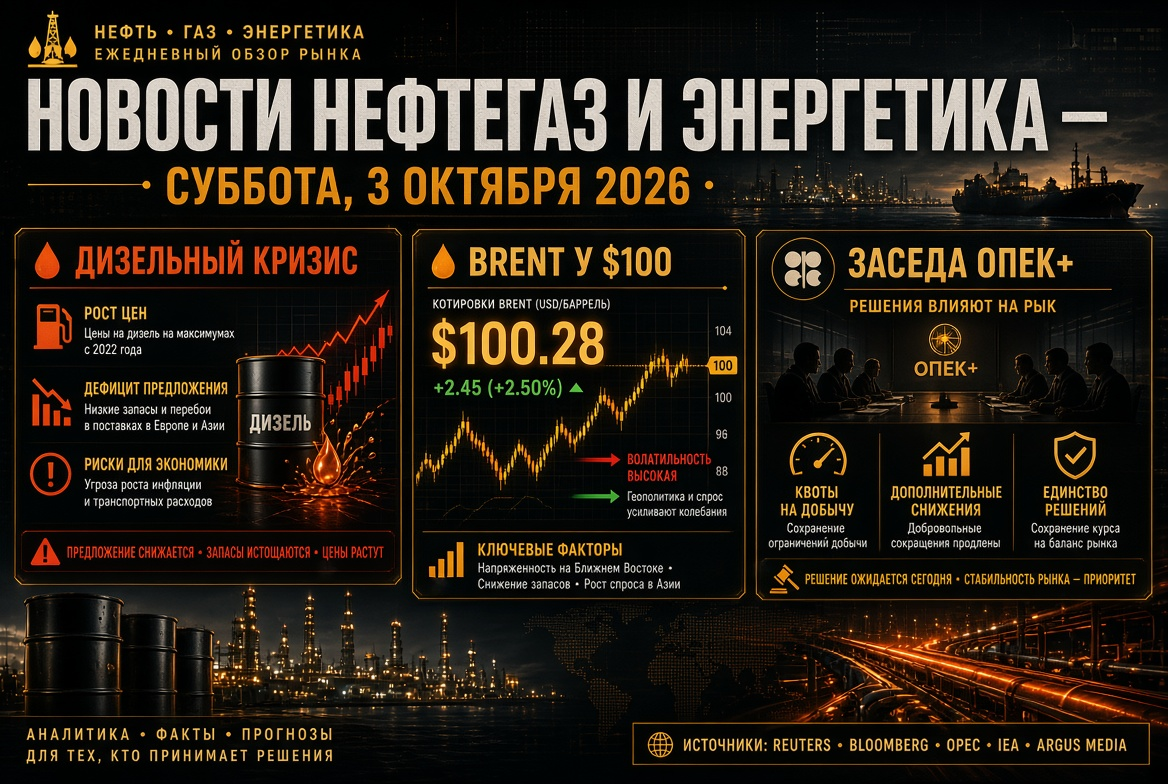
Oil remains the central indicator for the entire raw materials and energy sector. As of March 25, Brent futures were trading around $100 per barrel, while WTI hovered around $89 per barrel. For the global oil and gas market, this signifies a transition into a phase characterised by a persistently high risk premium: market participants are now assessing not only the current physical balance but are also factoring in the likelihood of prolonged disruptions to trade flows.
The current dynamics of oil are crucial for three main reasons:
- The Brent price remains sufficiently high to amplify inflationary pressures on the global economy;
- High oil prices automatically increase the cost of oil products and drive growth in refinery margins;
- The risk premium is beginning to influence investment decisions across upstream, midstream and downstream sectors.
Even after some signals suggesting a potential de-escalation, the market has not reverted to previous risk assessments. For investors, this indicates that volatility in oil prices will likely remain high in the upcoming days, with short-term downward corrections not appearing to signify a solid trend reversal.
OPEC+ and Supply: Symbolic Increase in Production Does Not Address Logistics Issues
OPEC+ has previously agreed to increase production by 206,000 barrels per day starting in April. Formally, this serves as a signal to the market regarding producers' readiness to add volumes. However, for the global oil and gas sector, the critical issue now is not just the additional production volumes but rather the ability to physically deliver oil to processing facilities and end markets.
This is why OPEC+’s decision is perceived as being of limited effectiveness. In practice, the market is facing the following constraints:
- Additional barrels do not fully compensate for logistical risks;
- Available capacities are concentrated in a limited number of countries;
- In the face of supply disruptions, buyers are willing to pay a premium for reliable routes, rather than simply for the volume of raw materials.
For oil companies, this means that even with an increase in supply, the market for oil may remain structurally tight. For investors in the energy sector, this enhances the importance of companies with stable export logistics, flexible sales channels, and a strong portfolio of downstream assets.
Gas and LNG: A New Round of Tension in the Global Gas Market
The gas market is again becoming one of the main drivers of global energy. Forward prices for LNG in Asia for 2026 are estimated at around $12.95 per MMBtu, while the European TTF for 2026 stands at approximately $12.41 per MMBtu, both significantly higher than the average levels of the previous year. This indicates that the market is already pricing in a more expensive gas balance not only spot-wise but also over the course of the year.
The European context is particularly important. In the Netherlands, gas storage levels have fallen to 5.8% of capacity — a record low for at least a decade. Meanwhile, the average level across the EU is noticeably higher, but the fact of such a low base at one of Europe’s key infrastructure points heightens market nervousness.
For the gas and LNG market, this implies:
- Europe may enter the injection season facing tougher competition for gas molecules;
- The cost of electricity will remain sensitive to any rise in gas prices;
- Asian buyers will be more aggressively competing for alternative LNG supplies.
Electricity in Europe: Gas Once Again Dictates System Prices
The electricity market in Europe is once again exhibiting the primary structural problem of recent years: even with a high proportion of cheap generation sources, the ultimate price is often set by gas stations that balance the system during peak demand hours. This means that expensive gas automatically translates into expensive electricity.
The European Union is already discussing temporary measures to alleviate price pressure, including tax reductions on electricity, lowering network fees, and targeted state support. The very existence of such discussions underscores that the energy shock is once again becoming a macroeconomic issue, rather than merely an industry news item.
Additionally, the fundamentals of Europe’s energy system are shifting. By the end of 2025, wind and solar energy accounted for 30% of electricity generation in the EU, surpassing the share of fossil fuel generation. However, the current situation demonstrates that while renewable sources enhance long-term resilience, the market remains vulnerable to gas price fluctuations in the short term.
Refineries and Oil Products: The Major Shortage Shifts from Oil to Refining
One of the most significant themes for the energy sector market as of March 26 is oil products and refining, where tensions appear to be the sharpest. In Asia, refining margins have surged to nearly $30 per barrel, with gasoline margins increasing to approximately $37 per barrel, and figures for jet fuel and diesel reaching multi-year highs.
The diesel market is particularly telling. In Europe, spot prices for ultra-low-sulphur diesel at the ARA hub have risen by nearly 55% since the end of February, and the typical diesel premium over oil has, at times, expanded to a range of $30–65 per barrel and above. This goes beyond mere raw material increases; it indicates a full-fledged stress in the oil product segment.
Key consequences for refineries and fuel companies include:
- Strong refining assets are experiencing a sharp improvement in short-term economics;
- Fuel consumers are facing accelerated growth in expenses;
- The deficit of diesel and jet fuel is becoming more critical than the overall oil balance.
The Valero Factor and Refining Risks in the US
An additional factor contributing to tension has been the shutdown and subsequent preparations for the restart of Valero's 380,000 barrel per day refinery in Port Arthur. For the global oil product market, this serves as an important signal: even local technological failures at large refining facilities, in the context of already high margins, instantly heighten market nerves.
When the global market fears a fuel shortage, every major hydrocracking unit, every refinery, and every export terminal begins to exert a greater influence on prices than usual. For investors, this renders the refining sector one of the most sensitive, yet also one of the most attractive in the short-term horizon.
Coal: A Temporary Beneficiary of High Gas Prices
The rise in LNG prices and tensions in supplies have already supported the coal segment. The Asian benchmark for thermal coal increased by 13.2% in March, while European futures rose by 14.2%. This indicates a familiar scenario for the global energy sector: amid high gas prices, some generation and industrial sectors are once again turning to coal as a more accessible backup fuel.
However, this is not a full-scale reversal in the energy transition, but rather a tactical adjustment. Coal remains a backup resource for energy systems and certain industries, while strategically, investment continues to shift towards more flexible generation, networks, energy storage, and renewables.
Renewables and the Energy Transition: Resilience Grows, but the Crisis Still Favors Strategy
The renewable energy market continues to solidify its position, particularly in Europe, where the growth of solar generation and the increased share of wind energy are altering the energy balance structure. However, amidst the current crisis, investors are witnessing a contrasting perspective: while renewable energy decreases medium-term dependency on fuel imports, it cannot instantly replace the volumes of oil, gas, and oil products that are being lost.
Therefore, in the near term, the market will evaluate renewables in two dimensions:
- As a long-term protective asset for the electricity sector;
- As an insufficiently quick response to the current shock in hydrocarbon supplies.
This contrast is defining investor behaviour today: interest in renewables remains, but the short-term focus is predominantly on oil, gas, oil products, refineries, and electricity.
For Investors and Energy Sector Participants
As of March 26, 2026, the global energy market is still in a phase of high price and logistical turbulence. Oil maintains a geopolitical premium, gas and LNG prices are rising, electricity remains reliant on gas pricing mechanisms, and oil products and refineries have become the main source of short-term shortages. Coal temporarily strengthens its position, while renewables reaffirm their strategic significance but do not alleviate current pressures.
For the oil and gas and energy markets, this indicates that the upcoming weeks will be determined not only by news regarding production but also by issues related to routes, inventories, refining, and fuel availability. Four indicators are of utmost importance for investors:
- The stability of Brent oil prices near current levels;
- The pace of recovery in gas and LNG supplies;
- The refining margins for diesel, gasoline, and jet fuel;
- The ability of energy systems to maintain electricity prices without new shocks.
Thus, the global energy landscape as of March 26 presents a narrative that extends beyond simply expensive oil. It encompasses how oil, gas, electricity, renewables, coal, oil products, and refineries simultaneously create a new map of risks and opportunities for the entire global energy sector.