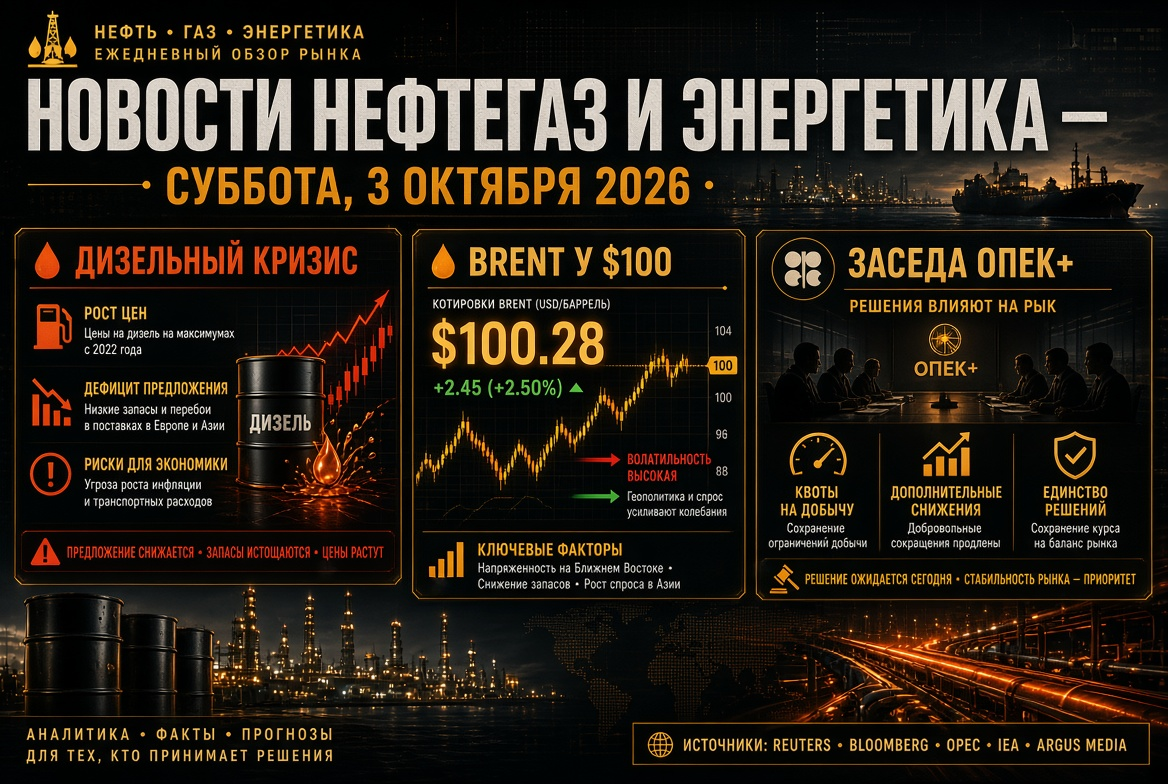
Current News in the Oil, Gas and Energy Sector for Saturday, 20 June 2026: Dynamics of Brent and WTI Oil Prices, the Situation in the Strait of Hormuz, Gas and LNG Market, Refineries, Oil Products, Power Generation, Renewable Energy Sources (RES) and Coal
The global fuel and energy complex enters Saturday, 20 June 2026, in a state of cautious stabilization following a period of high volatility. The key topic of the day for investors, participants in the fuel and energy sector, oil companies, gas traders, refineries, oil product suppliers, and power generation firms is the reassessment of risks surrounding supplies through the Strait of Hormuz and the gradual decrease of the geopolitical risk premium in oil prices.
While the oil and gas market in previous weeks operated under the logic of scarcity, logistical disruptions, and the threat of price spikes, the focus is now shifting to the question of how quickly physical supplies of crude oil, LNG, oil products, and base oils will recover. For the global audience, this is a crucial point: it directly affects the prices of Brent and WTI, refining margins, gas prices in Europe and Asia, coal dynamics, investments in RES, and the stability of the energy sector.
Oil: Brent and WTI Adjust After Easing of the Military Premium
The main event in the global oil market is the reduction of tension in the Middle East and the resumption of tanker movements through key maritime routes. Brent hovers around $80 per barrel, while WTI is around $77, with the past week marking one of the weakest periods for oil quotations in recent months. For investors, this signals that the market is gradually exiting panic pricing and returning to an analysis of supply and demand balances.
Three factors currently influence oil dynamics:
- The recovery of supplies through the Strait of Hormuz and the diminishing fear of physical scarcity;
- Expectations of increased output from Middle Eastern producers;
- Revisions to oil demand forecasts amid a slowing global economy and rising energy efficiency.
However, the sharp price decline does not mean a complete removal of risks. Logistics, tanker insurance, technical recovery of production, and trader trust require time. Therefore, the oil market remains sensitive to any statements regarding the Middle East, sanctions, OPEC+ production, and oil stock levels in the US, China, and Europe.
OPEC+ and the Long-Term Dispute Over Demand: The Market Sees Two Scenarios
For oil companies and funds, it is not only the current Brent level that matters, but also the divergence between forecasts from major energy institutions. OPEC maintains a more optimistic outlook for long-term demand, expecting global oil consumption to continue growing over the horizon of 2030-2050. The argument rests on developments in India, the Middle East, Africa, Latin America, and the enduring role of oil products in transportation, industry, and petrochemicals.
Conversely, the International Energy Agency is increasingly warning of a risk of surplus following the recovery of supplies and the introduction of new capacities. For investors, this creates two distinct scenarios:
- Sustainable Demand Scenario: Oil remains a fundamental raw material for transportation, petrochemicals, aviation, and emerging markets.
- Surplus Scenario: Supply rebounds faster than demand, putting downward pressure on prices in 2027.
The practical takeaway for the fuel and energy market is that oil assets with low production costs, stable logistics, and access to export channels gain a competitive advantage. Companies with high production costs and significant debt become more vulnerable as prices decline.
Gas and LNG: Europe and Asia Compete for Supply Flexibility
The gas market remains the second focal point after oil. Europe continues the injection season into underground gas storage, but the starting conditions for 2026 were weaker than in previous years. This heightens the importance of LNG supplies, weather factors, and competition with Asia. The hotter the summer in China, Japan, South Korea, India, and Southeast Asia, the greater the demand for gas for power generation and cooling.
In the US, natural gas is supported by high demand expectations for air conditioning and active LNG exports. This is crucial for the global market as American LNG remains one of the key balancing sources for Europe and Asia. If export terminals operate stably, the gas market gains extra flexibility. Conversely, if disruptions occur, price premiums can return quickly.
For gas companies, the key indicators for the coming weeks are:
- The pace of gas injection into European storage;
- Weather forecasts in Asia and North America;
- Loading levels at LNG terminals;
- The cost of freight and insurance for maritime deliveries;
- The price dynamics of TTF, Henry Hub, and Asian LNG contracts.
Refineries and Oil Products: Margins Remain Elevated
The refining sector remains one of the most interesting segments of the fuel and energy complex. Despite falling oil prices, the margins for diesel, gasoline, aviation fuel, and select oil products remain above historical averages. The reason lies in the consequences of logistical disruptions, limited supply in certain regions, high summer demand, and the need to replenish stocks.
This creates a favourable environment for refineries but simultaneously increases operational risks. Plants operate at high capacity, and deferring maintenance to preserve output may lead to more serious technical issues later on. The market is particularly attentive to the US, Europe, the Middle East, and Asia, where refining directly impacts the prices of gasoline, diesel fuel, and jet fuel.
For fuel companies, this means that procurement strategies must consider not only the price of oil but also regional spreads for oil products, fuel availability, delivery timelines, and the risk of local shortages.
Power Generation: Rising Demand Enhances the Importance of Networks and Backup Generation
The global power generation sector faces a dual challenge: demand is growing due to industry, data centres, artificial intelligence, electrification of transport, and air conditioning, while the generation structure is becoming increasingly complex. The US is expected to see record electricity consumption in 2026-2027, while Asia's demand is supported by urbanisation and industrial growth, and Europe is undergoing a restructuring of its energy systems and phasing out certain fossil fuel sources.
For investors in the power sector, not only solar and wind stations are gaining significance, but also networks, energy storage, gas generation, balancing capacities, and digital load management. Without modernising the grids, the growth of RES may lead to generation limitations and price instability.
Renewables: Growth Continues, but Oil and Gas Companies are Becoming More Pragmatic
Renewable energy remains one of the largest investment directions in global energy. China continues to actively develop solar and wind projects, and the substantial placement by China Resources New Energy demonstrates the high interest of capital in RES infrastructure. For the global market, this signals that green energy maintains access to financing even amid volatility in raw material markets.
However, oil and gas companies are becoming more cautious. Several major players are reassessing previous RES targets, focusing not on the volume of installed capacity but on the profitability of projects, electricity trading, gas generation, energy storage, and hybrid models. This represents an important shift: the energy transition is not being abandoned, but it is becoming more financially disciplined.
Coal: Asia Maintains Demand, but Market Structure is Changing
Coal remains an important part of the global energy balance, especially in Asia. In China, weak wind generation in May led to an increase in fossil fuel output, primarily from coal and gas. This shows that even with large-scale development of RES, traditional generation remains necessary for energy systems.
Conversely, in India, the import of thermal coal has dropped to the lowest levels in several years due to increased domestic production and upticks in renewable energy generation. For coal companies, this means a more complex geography of demand: the market remains substantial but is becoming more regionally heterogeneous.
What Matters to Investors and Energy Companies
Saturday, 20 June 2026, presents several key takeaways for the global fuel and energy market. Oil is no longer traded solely on scarcity fears but the geopolitical premium may return with any disruptions in negotiations or logistics. The gas market remains sensitive to weather conditions, LNG levels, and stocks. Refineries maintain high margins but operate under increased load. Power generation and RES receive long-term investment momentum but require enhanced networks, storage, and backup capacities.
Investors should closely monitor the following indicators:
- The prices of Brent and WTI after the recovery of traffic through the Strait of Hormuz;
- OPEC+'s production decisions and actual quota compliance;
- The rate of gas injection in Europe and LNG demand in Asia;
- Margins for refineries on diesel, gasoline, and aviation fuel;
- Electricity demand from data centres, industry, and transport;
- Investments in RES, networks, storage, and gas peaking generation;
- The dynamics of coal in China, India, and Southeast Asia.
The main conclusion of the day: the global fuel and energy sector is entering a phase not of diminishing resource significance but of a more complex energy balance. Oil, gas, electricity, RES, coal, oil products, and refineries are becoming increasingly interconnected. For investors, the winners will not be those companies that focus solely on a single resource, but those who can manage logistics, margins, infrastructure, supply flexibility, and energy security on a global scale.