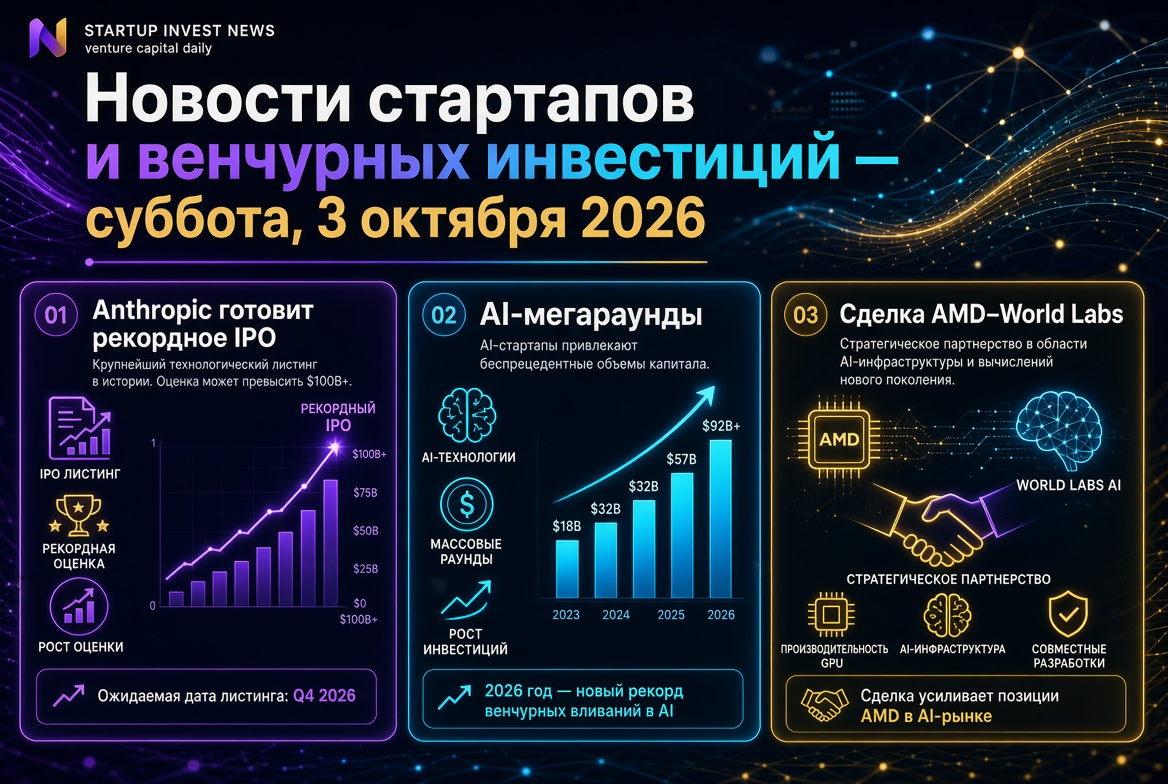
Startup and Venture Investment News for 20 March 2026: AI Mega Rounds, Infrastructure Growth, New IPOs, and Global Venture Market Trends
By 20 March 2026, the global startup and venture investment market continues to maintain a high pace but is becoming significantly more selective. Venture capital is increasingly concentrating on the largest deals surrounding artificial intelligence, corporate software, fintech, and computational infrastructure. For venture funds, this presents two realities: on one hand, capital is actively working again; on the other, access to the best deals is increasingly dependent on sectoral specialization, the quality of the syndicate, and the investor's ability to add strategic value after the funding round is closed.
Recent events indicate that the startup market is shifting towards mature growth models. The focus is now not just on ideas but on companies capable of rapidly monetizing their products, scaling enterprise sales, managing burn rates, and preparing for the next stage—strategic sale, secondary liquidity, or IPO. For venture investors and institutional funds, this creates a more structured market, where the premium on business quality once again becomes the key factor in valuation.
- Artificial intelligence remains the primary magnet for substantial capital.
- Infrastructure and applied AI startups draw the highest interest from funds.
- The IPO window is gradually coming to life but remains sensitive to geopolitical issues and market volatility.
- Fintech, legaltech, healthtech, and semiconductor startups are solidifying their positions as the second tier of growth.
- Europe is increasingly establishing institutional conditions to compete with the United States.
AI at the Core of the Venture Market
The main takeaway for the startup market as of 20 March is that artificial intelligence is not just a strong sector but, in fact, the backbone of all global venture activity. Capital is concentrating in companies that either create foundational models or deliver computational infrastructure, corporate AI solutions, and deployment tools for enterprise clients. This establishes a new standard of assessment: investors are increasingly looking not merely at abstract potential but at access to computational resources, strong engineering teams, clear monetization models, and consistent demand from major corporates.
For funds, this translates into intensified competition for quality. AI deals increasingly resemble private growth rounds involving not only traditional VCs but also private equity, strategic investors, and major cloud and chip players. In such a market, success is not reserved for those simply willing to pay inflated valuations but for those who can provide a startup with sales channels, access to enterprise clients, and subsequent scalability.
OpenAI, Thinking Machines, and the New Logic of Major AI Deals
One of the key signals of the week is the rising interest in structures whereby AI companies build not just products but entire ecosystems around corporate implementation. Major players are now competing not only for models but also for the distribution of AI technologies within fund and corporate portfolios. This significantly elevates the importance of platform strategy in the venture market.
Simultaneously, the infrastructure layer is becoming more robust. Access to computational power is becoming an asset almost as crucial as intellectual property. In this context, startups that can provide:
- scalable models for training and inference;
- integration into corporate processes;
- reduced deployment costs for enterprises;
- rapid expansion through partnerships with chip and cloud providers.
For venture investors, this creates an important fork in the road. Early funds have a chance to enter the infrastructure layer ahead of the next wave of asset revaluation, while growth investors are increasingly operating in a quasi-private-public market logic, where the scale of contracting and the speed of converting technology into cash flow play a crucial role.
Legaltech and Vertical AI Move to Prioritisation
While the primary focus in 2024–2025 was on universal AI models, by 2026, the startup market increasingly displays a shift towards vertical AI. Here, investors see quicker capital payback and reduced dependence on fundamental model races. Legaltech, enterprise automation, medtech, and specialised software are becoming some of the most attractive areas for venture investments.
The growth of the legal AI and legal data platform segments is particularly significant. For funds, this is an interesting asset class for several reasons:
- high ARPU in the corporate segment;
- long contracts and more predictable revenues;
- clear scaling economics through SaaS;
- low likelihood that the product will be quickly commoditised.
The growing interest in legaltech indicates that the venture market in 2026 is gradually moving away from the "invest only in the noisiest AI" model and returning to the classic principle: capital flows where there are real business pains, high tickets, and a strong potential for strategic exits.
Semiconductor Startups and Computational Infrastructure Become a Separate Asset Class
Another significant trend is the growing interest in semiconductor startups and companies developing AI infrastructure in Europe and the USA. For the global startup market, this is particularly important; investors no longer view chip companies as inherently lengthy and capital-intensive stories. Rather, the shortage of computing power, geopolitical fragmentation of supply chains, and the need for energy-efficient solutions are turning this sector into one of the most strategic.
Venture investments in such companies are increasingly extending beyond standard early-stage capital. They now include:
- blended financing involving funds, corporates, and government programmes;
- long-term commercial agreements as part of the investment logic;
- a focus on regional technological autonomy;
- support for both manufacturing and software stack simultaneously.
For funds, this means semiconductor startups can no longer be ignored as a niche segment. It is one of the few areas where deeptech, industrial policy, and traditional venture capital are beginning to function as a cohesive system.
Fintech: Between Ecosystem Growth and IPO Market Nerves
Fintech remains an important part of the global venture agenda, but here the dependence on market conditions is most pronounced. On one hand, the segment maintains scale, mature business models, and a global audience. On the other, the IPO market remains very sensitive to external volatility. This makes 2026 not a year of unqualified reopening but a year of selective windows for public offerings.
For venture investors, this suggests several practical conclusions:
- late-stage fintech requires more conservative scenario analysis;
- high valuations no longer guarantee a swift IPO;
- secondary transactions and private liquidity are becoming more significant than classic IPO timing;
- companies with sustainable unit economics and proven revenue growth are especially valuable.
In other words, fintech remains a priority, but investors increasingly want to see capital discipline rather than merely a story of scaling at any cost.
IPO is Back on the Agenda, but the Market Still Selects the Best
The revitalisation of the IPO theme is one of the most significant indicators that the venture market is emerging from a prolonged wait phase. New filings and the preparation of mature tech companies for listing signal that an IPO window exists. However, this window is not broad for everyone. The public market is ready to accept companies with robust corporate histories, quality revenues, and clear risk structures, but is not yet prepared to support every growth asset unreservedly.
This is particularly important for funds whose portfolios were constructed between 2020 and 2022. They now receive a more realistic map of exits:
- the best assets may prepare for IPO;
- second-tier companies will seek sales to strategics;
- some late assets will transition into extended private cycles;
- the secondary market will become a key channel for partial liquidity.
Thus, the startup and venture investment market in 2026 returns value to quality portfolio construction. For LPs and GPs, this is a positive signal: exit mechanisms are back in operation, albeit in a more disciplined form.
Europe Attempts to Close the Gap with the US
The European startup market is showing a significant institutional shift. Alongside substantial rounds in AI and deeptech, there is an increasing focus on simplifying the rules for creating and scaling technology companies. This could prove to be a crucial factor for funds that have historically viewed Europe as a region with strong engineering foundations but challenging regulatory environments.
Simultaneously, the positions of European fintech are strengthening. This is reshaping the global investment map: Europe is becoming not only a source of quality technical teams but also an independent platform for larger late-stage deals. For global venture investors, this opens new opportunities in segments such as:
- AI infrastructure;
- fintech and embedded finance;
- legaltech and enterprise software;
- industrial deeptech and chips.
If regulatory initiatives are implemented consistently, Europe has the potential to significantly increase the number of companies that can grow within the region rather than relocating to the USA upon scaling.
What This Means for Venture Funds and Investors
As of 20 March 2026, the venture investment market appears stronger than it did a year ago, yet simultaneously more complex. Capital is available, interest in technology assets is high, and the exit window is gradually opening. However, capital is being distributed unevenly: winners are receiving substantial capital, while others must prove efficiency, sales velocity, and the ability to survive without endless funding rounds.
For venture funds and investors, it is currently rational to maintain a focus on three areas:
- AI and vertical software as the primary driver of valuation expansion and strategic demand.
- Infrastructure and deeptech as a long-term bet on the shortage of computing power, chips, and industrial automation.
- Preparation for exits through IPO readiness, secondary liquidity, and more active engagement with strategic buyers.
The bottom line for the global startup market is clear: venture capital has not entered a defensive mode but has transitioned into a phase of more mature distribution. The most valuable companies are no longer simply fast-growing startups but platforms with strong economics, industry specialisation, and a high probability of becoming public or strategically indispensable assets. It is around such narratives that the venture agenda for the coming months will be constructed.