Current News on Startups and Venture Investments as of 18 September 2026: OpenAI's Negotiations for a New Round, Mega Rounds in AI Development, Record Bonuses for Research Teams, New Unicorns, Valuation Gap Between Europe and the USA, Deals in India, and IPO Window Testing Amidst High Costs of Capital
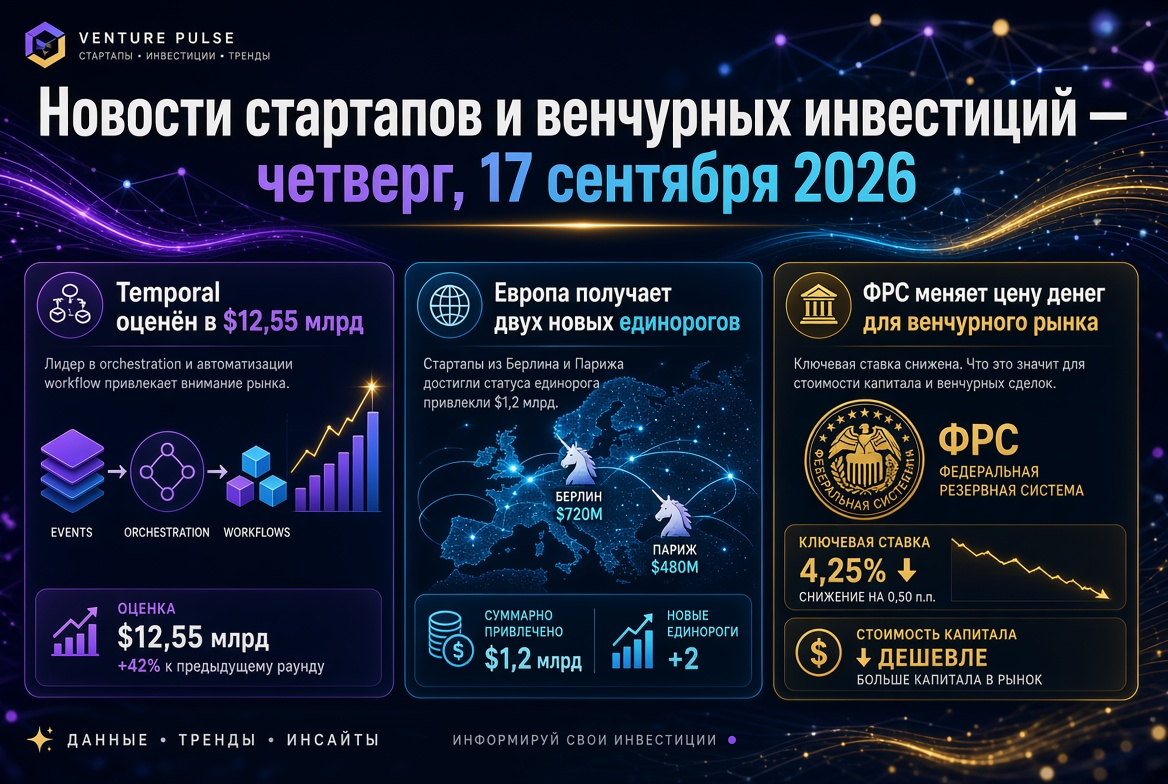
By the end of the third week of September, the global venture market is navigating two realities. On one hand, the US Federal Reserve raised rates on Wednesday for the first time since 2023 — to 3.75–4.00%, with the yield on ten-year Treasury bonds exceeding 5%, and 16 out of 18 committee members expect another hike by the end of the year. On the other hand, private capital continues to massively overvalue AI leaders within just months. For venture investors and funds, Friday, 18 September, presents a test: will the appetite for risk withstand the new cost of capital?
Key topics on the venture agenda:
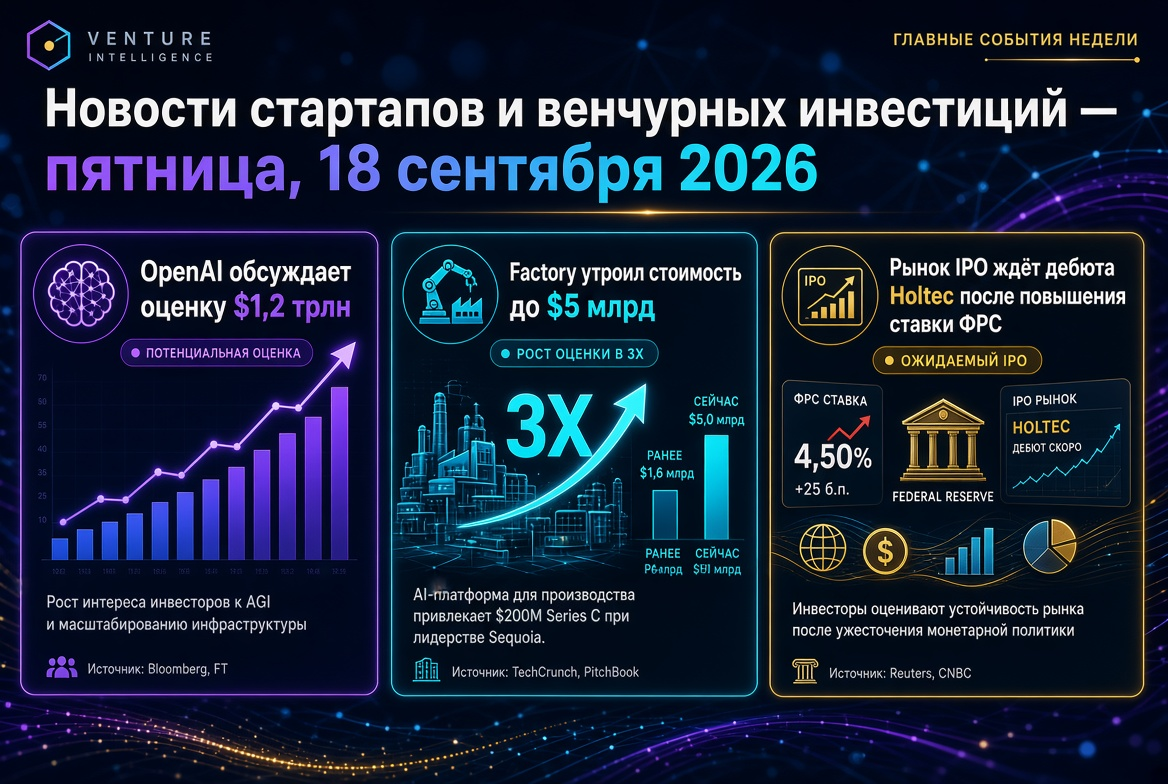
- OpenAI is in early negotiations for a round valuing the company above $1.2 trillion.
- Factory secured $200 million at a valuation of $5 billion — three times higher than in April.
- Discovery Loop by Jeff Dean is seeking capital at a valuation of around $50 billion, without a product or revenue.
- New unicorns: Profound ($1.8 billion), CADDi ($1.2 billion), Thatch ($1 billion).
- Europe: the median valuation of AI startups is nearly eight times lower than that of their US counterparts.
- IPO: Holtec's debut on Nasdaq is anticipated for Friday, while Oura is preparing for a listing by the end of the month.
OpenAI and the Race for Trillion-Dollar Valuations
OpenAI has initiated preliminary discussions regarding a new funding round which could value the company at over $1.2 trillion. The initiative has come from investors, and the deal parameters may still change. In March, the company closed the largest private round in history — $122 billion at a valuation of $852 billion, meaning the new benchmark would represent a roughly 41% increase in under six months. In August, there was a tender buyback of shares from employees at $7 billion based on the previous valuation.
The rationale is clear: IPO documents have been filed confidentially, but the listing has been pushed to 2027, and the private round provides capital without public disclosure obligations. Annual revenue surpassed $40 billion in July; however, 2025 closed with a net loss of $38.5 billion on revenue of around $13 billion. Competitor Anthropic, which raised $65 billion in May at a valuation of $965 billion, is reportedly preparing to list on Nasdaq as early as this autumn, with its shares trading on the secondary market at an implied valuation of around $1.2 trillion. The first to go public will set the multiplier for the entire sector.
AI Development: Factory and the Price of "Software Factories"
Startup Factory, which creates AI agents called Droids for writing, testing, reviewing, and deploying code, has secured $200 million at a $5 billion valuation. The round was backed by Khosla Ventures, Blackstone, and Sequoia Capital, with business angels such as Marc Benioff, Brad Gerstner, and Nico Rosberg participating. The dynamics of the valuation are telling:
- April — Series C at $150 million with a valuation of $1.5 billion;
- July — extension of $120 million at a valuation of $4 billion;
- September — $200 million at a valuation of $5 billion, accumulating over $400 million raised.
Among its clients are Nvidia, Adobe, Morgan Stanley, and Palo Alto Networks. The segment is overheated: Cognition raised over $2 billion in September at a $48 billion valuation, while SpaceX acquired developer Cursor for $60 billion. Venture funds will need to determine whether corporate demand is sufficient to support multiple players with the same thesis.
Team Premiums: Discovery Loop and Thinking Machines
Discovery Loop, founded on August 5 by former Google chief scientist Jeff Dean along with Sanjay Gemawat, Quoc Le, and Oriol Vinyals, is negotiating funding at a valuation of around $50 billion. Just weeks earlier, discussions were underway for $1 billion at a valuation of approximately $10 billion. The first round was led by Radical Ventures and Khosla Ventures, with Lightspeed and Kleiner Perkins participating, while Alphabet serves as a founding investor. The company aims to automate scientific experiments but currently lacks a product and revenue. Thinking Machines Lab, led by Mira Murati, is concurrently discussing a $1 billion round at a $40 billion valuation. The market is not paying for metrics, but rather for access to rare research teams — this represents the riskiest segment of the current cycle.
New Unicorns and Infrastructure Rounds of the Week
- Profound — $180 million Series D at a $1.8 billion valuation led by Sequoia and Kleiner Perkins, seven months after Series C; the platform helps brands appear in AI search responses.
- CADDi — $114 million Series D at a $1.2 billion valuation; an AI data platform for industrial manufacturing.
- Thatch — $108 million at a $1 billion valuation from General Catalyst and Index Ventures.
- Lyte — $165 million Series C at a $1.6 billion valuation; perception systems for "physical AI".
- TAR — $120 million Series A at a $1 billion valuation from Spark Capital; autonomous power supply for data centres.
- Crusoe and Fluidstack — over $3 billion at around $30 billion and $1.5 billion at an $18 billion valuation, respectively.
The common denominator remains consistent: venture capital flows to where there is scarcity — computing, energy, industrial data.
Europe: Volume Growth Amidst an Eightfold Discount
According to PitchBook, the median pre-money valuation of AI startups in Europe is €8.3 million compared to €64.2 million in the USA. Notably, artificial intelligence accounted for 60.2% of the value of European venture deals in the first half of the year, up from 37.8% in 2025, with total volume reaching €44 billion. Recent rounds include Integral (€18 million Series A from Mosaic Ventures and Reid Hoffman), Hackuity ($19 million Series B), and Veridion ($20 million Series A). Crane Venture Partners has closed four funds totalling $484 million. For global investors, the European discount poses both a liquidity risk and an entry point.
Asia: India Increasing Weekly Volume
Between 7-12 September, 24 Indian startups raised approximately $413 million — a 42% increase from the previous week. Leaders include space startup Pixxel ($100 million Series C from Temasek and Seraphim), restaurant chain Popo Global ($56 million from Artal Asia), and brand Nua ($50 million from Peak XV Partners). Year-to-date, India has raised $16.3 billion across 1,450 rounds: fewer deals but larger cheques.
IPO and Macro: A Test for the Listing Window
On Friday, Holtec Nuclear is expected to begin trading on Nasdaq under the ticker HNUC: 50 million shares in the $15–$18 range, approximately $825 million at the midpoint and a valuation of up to $10.2 billion. Demand for nuclear power is being driven by data centres, but the sector is heterogeneous: X-energy is trading below its offering price, while Standard Nuclear dropped on its first day. Oura is aiming for a listing by the end of September at a valuation exceeding $16 billion. The market's reaction to the Fed was muted for technology: the Dow fell by 1.2%, while Nasdaq remained relatively unchanged. The next benchmark will be the decision from the Bank of Japan.
Russia and the CIS: A Market of Isolated Deals
Various estimates suggest that the Russian venture market shrank by about half in the first half of 2026, with the number of active investors dropping from 50 to 33; one methodology estimates the volume at just $29.3 million. In the CIS, 92% of investments were secured by a round from the Uzbek marketplace Uzum at $131.5 million, with Uzbekistan accounting for 44 out of 58 deals in the region. Capital is concentrating in mature companies with proven revenue.
What This Means for Venture Investors and Funds
- The discount rate has risen, and valuations of leaders have increased as well. The gap between AI elite and the rest of the market will widen; late stages outside AI are likely to see a reassessment of multiples.
- The speed of revaluation is a risk in itself. A tripling in five months necessitates scrutiny of revenue retention, rather than just growth rates.
- Bets on teams without a product are justified only within a portfolio logic and with a limited fund share.
- Geography provides arbitrage opportunities. The European discount and early rounds in India appear more attractive than the overheated segments in the USA.
- Liquidity will define the autumn. The debuts of Holtec and Oura will indicate whether the public market is ready to accept new listings at yields above 5%.
The venture market enters the last decade of September with record private valuations and the highest cost of capital in three years. Startups that can demonstrate economic viability, rather than mere potential, will prevail.