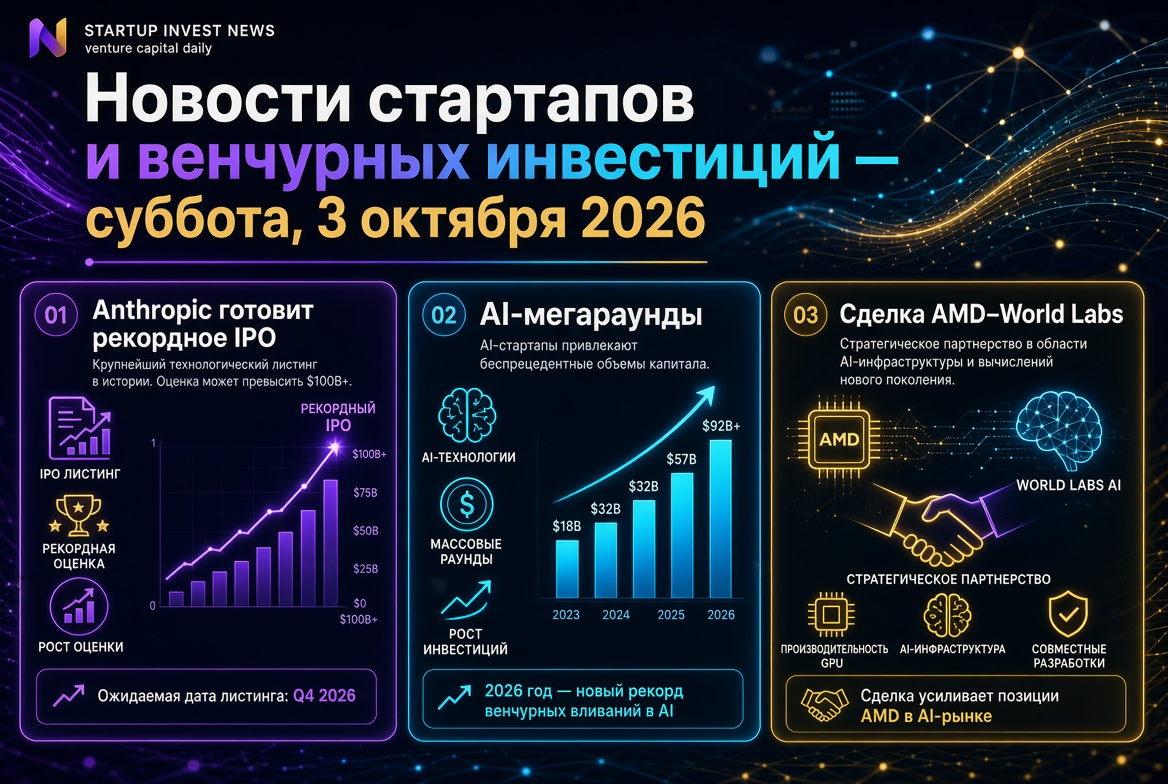
Latest Startup and Venture Investment News for Wednesday, 17 June 2026: DeepSeek's Mega Round, Sarvam AI's Growth, AI Agent Deals, Cybersecurity, and AI Infrastructure, a Review for Venture Investors and Funds
The global startup and venture investment market is entering mid-June 2026 with heightened capital concentration. The primary focus of the day is a new wave of mega rounds in artificial intelligence, AI agent infrastructure, cybersecurity, enterprise automation, and national technology platforms. For venture investors and funds, this is no longer just another cycle of interest in AI; rather, it represents a restructuring of the entire market architecture: capital is increasingly flowing to companies that control computational infrastructure, data, corporate security, and applied AI scenarios.
Three major trends are coming to the forefront: sovereign artificial intelligence, corporate agent systems, and vertical AI products for the real economy. The United States maintains its leadership in terms of venture capital volume, China is strengthening its national AI champions, India is developing its own model of technological sovereignty, while Europe is trying to establish a foothold in B2B segments, industrial automation, and HR tech.
DeepSeek Becomes the Main Event of the Week for the Global Venture Market
The most noteworthy news for the startup and venture investment market is the substantial funding for the Chinese AI company DeepSeek. The round, exceeding $7 billion, places the startup among the most valuable private companies in China's artificial intelligence sector. A valuation surpassing $50 billion indicates that global competition in AI infrastructure is no longer confined to American laboratories and cloud platforms.
This case is significant for venture funds for several reasons:
- Investors are willing to embrace complex deal structures in pursuit of access to strategic AI assets;
- National funds and large corporations are becoming key players in the venture market;
- The valuations of AI startups are increasingly influenced not only by revenue but also by the company's role in the country’s technological sovereignty;
- The competition between the US and China is shifting from chips and clouds to the private capital market.
DeepSeek demonstrates that venture investments in 2026 are increasingly fulfilling not just a financial, but also a geo-economic function. For funds, this means a rise in political, regulatory, and structural risks, but simultaneously the emergence of significant opportunities in the segment of national AI platforms.
Sarvam AI Shows Growth in Interest for Sovereign AI in India
Indian startup Sarvam AI has raised $234 million at a valuation of approximately $1.5 billion, becoming one of India's new AI unicorns. The round, backed by prominent tech investors, highlights a crucial shift: India aims not only to utilise Western and Chinese AI models but also to build its own AI infrastructure, taking into account local languages, corporate demand, and government requirements.
For venture investors, Sarvam AI is significant as an example of a new investment category — sovereign AI startups. Such companies build local models, applied solutions, and infrastructure for countries with sizeable domestic markets, engineering talent, and a strategic interest in technological independence.
A key takeaway for funds: in 2026, prospects are not only for global AI platforms but also for regional leaders capable of serving national markets, considering language, regulation, data, and corporate specifics.
Salesforce Acquires Fin: The AI Agent Market Moves to M&A Phase
Salesforce's acquisition of the AI platform Fin for approximately $3.6 billion sends an important signal to the exit market. Following a prolonged period of limited liquidity, venture investors are closely monitoring significant M&A transactions, particularly in the AI agents and corporate automation segments.
Fin operates in the AI customer service and communications automation field. For Salesforce, this acquisition strengthens its strategy around Agentforce and demonstrates that large public SaaS companies are ready to buy AI-native assets to safeguard their positions against technological shifts.
For venture funds, this deal is important for three reasons:
- AI agents are transitioning from an experimental product to a fully-fledged corporate infrastructure.
- Major strategic buyers are again willing to pay significant multiples for rapidly growing AI companies.
- The M&A market could become the primary channel of liquidity for mature B2B startups until the mass IPO window reopens.
NewCore and Arcade: New Infrastructure for the AI Agent Economy
One of the most promising areas of the venture market is the infrastructure for managing AI agents. NewCore secured $66 million to develop a platform for identifying and controlling access for AI agents, while Arcade.dev obtained $60 million for solutions enabling the authorisation of actions by autonomous systems within corporate environments.
These deals illustrate that the AI market is rapidly shifting from generating text and images to addressing the question of: who controls the actions of AI agents within a company? As autonomous systems gain access to CRM, ERP, payment tools, internal databases, and customer communications, businesses require a new layer of security, auditing, and rights management.
For venture investors, a new category is forming here: AI agent infrastructure. This encompasses startups addressing issues of digital identity, authorisation, logging, compliance, access management, and corporate data protection. The potential market could rival that of cybersecurity and cloud infrastructure, as AI agents gradually become part of companies' operational models.
Cybersecurity Re-emerges as a Priority for Venture Funds
Funding rounds for NewCore, Arcade, and Ent reveal that in 2026, cybersecurity is gaining new momentum due to the rise of autonomous AI systems. The startup Ent has raised $100 million to enhance a platform for monitoring the behaviour of endpoint devices. The focus is shifting from classic attack detection to preventing actions taken by humans, machines, or AI agents exhibiting atypical behaviour.
For funds, this signifies a growing interest in the following areas:
- Protection of AI agents and corporate data;
- Monitoring the actions of autonomous software;
- Endpoint device security;
- Tools for auditing and investigating incidents;
- Solutions for regulated industries — finance, defence, healthcare, and manufacturing.
Cybersecurity is becoming not merely a separate vertical but a foundational investment layer for the entire artificial intelligence economy.
Orbio AI Strengthens the Trend Towards HR and Frontline Workforce Automation
The Spanish startup Orbio AI has raised $21 million in a Series A round to develop its agent-based AI platform in HR tech. The company automates hiring, onboarding, and managing frontline employees across retail, healthcare, hospitality, and other sectors characterised by high staff turnover and significant operational burden.
For the venture market, this serves as an important example of vertical applications for AI agents. Unlike general AI assistants, such products address a specific business challenge: reducing hiring costs, accelerating employee adaptation, enhancing communication quality, and minimising staff turnover.
Funds are increasingly assessing such startups based on practical metrics: reduced hiring times, increased candidate conversion rates, lower employee churn, savings on operational teams, and product scalability across different countries.
Prometheus and Industrial AI: Capital Flows into the Real Sector
The industrial AI startup Prometheus, related to developing solutions for the design and manufacturing of complex physical products, has become one of the most talked-about private assets of June. A substantial round and a valuation in the tens of billions of dollars indicate that investors are expecting the next growth wave not only in software but also in industrial AI.
Interest in industrial artificial intelligence can be easily explained: if AI can accelerate the development of engines, medical devices, robotics, electronics, and manufacturing processes, its economic impact may exceed that of many consumer applications. For venture funds, this opens opportunities in deep tech, robotics, manufacturing automation, AI design tools, and digital modeling.
However, this segment requires a longer investment horizon, capital-intensive infrastructure, and strong expertise in manufacturing. Consequently, industrial AI startups are more frequently attracting not just traditional venture funds, but also strategic investors, corporations, private equity, and large institutional structures.
Fintech and Industrial Automation: The Market Extends Beyond AI Models
Against a backdrop of AI mega rounds, deals continue to occur in other sectors. Interchecks raised $50 million to develop instant payment infrastructure, while Podium Automation secured $18 million to scale manufacturing of industrial control panels through software-enabled manufacturing.
This news illustrates that the venture market is not limited to big language models. Investors maintain interest in companies that address infrastructural challenges in payments, industry, logistics, automation, and corporate processes.
For funds, clear metrics become critical: revenue, profitability, unit economics, sales repeatability, customer acquisition costs, and demand sustainability. Amid overheated valuations in AI, such B2B startups may present a more rational alternative for portfolios needing a balance between high growth and controlled risk.
What This Means for Venture Investors and Funds
The primary takeaway for Wednesday, 17 June 2026, is that the venture investment market remains robust but increasingly polarised. The largest cheque sizes are directed towards AI infrastructure, national models, agent systems, and cybersecurity. Startups lacking a technological advantage, data, distribution, or clear revenue will find it significantly more challenging to attract capital.
Venture investors should pay attention to several directions:
- AI Infrastructure: computing, security, AI agent identification, data governance, and corporate integration.
- Sovereign AI: local models for India, China, Europe, the Middle East, and other major markets.
- Vertical AI: solutions for HR, healthcare, industry, finance, education, and customer service.
- Cybersecurity: protection for autonomous systems, endpoint security, behaviour monitoring, and compliance.
- M&A-ready Startups: companies that could become strategic assets for Salesforce, Microsoft, Google, Oracle, Adobe, ServiceNow, and other large platforms.
Simultaneously, risks are also increasing. Valuations for AI startups remain high, competition is intensifying, computing costs are putting pressure on model economics, and regulators are becoming more scrutinising regarding data, privacy, and cross-border investments. For funds, this signifies the need for more rigorous due diligence: checking not only the technology but also data access, cost structure, revenue quality, product defensibility, and potential exit scenarios.
The startup and venture investment market as of 17 June 2026 appears to be one of winners with strong capital concentration. Money is available, but it is becoming more selective. The best opportunities will belong to companies that are not just building yet another AI-based application but establishing a key layer of new technological infrastructure — from AI agents and cybersecurity to industrial artificial intelligence and national platforms.