Current News on Startups and Venture Investment as of 23 March 2026: Megarounds in AI, Increased Interest in Infrastructure and Defence Tech, Changes in the IPO Market and Strategies of Venture Funds
As the new week begins, the global startup and venture investment market maintains a strong pace but is becoming increasingly polarised. Capital continues to flow actively into artificial intelligence, defence technologies, AI infrastructure, and certain segments of fintech, while traditional software models and some late-stage ventures face tougher valuation and exit requirements. For venture investors and funds, this signifies one thing: the market has not weakened, but it has become significantly more selective.
A key feature of the current cycle is the concentration of capital in a small number of companies and themes. AI startups continue to attract megarounds, leading platforms accelerate corporate commercialisation, and funds are increasingly searching not just for technology but for scalable sales channels, access to corporate clients, and sustainable infrastructural revenue. At the same time, Europe is enhancing institutional support for innovation, while fintech and deep tech are confirming that the market is no longer solely focused on generative AI.
Below are the key themes shaping the market agenda for Monday, 23 March 2026:
- AI remains the primary magnet for venture capital and new 'unicorns'.
- Venture investments are shifting towards infrastructure, chips, defence, and enterprise solutions.
- Funds and private equity are increasingly looking for ways to accelerate AI monetisation through corporate channels.
- Europe is strengthening its position in fintech and deep tech, reducing the gap with the US.
- The IPO and exit market remains open only to quality stories, with weak offering windows closing rapidly.
The AI Sector Remains the Primary Centre of Capital Attraction
Assessing the startup market in March 2026 in terms of capital distribution, the dominance of artificial intelligence is virtually unquestionable. AI startups are driving the largest rounds, setting new valuation benchmarks and defining the investment agenda for global funds. For venture investors, this is no longer simply a fashionable sector, but a fundamental layer of the entire new technological economy — from models and chips to applied corporate solutions.
The market is particularly attentive to companies that combine strong scientific foundations with the potential for industrial scalability. In this context, investments in AI are increasingly viewed not as a bet on a single product, but as a purchase of access to what will become the future infrastructure standard. This is why funds are willing to accept high valuations if they see a chance to secure a place in the next generation of platform winners.
Megarounds Confirm Increased Appetite for Large Bets
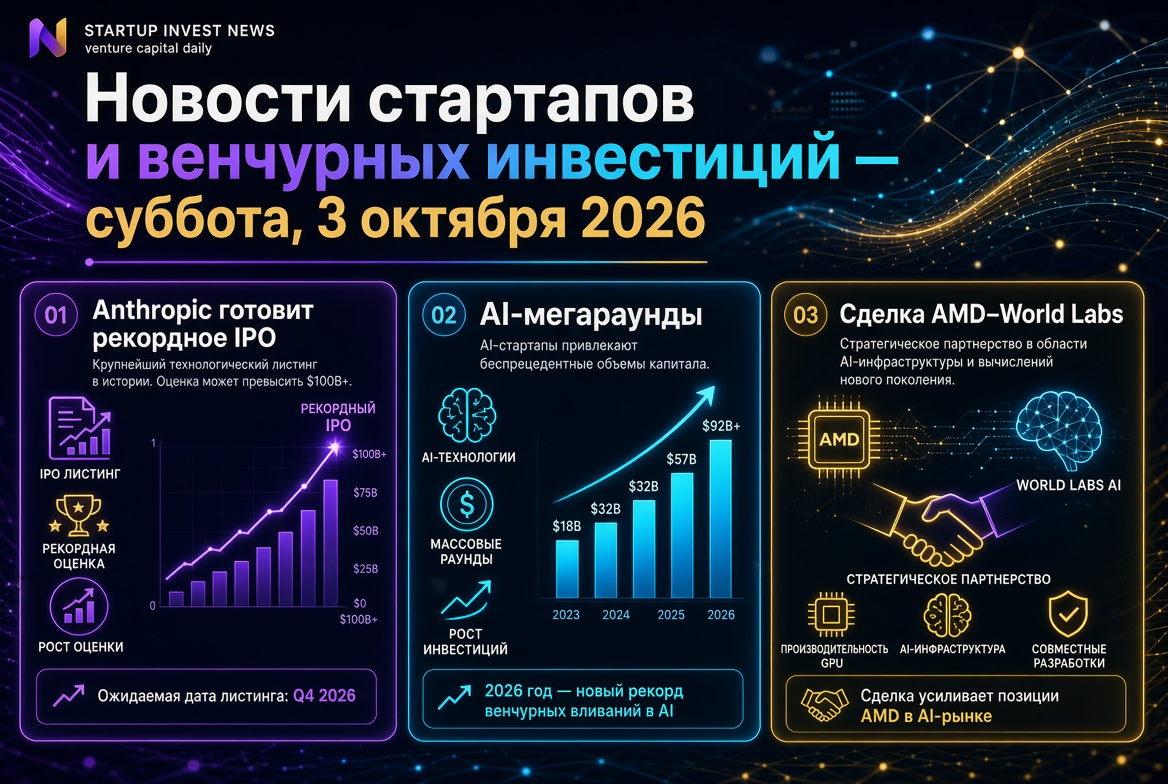
Recent weeks have shown that the market is once again ready for very large deals. The startup AMI Labs, associated with a new wave of research in 'world models' and deeper machine logic, raised over $1 billion, and in the defence sector, Anduril is discussing a new multibillion-dollar round that could effectively double its valuation. This is a significant signal: capital is returning to projects that aim for a strategic role in the industry rather than a niche function.
For the startup and venture investment market, this translates to an expansion of the group of 'acceptable megarounds'. Previously, super-sized deals were concentrated around a few generative AI leaders; now, investors are willing to finance a broader group of companies across defence tech, AI infrastructure, enterprise AI, and the chip sector. This makes the market deeper but simultaneously intensifies the divide between leaders and other startups.
The Focus is Shifting from Models to Infrastructure and Corporate Integration
One of the most significant trends for tomorrow is that venture capital is increasingly gravitating toward areas with infrastructure, integration, and repeatable corporate revenue. Investments in SambaNova and Axelera AI demonstrate that the market is placing confidence not only in model creators but also in producers of computational bases, inference solutions, and specialised AI chips. This is no longer a stake in abstract 'AI growth' but rather a bet on specific market bottlenecks that will drive margins.
It is worth highlighting the strengthening of the enterprise vector. Major AI companies are eager to offer not just access to models but comprehensive solutions for companies, funds, and large industrial groups. Practically, this translates to a growing interest in startups that can integrate into corporate processes, reduce costs, and create measurable ROI. For funds, this is particularly important as the market begins to require economics rather than simply growth narratives.
The New Connection Between Venture and Private Equity is Changing the Market
One of the most notable shifts in March is the convergence of the venture investment world, AI platforms, and private equity. Major players are considering joint structures that will facilitate quicker AI implementation in portfolio companies and enable immediate scale-up of commercialisation. Essentially, the market is searching for a new format where investment in technology is directly accompanied by distribution channels, corporate orders, and implementation at the level of entire corporate groups.
For startups, this opens up a new growth logic. Success will not only come to those with the best products but also to those who gain access to the enterprise ecosystem more quickly. For venture funds, this shift is even more pronounced: value creation increasingly depends not solely on the subsequent round but also on the capacity to secure a paying corporate client for the companies involved. In this sense, the startup market is moving closer to the infrastructure model of private markets.
Europe is Strengthening its Position in Fintech and Startup Policy
The European market is also sending strong signals. London is reinforcing its status as a global fintech hub, and Europe as a whole is demonstrating noticeable improvement in capital inflows into financial technologies. In this context, it is particularly important that the European Union is discussing measures to simplify the launch of companies under unified regulations. If these initiatives are fully implemented, the European startup ecosystem could gain substantial structural acceleration in the coming years.
For global funds, this indicates that Europe is becoming not just a secondary market after the USA, but a full-fledged platform for deals in fintech, AI infrastructure, cybersecurity, and industrial deep tech. Considering that some American segments are already overheating in terms of valuations, European assets are becoming increasingly attractive on the basis of price, engineering quality, and regulatory predictability.
The Market is Expanding Beyond AI: Healthtech, Cybersecurity and Defence Tech
Although artificial intelligence dominates the headlines, the venture market is broadening. The recent round for Grow Therapy shows a robust interest in healthtech platforms with clear business models and strong demand from end customers. In cybersecurity, there remains high interest in solutions embedded directly into the operational framework of engineers and enterprise teams. Meanwhile, defence tech is firmly establishing itself as one of the fastest-growing investment segments, no longer considered a 'controversial niche'.
For venture investors and funds, this is encouraging news. The market is not confined to a single asset class, opening up more scenarios for diversification. However, capital is flowing only to those areas where there is either technological uniqueness, a powerful geopolitical driver, or clear commercial applicability. The era of 'funding anything tech-related' has not returned — instead, we have returned to an era of funding the best.
Exits and IPOs: The Window is Open, but Only for the Strongest
Another important story for 23 March 2026 is that the exit market remains uneven. On one hand, individual companies are still preparing for the public market, and new confidential filings confirm that interest in IPOs is alive. On the other hand, some issuers are postponing placements due to volatility and stricter risk assessment. This is especially the case for those stories where investors do not see sufficient premium for market entry at this time.
For startups, this means the necessity of structuring the company to be ready for several scenarios: IPO, sale to a strategic buyer, secondary transactions, or a longer private cycle. For funds, the logic is even stricter: exits must once again be earned. Simply having a brand, growth, or a previous high valuation does not guarantee liquidity.
Implications for Venture Investors and Funds in the Coming Week
As the week begins, the strategy for market participants looks quite clear:
1. Where Capital Interest is Maximised
- AI infrastructure and corporate AI solutions;
- chips, inference, computational platforms;
- defence tech and dual-use technologies;
- fintech in Europe and scalable B2B models;
- healthtech with clear unit economics.
2. What Investors Will Scrutinise Especially Closely
- speed of product commercialisation;
- access to corporate sales channels;
- margin after scaling;
- technology defensibility and team quality;
- realism of exit scenarios in the 2–4 year horizon.
The key takeaway for Monday, 23 March 2026, is straightforward: the startup and venture investment market remains very strong but is no longer forgiving of mediocrity. Capital is available, funds are active, and new large rounds are occurring almost weekly. However, winning companies are primarily those capable of combining technological advantage with commercial discipline, as well as those aligned with long-term structural trends — artificial intelligence, corporate automation, security, deep tech, and the new infrastructure of the economy. For investors, this continues to be a market of opportunities, but only with a high degree of selectivity.