The Global Startup and Venture Investment Market Accelerates Unevenly by the End of March 2026: Capital Continues to Flow Primarily into Artificial Intelligence, Infrastructure Platforms, Robotics, and Defence Tech, While Funds Become More Selective About Revenue Quality, Unit Economics, and Paths to Liquidity
As of 29 March 2026, the venture capital market appears more active than in previous quarters, but also more discerning. Startups with a robust technological foundation, access to computational power, corporate contracts, and a clear scaling strategy are securing large funding rounds more quickly than a year ago. Meanwhile, investors globally are no longer financing just any "growth story": the focus is now on AI infrastructure, defence tech, legal AI, robotics, climate tech, and mature fintech models. For venture investors and funds, this signifies a shift to a new market phase, where the cost of capital remains high but the premium for quality assets has risen even further.
Key Theme of the Day: Capital Continues to Concentrate Around AI Infrastructure
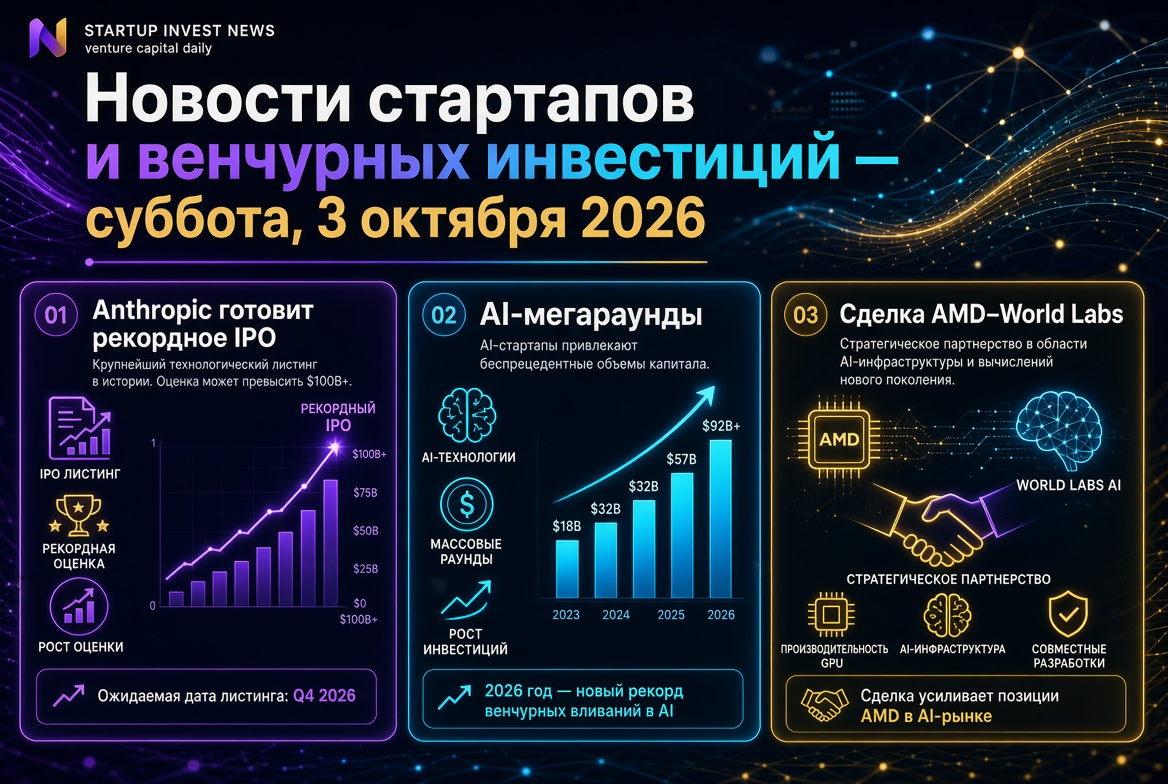
A defining characteristic of the current startup and venture investment market is not just the popularity of artificial intelligence, but the sharp concentration of capital among a select group of leaders. The 2026 venture market increasingly resembles a model in which substantial checks are awarded to companies poised to become the foundational infrastructure for the next technological cycle. This includes not only model developers, but also orchestration platforms, data infrastructure, computing clusters, robotics, and corporate AI solutions.
In this context, it is noteworthy that a substantial financial structure is forming around OpenAI. SoftBank has secured a bridge financing round of $40 billion to bolster investments in OpenAI and other AI-related areas. The mere scale of this initiative confirms that the largest investors are betting not on standalone startups but on entire ecosystems surrounding generative AI, cloud infrastructure, and corporate AI integration.
Mega Rounds are Returning, but Not All Companies are Benefiting
An uptick in activity does not signify a return to the chaotic funding characterised by the era of zero interest rates. On the contrary, the venture investment market has become more stringent. Yes, mega funds and large rounds are dominating discussions again, but access to such funding is restricted to startups with strong technological differentiation, a solid contract base, and a significant potential moat.
- Shield AI raised $2 billion in Series G funding, achieving a valuation of $12.7 billion.
- AMI, related to an alternative approach to AI development, secured $1.03 billion.
- Legora in the legal AI sector attracted $550 million with a valuation of $5.55 billion.
- Mind Robotics, a spinout from the Rivian ecosystem, raised $500 million in Series A funding.
This set of deals indicates a significant transformation: mega capital is flowing not only into foundation models but also into applied layers where AI becomes an industry product. This is particularly relevant for funds looking for not overheated stories, but markets with clear enterprise demand and real barriers to entry.
Defence Tech Establishes Itself as a Key Winner of the Cycle
Defence tech deserves special attention. Not long ago, many traditional funds approached defence technologies with caution, but by March 2026, this segment has effectively emerged as one of the key areas of the global venture market. The reason is simple: the demand for autonomous systems, AI navigation, simulation, unmanned platforms, and secure software has ceased to be hypothetical.
The Shield AI deal stands as one of the strongest markers of this trend. The company not only secured a large funding round but also enhanced vertical integration through the acquisition of Aechelon Technology. For investors, this serves as an important signal: the best defence tech startups are no longer building a singular product but are developing complete technological stacks.
Additional context is provided by January deals in the national security software segment, as well as a growing interest from large funds in defence sectors. This implies that startups at the intersection of AI, robotics, autonomy, and security will remain among the priority targets for capital in Q2 2026.
Robotics Returns to the Forefront of the Venture Agenda
While robotics was often perceived as a long-term bet with high technical risks in 2024–2025, it is now re-emerging as one of the hottest segments. The reason lies in the synergy with AI. Investors are no longer viewing robotics as a standalone hardware market; it is now seen as the physical extension of intelligent software.
Two key lines of development are noteworthy:
- Startups building autonomous systems for industry, logistics, and defence;
- Companies securing capital by blending proprietary models, data, and access to real deployment.
Mind Robotics, with a $500 million round, and the anticipated new capital raise by Physical Intelligence confirm that the market is once again ready to finance substantial robotics stories. For venture funds, this signifies a renewed interest in deep tech, but now in conjunction with AI models and not merely as "pure hardware."
The European Market Becomes More Prominent and Confident
As of 29 March 2026, Europe appears stronger in the startup and venture investment news compared to a year ago. Several signals indicate the region's strengthening. Firstly, European companies are increasingly securing large rounds in specialised niches: from legal AI to AI infrastructure. Secondly, the European regulatory and institutional landscape has started to actively foster the creation of a more competitive environment for startups.
A significant factor is the discussion of the EU Inc initiative, aimed at simplifying the creation and scaling of innovative companies within Europe. Concurrently, financial studies are noting a strengthening of the European fintech landscape: London has emerged as a leader among global fintech hubs, and the volume of European fintech financing is approaching levels seen in the United States.
For global venture investors, this signifies that Europe no longer merely serves as a source of strong teams to be relocated to the US. It is gradually reclaiming its status as a viable platform for nurturing unicorns and specialised technological platforms.
The IPO Window is Gradually Opening, and the Market is Once Again Thinking About Exits
For funds, 2026 is significant not only for new rounds but also for the revival of discussions about exits. Amid signs of a resurgence in the public placement market, SpaceX is reportedly nearing the filing of its IPO documents. Even though timelines may still shift, the underlying momentum indicates that the liquidity window is gradually reopening for the largest technology stories.
This has fundamental implications for the entire venture ecosystem:
- Discipline regarding revenue quality and corporate governance is strengthening;
- Funds are beginning to reassess their asset retention horizons;
- Mature startups are gaining an additional argument in negotiations for late-stage funding.
In other words, startup news by the end of March 2026 is no longer solely about new rounds, but also about future liquidity. This is particularly important for the venture investment market following several years of prolonged scarcity of large exits.
Not Only AI: Climate Tech, Fintech, and Vertical Software Retain Opportunities for Capital
Despite the dominance of artificial intelligence, the market is not limited to AI models. Investors continue to seek strong stories in climate tech, fintech, and industry software. In Brazil, the startup Re.green secured a long-term concession for the restoration of areas within the Amazon, which is not a traditional venture funding round but serves as a strong signal that climate projects are increasingly taking on institutional forms and could evolve into scalable investment platforms.
In fintech, attention is shifting towards sustainable business models. The growth of Revolut, Airwallex's expansion in Europe, and interest in insurance AI such as Notch illustrate that capital is increasingly flowing to companies where technology is embedded in the cash flow, rather than existing separately from it. For venture investors and funds, this suggests a return of interest in fintech 2.0—more pragmatic, infrastructural, and international.
What This Means for Funds and Investors Right Now
As of 29 March 2026, the startup and venture investment market is drawing several clear conclusions for professional participants:
Key Takeaways
- AI remains a magnet for capital, but infrastructure and industry players are emerging as winners, not everyone.
- Defence tech and robotics have definitively moved beyond niche status and have become mainstream in the venture market.
- Europe is strengthening its position through regulatory changes, specialised unicorns, and a growing fintech ecosystem.
- The theme of IPOs and liquidity is returning to investment committees, meaning the requirements for asset quality will increase.
- Funds are finding it increasingly difficult to neglect climate tech and vertical software if there is real commercial demand behind them.
For investors worldwide, this indicates a transition to a phase of "selective acceleration." There is plenty of money in the system, but it is being redirected towards startups with strong technology, clear revenue, and proven scalability. Such companies will define global startup and venture investment news in the second quarter of 2026.
As Sunday, 29 March 2026 arrives, the market greets it with a sense of confident yet conditional optimism. Venture capital is once again active, mega rounds are making headlines, and startups with strong AI, robotics, defence tech, and legal tech profiles have a chance to accelerate sharply. Simultaneously, discipline is tightening: in 2026, it is the most prepared, not the loudest, that will prevail. For venture funds, this is a market of opportunity, but only with high selectivity, rigorous screening, and an understanding of where hype truly translates into long-term value.