Key Trends in the Startup and Venture Capital Market as of 6 April 2026: AI Infrastructure, Defence Technologies, and New Capital Concentration
By early April, it has become clear that the venture market is no longer moving uniformly. Funds are still available, but their distribution is highly uneven. The main flow of capital is directed towards the largest AI companies, computational infrastructure, autonomous systems, and technology platforms that could form the new backbone of corporate software stacks.
This creates several significant consequences for the market:
- large funding rounds are once again setting the tone for the entire sector;
- valuations of leaders are rising faster than the operational metrics of the market as a whole;
- funds are finding it increasingly difficult to compete for the best deals without industry specialisation;
- early-stage activity remains robust, but the requirements for quality teams and products are noticeably higher.
In other words, a startup in 2026 attracts capital not only through growth potential but also through its ability to integrate into one of the global investment theses: AI, autonomy, security, energy efficiency, financial infrastructure, or industrial software.
AI Infrastructure Becomes the Major Magnet for Large Deals
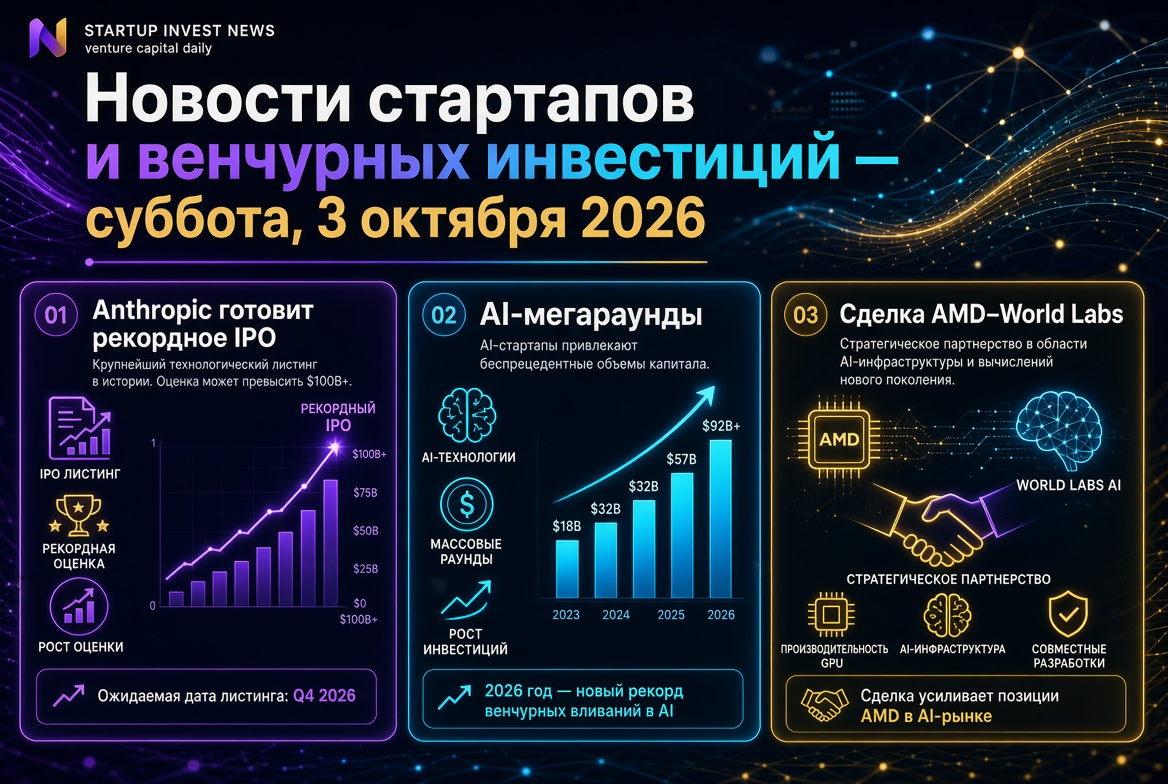
The chief theme of the market going forward is not just artificial intelligence as an applied product but rather AI infrastructure. Investors are increasingly funding companies that are building the physical and digital foundation for the next wave of AI demand: data centres, GPU management, computation orchestration, energy supply, and new forms of distributed infrastructure.
Notably, European company Mistral has secured significant debt financing for developing data centre facilities and procuring Nvidia chips. This is an important signal: the market is starting to utilise not only traditional venture capital but also more complex financing forms for infrastructure with predictable demand.
Practically, this translates to:
- investors are willing to finance not only models but also the "shovels" for the AI boom;
- the market is accepting high capital intensity as the new norm;
- the boundary between venture capital, private equity, and infrastructure financing is becoming increasingly blurred.
For funds, this is particularly significant as future returns are increasingly being established not in high-level applications but rather in control over scarce resources—computation, energy, and productivity.
Space and Cloud Infrastructure Transition from Exotic to Investment Mainstream
One of the most illustrative cases in recent times is the funding round for Starcloud. This company, which is working on orbital infrastructure for AI workloads, has secured substantial financing and quickly achieved unicorn status. Just a short while ago, such projects were seen as a fringe story blending deep tech and science fiction; however, capital now views them as potential solutions to real issues—specifically, the scarcity of energy, land, and power for ground-based AI data centres.
In a broader context, this reflects a new investment logic:
- if AI continues to increase its energy consumption, the market will support unconventional infrastructure solutions;
- deep tech projects now have a chance for faster commercialisation than was possible in the previous cycle;
- startups at the intersection of space, energy, and computation are now classified as strategic assets.
For venture investors, this is an important marker: the market is beginning to reward not only product speed but also the scale of engineering ambition when backed by evident structural demand.
Defence Technologies Become a Full-Fledged Part of Global Venture Mainstream
Another persistent trend is the growing interest in defence tech. The significant funding round for Shield AI confirms that defence technologies are no longer viewed as a niche with a limited circle of investors. On the contrary, autonomous systems, software for complex environments, simulators, and intelligent management systems are emerging as a key theme at the intersection of government, industry, and private capital.
Why is this important right now?
- government budgets and military programmes create sustained demand;
- defence software increasingly has dual-use and commercial potential;
- autonomy, robotics, and modelling have become critical for both security and industry.
For the venture investment market, this means that defence tech is gradually becoming what fintech was in the last cycle: a sector where large checks, strategic clients, and high technological advantage valuations can coexist.
Fintech Returns to Focus Through Stablecoins, Tokenisation, and Market Infrastructure
While many anticipated that the next wave of fintech startups in 2024-2025 would be exclusively tied to AI, by April 2026 the market presents a more complex picture. Companies that are restructuring core financial infrastructure—such as international payments, FX platforms, asset tokenisation, and linking traditional financial markets with blockchain rails—are stepping into the foreground.
Two recent examples illustrate this trend:
- OpenFX is enhancing its stake in cross-border payments and currency exchange using stablecoin infrastructure;
- Midas is developing asset tokenisation for investment products, targeting not only the crypto audience but also institutional demand.
For funds, this signifies a pivotal shift. The investment thesis in fintech is again structured not around attractive interfaces but rather around infrastructural advantages: transaction speeds, reductions in transactional costs, access to new classes of liquidity, and regulation-resilient architecture.
Europe Strengthens its Position in the Race for Technological Sovereignty
The European startup ecosystem is no longer appearing as a secondary market relative to the USA. Amidst the development of Mistral, the growth of major AI companies, and the expansion of late-stage funding, Europe is increasingly building its technological base—particularly in segments where control over infrastructure has become both a political and economic issue.
This creates several new scenarios for investors:
- European companies may command a premium for strategic autonomy;
- local champions are capable of attracting public, private, and banking capital simultaneously;
- some funds will redistribute their mandates in favour of Europe as a venue for less overheated but high-quality deals.
For the global venture capital market, this is a positive signal: ecosystem competition is intensifying, thus expanding the geography of quality opportunities outside of several traditional clusters.
Early Stage Remains Vibrant, but Entry Barriers for New Startups Have Increased
Despite the dominance of mega-rounds, the early-stage market does not appear to be dead. On the contrary, by April 2026, it is evident that seed and early-stage activities remain highly active, and the number of young unicorns remains unusually high. However, the market structure has changed: investors are more frequently opting not just for interesting ideas but for teams demonstrating outstanding execution speed and a clear path to dominate their niche from the outset.
Today, early startups benefit most from the following characteristics:
- a well-defined AI component or infrastructural value;
- deep technical expertise among the founders;
- the ability to rapidly penetrate a vertical with a large market;
- the potential to become a strategic acquisition target even before the IPO stage.
This indicates that the classical “venture for hypothesis” is giving way to “venture for early leadership.” Early-stage rounds remain accessible, but quality requirements for startups have escalated to nearly the level of previous Series A.
Exits and M&A Again Become an Important Part of the Investment Model
The exit market is also coming back to life. Although the IPO window cannot yet be termed fully open for the entire market, investors are increasingly considering large public placements as a realistic scenario for the best technology companies. Concurrently, M&A activity is intensifying: strategic buyers are returning for technologies, teams, and infrastructure.
The most significant takeaways for investors here are:
- major players are willing to acquire mature private companies at billion-dollar valuations;
- acqui-hires and targeted technology acquisitions are accelerating, particularly in AI;
- for many funds, selling to a strategic buyer is once again as realistic a scenario as an IPO.
For the venture investment market, this is crucial: liquidity is returning, meaning investment committees have more grounds to support new deals in late stages.
What This Means for Venture Funds and Private Investors
As of Monday, 6 April 2026, the key takeaway is crystal clear: the market has become “big” again, but not “broad.” There is capital available, activity is high, valuations are rising; however, most profits are likely to concentrate in segments where foundational technological infrastructure for the new cycle is created.
Investors should pay particular attention to the following directions:
- AI infrastructure and computation management;
- defence and autonomous systems;
- financial infrastructure based on stablecoins and tokenisation;
- European technology champions with clear scaling strategies;
- early teams that can quickly evolve into infrastructure players or M&A targets.
This is where the new map of opportunities for venture capital is currently being formed. For global funds, it represents a market with high concentration, competition, and potential returns. For founders, it is a market where not just good ideas win, but technological platforms capable of becoming part of the next industrial and digital cycle.