Latest Startup and Venture Investment News as of 9 April 2026: Including AI Infrastructure Growth, Robotics, Fintech, and Global Venture Market Trends
The global startup and venture investment market approaches 9 April 2026 in significantly stronger shape than just a few quarters ago. Following a period of caution, capital is now actively flowing back into technology companies; however, the nature of this growth has changed. Whereas the market was previously relatively broad in terms of sectors, the focus has now shifted to a few segments where investors are willing to pay a premium for scale, speed, and strategic importance. This primarily includes artificial intelligence, computational infrastructure, robotics, cybersecurity, and next-generation financial technologies.
For venture investors and funds, this marks a transition to a new phase of the cycle. There is more money in the market, but it is being allocated more selectively. The largest rounds are not merely going to AI startups, but to companies that are building computational power to accelerate model training, automating security, and creating infrastructure for corporate AI integration. Simultaneously, there is a growing demand for concrete exit scenarios: the M&A market has revived, and the window for individual public offerings is gradually opening. In this configuration, startups that either become systemically important to the new AI economy or quickly evolve into scalable platforms are the winners.
The Venture Market Starts the Year with Record Volumes, but Growth is Highly Concentrated
A key signal for the global startup market is the strong start to 2026 regarding venture funding volumes. However, this growth cannot be interpreted as a uniform recovery of the entire ecosystem. On the contrary, the market has become significantly more polarised: huge sums are being attracted by a few leading technology companies, while many later-stage and mid-sized startups continue to face tough capital-raising conditions.
For funds, this serves as an important marker. Venture investments are once again on a large scale, but the cost of errors is higher than in previous cycles. Investors prefer projects that can rapidly occupy a critically important position in the AI value chain, rather than simply demonstrating user growth. As a result, the startup market is splitting into two layers: a narrow segment of companies with almost unlimited access to capital and a broad segment where requirements for unit economics, sales efficiency, and the speed of revenue generation remain stringent.
AI Infrastructure has Become the Main Magnet for Capital
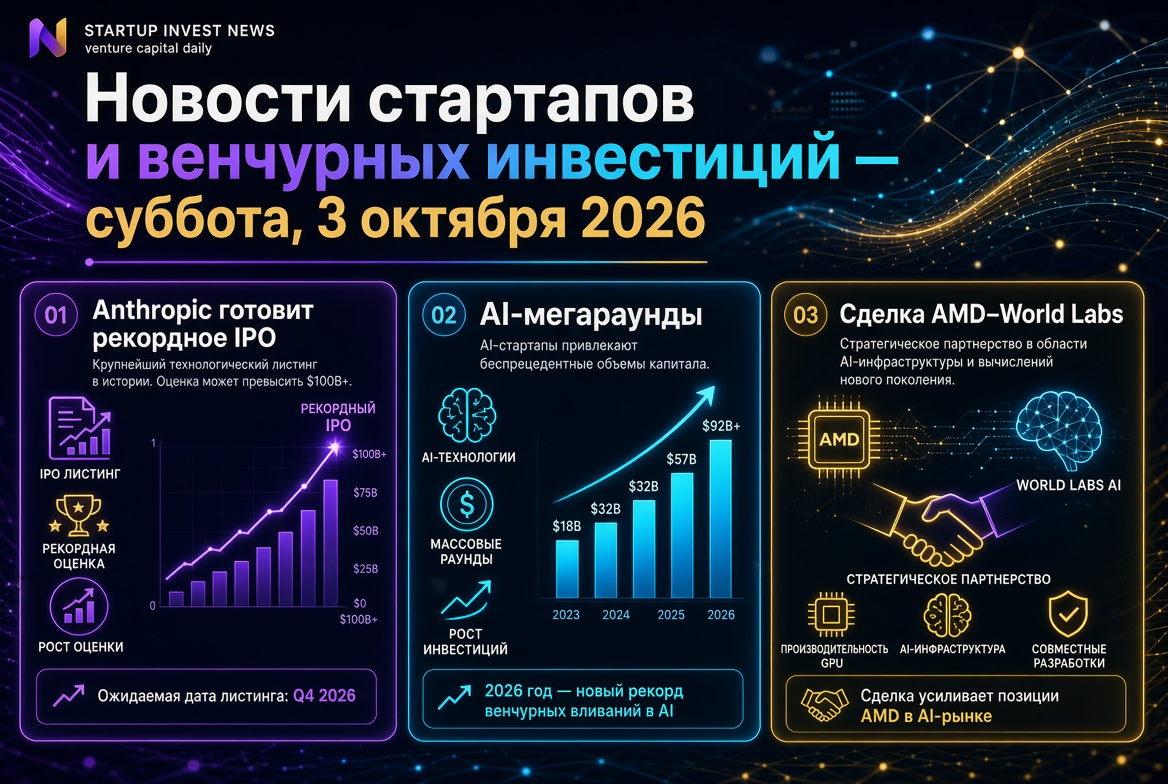
The most pressing topic as of 9 April is not just artificial intelligence per se, but the infrastructure surrounding it. Venture investors are increasingly financing startups that provide computing resources, network bandwidth, cloud capabilities, model optimisation, and specialised data centres. In other words, capital is increasingly flowing not into the 'showcase' of AI but into the foundation without which the growth of the industry would be limited by resource shortages.
This shift reflects the new logic of the market:
- value is created not only by model developers but also by infrastructure providers;
- funding rounds are increasingly justified by projected future capacity utilisation rather than just current revenue;
- strategic investors are beginning to play a role as significant as that of traditional venture funds;
- access to chips, electricity, networks, and corporate contracts becomes a key competitive advantage.
For the startup market, this indicates that the next wave of unicorns will form not only among app creators but also among companies that build the 'shovels and pickaxes' for the AI boom.
Europe Strengthens its Position through Sovereign Computing and Proprietary AI Platforms
The European startup landscape in 2026 appears more robust than many funds anticipated just a year ago. The region is increasingly promoting the idea of technological sovereignty: capital is being directed into domestic AI companies, semiconductor projects, data centres, and infrastructure platforms. This creates an important counterbalance to the dominance of the USA and partially alters the perception of Europe as a market strong in research but weak in scaling.
This is particularly evident in segments where not only models are required but also physical infrastructure. For European startups, venture investments are increasingly tied to the theme of strategic autonomy, broadening the pool of potential investors to include banks, state development institutions, and corporate partners. For international funds, this enhances the appeal of deals in Europe: startups receive not only capital but also political backing, state demand, and access to long-term programmes.
China Demonstrates its Own Model of Venture Growth — Through State Capital and Deep Tech
In the Asian landscape, a critical trend is the acceleration of venture activity in China. However, this is not a classic private market story in the American sense. The new wave of funding largely relies on state and quasi-state sources of capital, with priorities in AI, robotics, quantum technologies, and other strategic industries.
For global investors, this presents a dual-edged signal. On one hand, the Chinese startup market is once again becoming substantial in terms of capital raised. On the other, the role of politics in capital allocation is increasing, heightening the risks of distorted valuations and decreasing market transparency. Nevertheless, ignoring this market is difficult: in the upcoming quarters, China may emerge as one of the largest generators of new deep-tech companies with global ambitions.
Robotics is Transitioning from Long-Term Bets to Practical Scaling
Another important shift in the startup market is the acceleration of robotics, especially at the intersection of AI and industrial automation. Venture funds are increasingly willing to finance companies that can demonstrate not only technological novelty but also concrete contracts in logistics, manufacturing, warehousing, and corporate services. This is particularly relevant in the context of the global labour shortage and rising business costs.
The investment logic is changing here. Previously, a robotics startup was perceived as a capital-intensive project with a distant payback period; now stronger players have a more convincing investment case:
- AI enhances the perception quality of the environment and decision-making by machines;
- corporate clients are more willing than ever to pay for automation;
- large industrial partners are becoming both customers and investors;
- the exit market for such companies is gradually expanding due to strategic buyers.
For venture investors, this opens a new layer of deals between software and hardware, where multiples can remain high in the presence of clear industrial demand.
Cybersecurity Establishes Itself as One of the Most Resilient Sectors of the Venture Market
Cybersecurity remains one of the few areas where startups can attract significant capital regardless of the overall market sentiment. The reason is clear: with the growth of AI, automation, and cloud infrastructure, the attack surface expands, and corporate demand for protection becomes non-cyclical. Therefore, security deals appear as a more defensive element in the portfolio compared to purely consumer technology bets for funds.
Current focus areas include startups that:
- automate SOC operations and response processes;
- mitigate AI development and AI-assisted coding risks;
- integrate into large corporate platforms;
- can scale quickly through B2B sales and channel distribution.
For the global market, this means that cybersecurity remains one of the most disciplined segments of startups, where venture investments are often backed by understandable revenue and high-quality clients.
Fintech is Regaining Momentum, but in a Different Configuration
Fintech has not disappeared from the agenda but has clearly evolved. In 2026, capital flows primarily to companies that solve infrastructure challenges: cross-border payments, currency liquidity, integration of stablecoins into transactions, corporate platforms for international transfers, and B2B financial automation. The 'growth for growth's sake' model, characteristic of parts of the fintech boom in previous years, is giving way to a more pragmatic approach.
This aligns well with the overarching trend: a startup must not only attract users but also reduce operational costs, accelerate capital movement, and improve clients' financial infrastructure. For venture funds, this makes the best fintech companies attractive again, especially if they build a global product and quickly achieve corporate revenue.
The Exit Window is Gradually Opening: M&A Outpacing IPOs
For the venture market, the issue of exits remains crucial. It is here that practical progress is evident in 2026. Activity in mergers and acquisitions is growing faster than the IPO market, with strategic buyers willing to pay for mature assets with critically important technologies. This marks an important turnaround following a period where many startups could attract capital but lacked a clear exit strategy.
At this stage, the most realistic picture for funds appears as follows:
- large tech corporations continue to acquire infrastructure and security assets;
- the public market is selectively opening, primarily for companies with a proven growth history;
- secondary deals and partial liquidity are becoming increasingly important for later stages;
- the valuation of a startup increasingly depends on how understandable it is to potential buyers.
This is why today, startups that are not merely creating a trendy product but are building a strategic asset for a large market appear to be in the strongest position.
What This Means for Investors and Funds
As of 9 April 2026, the startup and venture investment market appears robust but uneven. Capital has returned; however, its cost and distribution are dictated by a new hierarchy. At the top of the market are AI infrastructure, cybersecurity, robotics, sovereign computing, and mature B2B fintech. Below are startups lacking a distinctive technological advantage, for whom justifying high valuations is becoming increasingly challenging.
For venture investors, this necessitates a more precise selection of segments and a recognition that overall market growth does not equate to a broad recovery of the entire startup landscape. The main theme in the upcoming months will be the battle for infrastructure assets and companies capable of becoming the foundational layer of the new AI economy. This is where the primary potential for the next wave of large rounds, strategic deals, and future exits is forming.