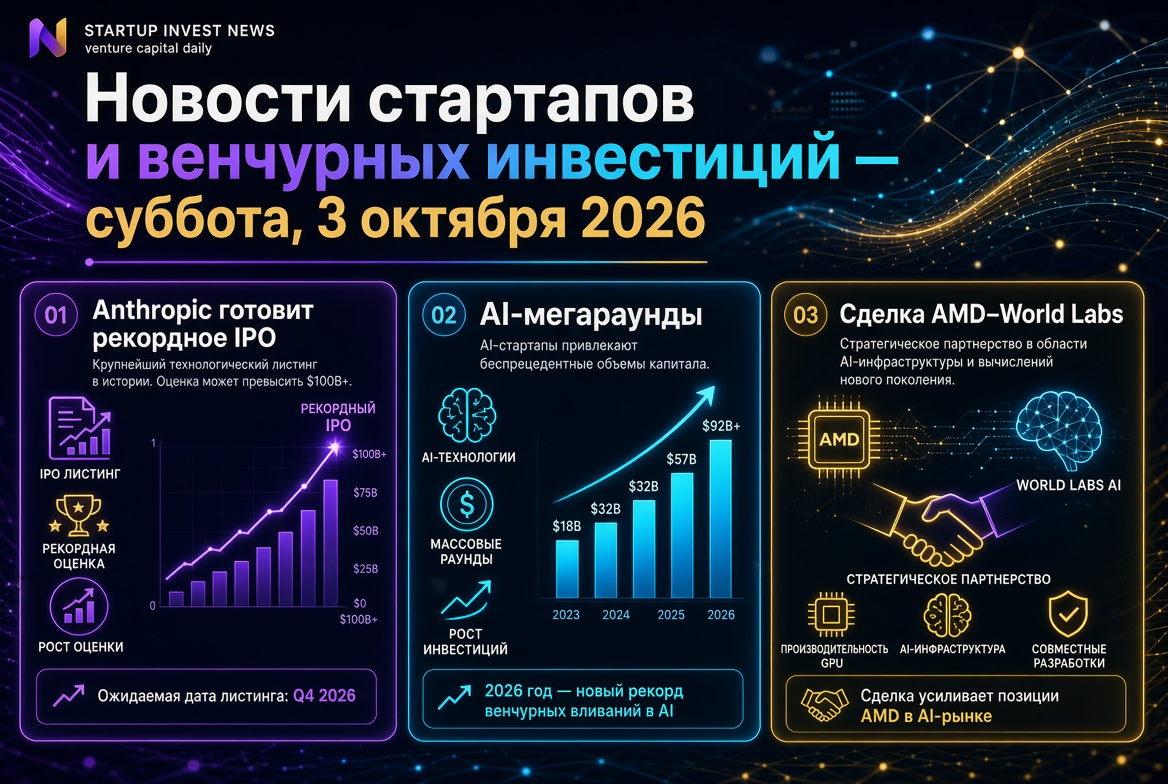
Latest Startup and Venture Investment News for Saturday, 20 June 2026: AI Megarounds, Growth in AI Infrastructure Investments, Cybersecurity, Asian Unicorns, European Tech Sovereignty, and Revival of the IPO and M&A Markets
The global startup and venture investment market is approaching 20 June 2026 in a state of high capital concentration. Investment flows are once again actively targeting technology companies, albeit with increasing selectivity: investors prefer AI infrastructure, cybersecurity, autonomous systems, deeptech, medical technologies, and startups that already demonstrate a clear commercial model.
The main theme of the week is the continuation of the AI boom. Venture capital is increasingly shunning abstract ideas and is instead seeking companies that can become fundamental infrastructure for the new digital economy. For venture funds, this shift signifies a transition from broad bets on artificial intelligence to a more discerning selection: who controls computation, data, security, corporate workflows, and access to strategic clients.
The Core Focus of the Day: Capital is Flowing into Major AI Rounds
A key feature of the current market is the rise in the number of megavalues. Startups in the AI sector are receiving funding not only as tech companies but also as future infrastructure for entire industries. In this context, venture investments increasingly resemble a strategic struggle for control over platforms that will serve the corporate sector, government agencies, and industrial markets.
- AI infrastructure is becoming the primary focus for late-stage rounds.
- Cybersecurity is gaining additional momentum due to geopolitical risks.
- Asia is strengthening its position through major AI rounds and IPOs in Hong Kong.
- Europe is betting on technological sovereignty and local growth funds.
- The M&A market is reviving due to large tech platforms acquiring AI companies.
Baseten and the Race for AI Inference
One of the most discussed events has been the news surrounding a new major round for Baseten. The company, operating in the AI inference segment, may raise around $1.5 billion with an estimated valuation of approximately $13 billion. If the deal closes under these terms, it will confirm the main trend of 2026: investors are willing to pay a premium not only for AI models but also for the infrastructure that allows these models to operate in real products.
For venture investors, this serves as an important signal. Demand is shifting away from "pretty AI applications" to companies that provide scalability, request processing speed, cost reduction in computing, and stable performance of corporate solutions. In this regard, Baseten is becoming not just a startup but a potential participant in a new infrastructural chain of the AI economy.
Odyssey: Global Models and Strategic Capital
The AI lab Odyssey has raised $310 million in a Series B round, achieving an estimated valuation of around $1.45 billion. Investor interest in the company is linked to its development of systems that model the physical world, interact with it, and can be utilised in autonomous technologies, robotics, simulations, and corporate AI products.
An important detail is the involvement of strategic investors and technology partners. For the venture capital market, this means that the next-generation AI startups are increasingly funded not solely by traditional funds but by companies interested in access to computational infrastructure, data, models, and future industrial standards. This format increases the likelihood of commercialisation but also intensifies the dependency of startups on large technology ecosystems.
Dream and the Growth of the AI Cybersecurity Market
Israeli startup Dream has secured $260 million at an estimated valuation of around $3 billion. The company operates in the field of AI cybersecurity, focusing on protecting governments, critical infrastructure, energy, water supply, and other strategically important systems. This direction is becoming one of the most attractive for venture funds, as demand comes not only from businesses but also from governments.
Cybersecurity in 2026 is becoming a distinct investment theme within the AI market. The reason is straightforward: the quicker companies and governments adopt artificial intelligence, the higher the risk of attacks, automated breaches, and the misuse of generative models by malicious actors. Thus, startups offering infrastructure protection, threat monitoring, and sovereign AI platforms receive a premium on their valuation.
Asia: DeepSeek, Sarvam, and a New Wave of Tech Unicorns
The Asian market remains one of the primary centres of venture activity. Chinese AI startup DeepSeek, according to market reports, has closed a significant round with more than $7 billion at a valuation exceeding $50 billion. Investors were particularly drawn to the structure of the deal, which allows the founder to retain control while limiting the influence of certain investors. This underscores a new trend: the largest AI companies are striving to attract capital without losing strategic control.
In India, a significant event was Sarvam's round of $234 million, which propelled the company into unicorn status with an estimated valuation of around $1.5 billion. For the Indian startup ecosystem, this serves as an important signal: local AI companies can attract substantial capital not only through the domestic market but also due to global demand for language models, corporate solutions, and national technology platforms.
Europe Strengthens Technological Sovereignty
The European venture market in June 2026 increasingly revolves around the theme of technological independence. France has announced the mobilisation of approximately €13 billion in additional capital as part of the Tibi initiative, aimed at supporting technology companies and European sovereignty. For funds, this signifies the emergence of a more robust institutional base for financing growth-stage startups.
There remains particular interest in AI, defence tech, dual-use technologies, healthtech, and industrial software. While Europe currently lags behind the US in terms of private AI valuations, it is attempting to compensate through government-institutional mechanisms, local funds, and a focus on critically important technologies. For venture investors, this creates opportunities in companies that could become suppliers of solutions for government, industry, defence, and regulated sectors.
IPO and M&A: The Exit Market Gradually Revives
For venture funds, not only new rounds are significant but also the prospect of exits. In this respect, the market shows signs of recovery. Chinese company Momenta, which operates in the area of autonomous driving, is preparing for an IPO in Hong Kong amounting to around $1 billion, with a potential valuation of approximately $9 billion. Hong Kong is strengthening its position in 2026 as a platform for tech listings, particularly for Chinese and Asian companies from the new economy.
In the US, a positive signal has emerged from the biotech sector: Kardigan successfully debuted on Nasdaq following an IPO of $400 million. This demonstrates that investors are once again willing to consider companies in late stages of development with a clear scientific foundation. The M&A market has seen a notable deal with Elastic acquiring DeductiveAI for up to $85 million. For the venture ecosystem, this represents a quick exit example in the field of AI tools for development and software reliability.
What This Means for Venture Investors and Funds
The current situation in the startup and venture investment market appears positive, yet uneven. Capital is present, but it is concentrating in companies that possess technological barriers, strategic significance, and a clear scaling scenario. Startups without revenue, a strong team, and proven demand are encountering stricter capital-raising conditions.
- Funds should be more meticulous in assessing not only technology but also the cost of computing, access to data, and a startup's ability to maintain margins.
- Late-stage AI rounds require caution: valuations are rising faster than public benchmarks in revenue and profit.
- Cybersecurity, defence tech, and sovereign AI are becoming long-term investment directions.
- Europe and Asia are establishing their own venture capital hubs, reducing absolute dependence on the US.
- For funds, exits—IPOs, strategic sales, and secondary transactions—are playing an increasingly crucial role.
Key Risks: Overheating of Valuations and Capital Concentration
Despite the strong news flow, the market does not appear uniformly healthy. Venture capital is concentrating around a small number of companies, and valuations for leaders in the AI segment are increasing faster than for most other technology sectors. This creates the risk of overheating, particularly if future revenues fail to meet current investor expectations.
For funds, the primary challenge becomes entry discipline. In the midst of the excitement surrounding artificial intelligence, it is vital not to overpay for companies that lack sustainable advantages. The most attractive startups remain those capable of integrating into real business processes: AI infrastructure, development automation, cybersecurity, corporate data, healthcare, autonomous technologies, and industrial software.
Conclusion: The Venture Market Enters a Phase of Quality Selection
Saturday, 20 June 2026, reveals a venture market in a transitional phase. On one hand, significant AI rounds, new unicorns, and the revival of IPOs confirm a return of risk appetite. On the other hand, investors are becoming considerably more demanding regarding startup economics, deal structures, team quality, and exit prospects.
The key takeaway for venture investors and funds is that the startup market is active again, but not all are beneficiaries. Capital is flowing to where there is an infrastructural role, strategic significance, protection from competitors, and potential for exits through IPO or M&A. In the coming months, AI infrastructure, cybersecurity, technological sovereignty, autonomous systems, and new corporate automation models will remain critical themes.