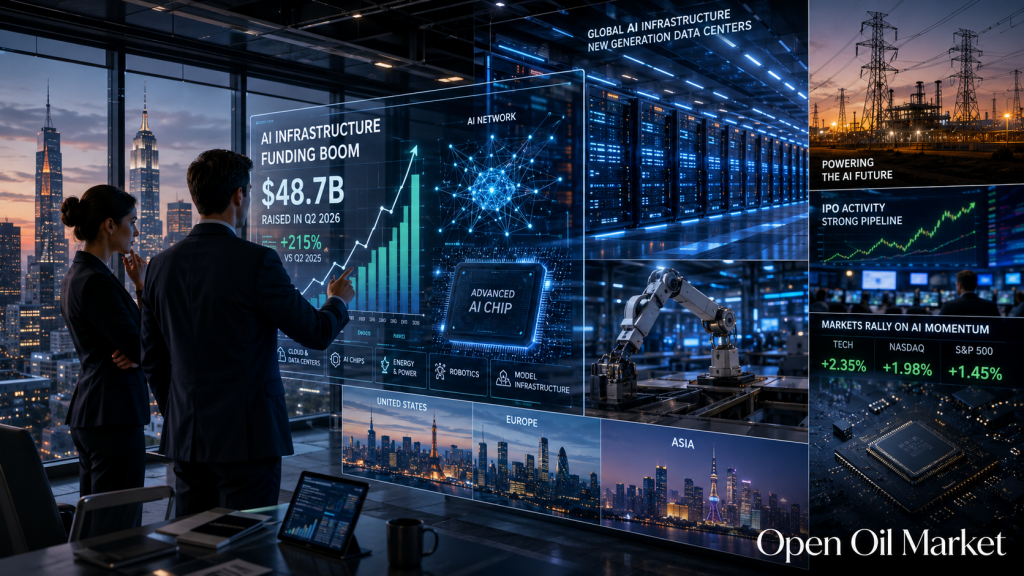
Startup and Venture Capital News for Friday, July 10, 2026: Record AI Mega Rounds, Growing Investment in AI Infrastructure, Chips, Data Centres, Energy Tech, Deep Tech, and Expectations for Tech IPOs
As of Friday, July 10, 2026, the global startup and venture capital market enters the second half of the year exhibiting robust yet highly uneven growth. The primary theme of the week is the unprecedented concentration of capital in artificial intelligence, AI chips, data centre infrastructure, energy for computational power, and late-stage technology companies. For venture capitalists and funds, this signifies not merely a resurgence in risk appetite, but a transition of the market into a new phase: capital is once again accessible, but predominantly to category leaders.
Global venture capital reached record levels in the first half of 2026. The US market is particularly notable, with investment volumes already surpassing those of most previous full years. Concurrently, Hong Kong's role as a hub for Chinese technology firms is growing, Europe is strengthening its position in deep tech and fusion energy, and the IPO window is gradually reopening for the largest AI companies. The startup ecosystem is becoming more globalised yet increasingly polarised: mega funds and institutional investors are prioritising scale, revenue, infrastructural significance, and technological defensibility.
The Venture Market of 2026: Record Volumes and High Capital Concentration
A key indicator for the venture market is the sharp increase in investments during the first half of the year. Global startups attracted a record amount of funding, with the US remaining the primary capital magnet. However, the recovery cannot be described as uniform: a significant portion of funds is flowing into deals sized from $100 million and above, while early-stage and mid-size rounds continue to face stiff competition for capital.
This creates a new investment reality for venture funds:
- The best AI startups are garnering capital faster and at higher valuations;
- Late-stage investments are once again appealing due to the anticipation of IPOs;
- Funds are increasingly betting on infrastructure assets rather than merely on applications;
- Startups without revenue, technological advantages, or a clear unit economics face pressure.
In practice, venture investments in 2026 resemble less a broad distribution of capital across the market and more a competition for a limited number of companies capable of becoming systemic players in the new AI economy.
AI Infrastructure Remains the Primary Focus of Venture Investments
Artificial intelligence remains the central theme for startups, venture funds, and strategic investors. However, the market's focus is shifting: investors are increasingly financing infrastructure over abstract AI applications, which is essential for scaling models, corporate agents, and automating workflows.
The most sought-after areas include:
- AI chips and specialised accelerators for inference workloads;
- Cloud platforms for training and deploying open models;
- Systems for optimizing computational costs;
- Corporate AI agents for finance, marketing, development, and legal processes;
- Infrastructure for security, monitoring, and quality control of AI models.
A notable example is the significant round raised by SambaNova Systems. The company, operating in the AI chip, hardware systems, and cloud infrastructure sectors for inference, secured $1 billion at an estimated valuation of around $11 billion. This deal underscores that the market is willing to pay a premium for solutions that reduce businesses' dependence on generic GPUs and facilitate faster, more cost-effective AI model deployment closer to corporate data.
Together AI and Open Models: A Bet on Alternatives to Closed Ecosystems
Another critical trend is the increased demand for platforms offering open-source AI solutions. Together AI raised $800 million at an estimated valuation of around $8.3 billion, bolstering the segment that enables companies to train and run AI workloads on open models. For venture investors, this is an important signal: the market does not want to rely solely on a few closed providers of foundation models.
The focus on open models is becoming part of a broader investment logic. Corporate clients desire to:
- Control data and infrastructure;
- Reduce inference costs;
- Avoid dependence on a single supplier;
- Adapt models to industry-specific tasks;
- Gain transparency regarding security and compliance issues.
For funds, this means that in 2026, not only model developers will be attractive, but also companies building management, optimisation, and industrial deployment layers for artificial intelligence.
Energy for AI Becomes a New Venture Category
One of the most significant trends of the week is the intersection of venture capital, energy, and AI infrastructure. The growth of data centres is creating immense demand for electricity, and investors are beginning to view energy as an integral part of the AI technology chain.
A significant deal involving Joulent illustrates how rapidly this market is evolving. The energy platform, focused on infrastructure for data centres, secured a strategic investment of $1.75 billion from National Grid. The funds are directed towards enhancing capacity related to energy supply for large computing campuses. For venture funds, this signals the emergence of a new category of deals—AI power infrastructure—where value is created not by software code but through access to energy, networks, turbines, sites, and long-term contracts.
A similar rationale can be observed in Europe. The German firm Proxima Fusion attracted €411 million at an estimated valuation of approximately €2.4 billion. Investors, including major strategic players, are funding fusion energy as a long-term bet on energy independence, technological sovereignty, and future infrastructure for an energy-intensive economy.
Hong Kong Enhances Its Role as an Asian Tech Exchange Hub
The Asian market is also showing a high level of activity. Chinese technology companies, including AI developers, semiconductor manufacturers, robotics, battery tech, and advanced manufacturing, are actively raising capital through listings in Hong Kong. Since the beginning of the year, such companies have attracted over $17 billion, making Hong Kong one of the key hubs for tech capital in 2026.
The listings of companies from segments including:
- Artificial intelligence and large language models;
- Semiconductors and AI chips;
- Electric vehicles and battery technologies;
- Robotaxis and autonomous driving;
- Components for smartphones, servers, and data centres.
For global investors, this represents not just access to China, but also an indicator of the competition between the US, China, and Europe for technological leadership. The venture market is increasingly influenced by geo-economics, industrial chains, and state support for strategic sectors.
The IPO Window Opens, But the Market Expects Only the Strongest
The venture industry is closely monitoring public offerings. After several years of limited liquidity, IPOs are once again becoming a central theme for funds, LP investors, and late-stage startups. The largest AI companies are preparing for public markets, and successful listings could serve as a catalyst for the entire venture ecosystem.
Special attention is focused on companies of the calibre of OpenAI, Anthropic, SpaceX, and major infrastructure tech players. Their potential IPOs are poised to:
- Reintroduce liquidity to venture funds;
- Create new public benchmarks for valuing AI companies;
- Pave the way for mid-sized tech IPOs;
- Intensify competition for capital between private and public markets.
However, investors will assess not only revenue growth but also capital intensity, profitability, computation costs, dependence on partners, and regulatory risks. In 2026, the public market is prepared to pay for AI but will demand a more transparent business economy.
Deep Tech, Defence Tech, and Biotech Return to the Funds' Focus
Despite the dominance of artificial intelligence, venture investments are gradually diversifying. Growing interest is being observed in deep tech, defence technologies, quantum computing, biotechnology, fusion energy, robotics, and industrial automation. This represents an important shift: investors are seeking not only rapid software growth but also long-term technological barriers.
The most promising categories for funds include:
- AI chips and computational infrastructure;
- Energy for data centres;
- Biotechnology and drug discovery;
- Defence tech and autonomous systems;
- Cybersecurity for AI agents;
- Robotics and industrial AI;
- Fintech infrastructure and banking process automation.
This diversification reduces the risk of overheating in one segment, but does not negate the primary factor: capital continues to flow to companies that can prove scalability, technological uniqueness, and the capacity to become part of strategic infrastructure.
What This Means for Venture Investors and Funds
For venture investors, Friday, July 10, 2026, is characterised by a robust market yet high selectivity. Record investment amounts do not equate to easy access to capital for all startups. On the contrary, the market is becoming more demanding: funds prefer companies with clear revenue, a strong team, technological moats, large TAMs, and confirmed demand from corporate clients.
Venture funds should pay attention to several factors:
- Capital Concentration. Much of the funding is directed towards AI and mega rounds; therefore, the "broad market" strategy requires re-evaluation.
- Infrastructure Value. Chips, energy, cloud services, security, and data layers are becoming as important as AI applications themselves.
- IPOs as a Valuation Test. Future listings of the largest AI companies will set multipliers for late-stage startups.
- Geography of Capital. The US leads, Asia is accelerating through Hong Kong, and Europe is enhancing deep tech and energy projects.
- Overheating Risks. High valuations require discipline: investors must analyse not only growth but also the cost of scaling.
Day's Summary: The Venture Market is Growing, but it is Becoming a Market for Winners
The main takeaway for the startup ecosystem as of July 10, 2026, is that the venture market is once again strong, but its structure has changed. Capital has returned; however, it is distributed unevenly. Artificial intelligence remains the primary driver, but the real competition is unfolding around infrastructure: chips, energy, data centres, open models, corporate deployment, and public markets.
For startups, this means the necessity to demonstrate product value and growth economics more rapidly. For venture funds, it necessitates stricter category selection, assessment of technological defensibility, and avoiding overpayment for hype. For LP investors, it represents a chance for liquidity recovery through IPOs and M&A, but only if the largest tech listings confirm market expectations.
In 2026, venture investments are not merely a bet on innovation but a tool for global competition over computational power, energy, data, and technological sovereignty. These are the areas currently shaping the new landscape of startups and venture capital.




