Key themes of the venture agenda for Wednesday, 12 August 2026:
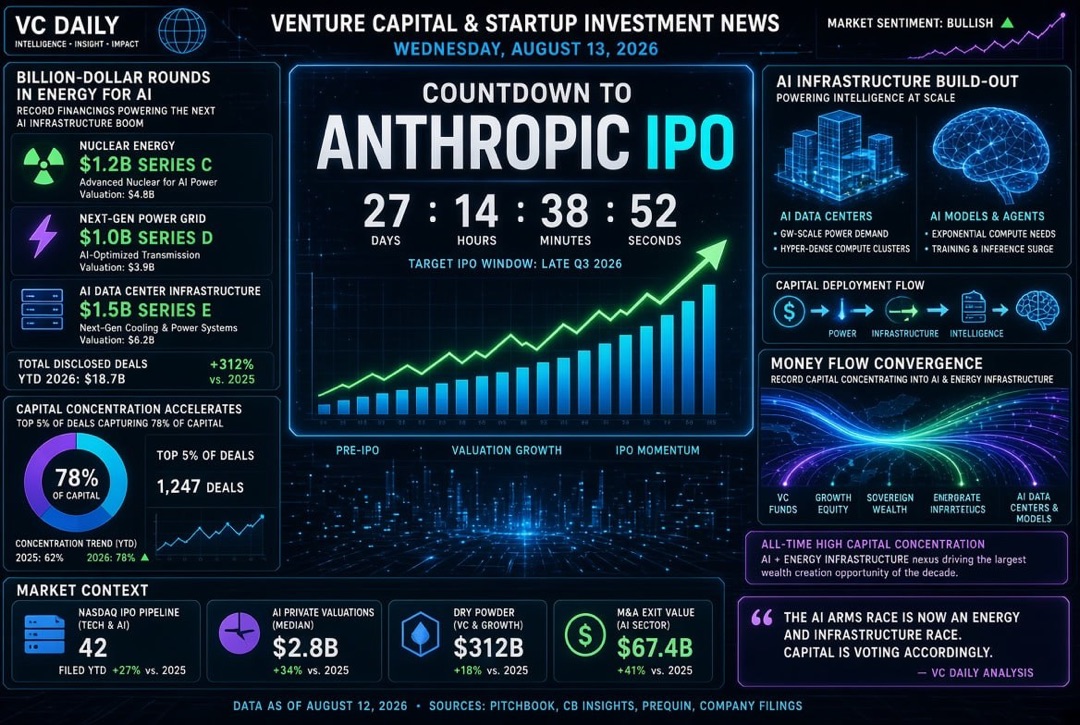
- The Anthropic IPO is nearing the finish line. Underwriters are scheduling meetings with institutional investors; the offering could happen as early as October, and the last private valuation of the company reached $965 billion.
- Mega funds are dominating the market. Funds over $1 billion have accounted for approximately 72% of all venture capital raised in the US since the beginning of the year.
- Energy is the new frontier in the AI race. Billion-dollar rounds for Base Power and Valar Atomics confirm that investors are financing the physical infrastructure of artificial intelligence.
- Defence technologies are breaking records. The sector attracted $12.3 billion in the first half of the year—almost double the total for all of last year.
- Retail investors gain access to venture capital. Robinhood is preparing an IPO for its second public venture fund of $200 million on 13 August.
Anthropic IPO: Countdown to the offering of the year
The main intrigue of the venture market remains Anthropic's preparation for its stock market debut. The company, developer of the Claude model family, confidentially submitted a prospectus to the US Securities and Exchange Commission on 1 June, and now underwriters are actively scheduling meetings between management and the largest institutional investors. According to informed sources, the listing may take place as early as October.
The stakes are extremely high. The last private valuation of Anthropic reached $965 billion, and its $30 billion Series G round became one of the largest private venture deals in history. A successful offering would take the company public ahead of its main competitor—OpenAI, which has postponed its own listing plans to 2027. For venture funds, the Anthropic IPO will be the largest exit of the year and a benchmark for re-evaluating the entire portfolio of AI assets.
Mega funds and record capital concentration
The structure of the venture market is rapidly polarising. According to industry analytics, funds over $1 billion have accumulated about 72% of all capital raised in the US since the beginning of 2026, while new fund managers account for less than 10%. The largest players are closing record funds:
- Thrive Capital has completed the formation of the Thrive X fund with a volume of $10 billion;
- Sequoia Capital closed a specialised late-stage AI fund valued at $7 billion;
- Andreessen Horowitz raised $6.75 billion for a new growth fund;
- Founders Fund closed its largest growth fund in history at $6 billion.
The concentration of capital gives mega funds unprecedented pricing power in negotiations with startups, but simultaneously narrows the funnel for smaller managers and emerging funds. For institutional investors, this means the need for increasingly careful selection of niche strategies capable of competing with the giants.
Record half-year: Numbers defining the market
The results of the first half of 2026 appear unprecedented. Global venture investments reached $510 billion, exceeding the total for all of 2025. The first quarter brought in $305 billion, while the second quarter added another $205 billion. Notably, OpenAI and Anthropic alone attracted a total of $217 billion—approximately 43% of all venture investments worldwide in the half-year period.
Analysts emphasise that excluding the two frontier laboratories, the market appears much calmer and activity levels are closer to those of 2024-2025. Late-stage funding has increased by 141% year-on-year; however, the number of deals has hardly changed—capital is concentrating around already proven leaders.
Energy and AI infrastructure: Billion-dollar rounds of the week
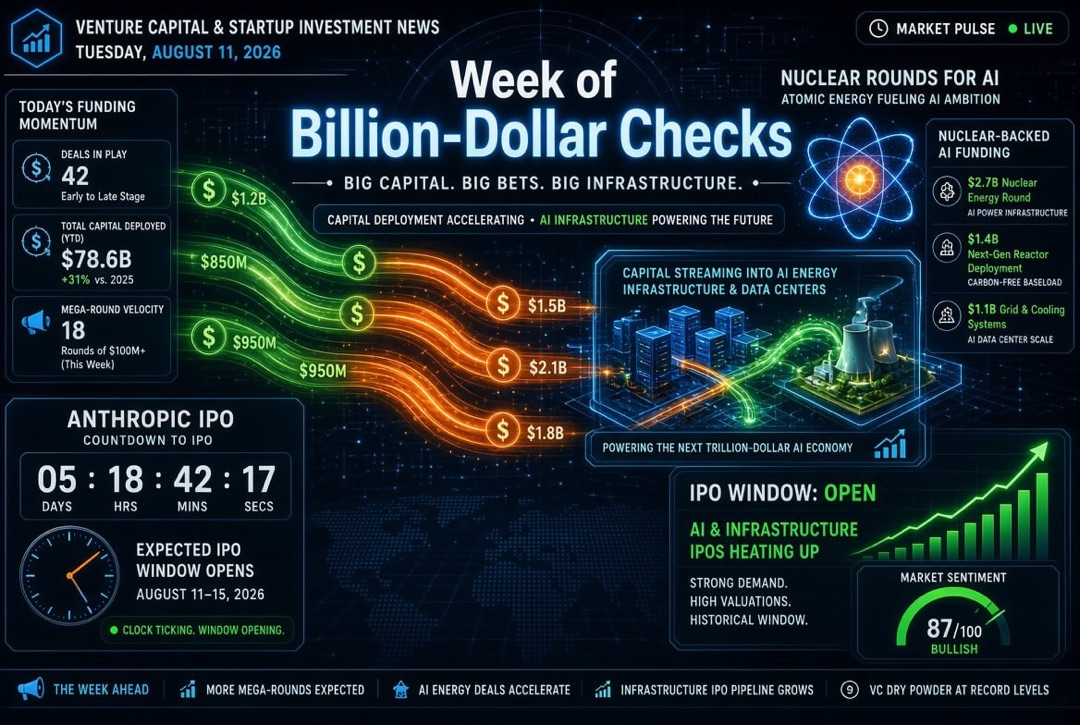
The latest deals in August confirm a key shift: venture capital is financing the physical foundation of artificial intelligence. Texas-based Base Power closed a Series D round at $1 billion with a valuation of $13 billion—led by Ribbit Capital, Addition, Valor Equity, and the venture arm of JPMorgan. The company produces home energy storage systems and has already launched production in the US amid record energy consumption and explosive growth of data centres.
Nuclear startup Valar Atomics raised $1 billion in a Series B round led by Sequoia Capital, complemented by a $200 million credit line from a syndicate led by JPMorgan. The infrastructure segment is also in the spotlight: Baseten, an AI inference platform, closed a Series F at $1.5 billion with a valuation of $13 billion, demonstrating twenty-fold annual growth.
Defence technologies: Doubling in a year
The defence segment has become one of the main beneficiaries of geopolitical tension. In the first half of 2026, venture funds invested $12.3 billion in defence tech—almost double the total for all of 2025. Capital is directed towards autonomous maritime platforms, drones, and combat AI systems. The adjacent cybersecurity segment is also on the rise: Horizon3.ai raised $250 million for the development of autonomous penetration testing, while Zenity closed a Series C at $125 million to protect corporate AI agents.
The IPO and exit market: The window remains open
Following the blockbuster June listing of SpaceX, the public offering market continues to exhibit high activity. In the second quarter, 32 companies went public with valuations exceeding $1 billion, and another 24 were acquired for a total of $113 billion—a record quarter for exits. Hong Kong is experiencing its own IPO boom, returning much-needed liquidity to Asian funds.
A significant event of the week will be the listing of Robinhood Ventures Fund II: on 13 August, the fund of approximately $200 million will debut on the New York Stock Exchange, directing the raised funds to Y Combinator startups. This continues the trend towards democratising venture asset classes, although the premiums of such instruments to net asset values have noticeably decreased in recent weeks.
A two-speed market: Risks for investors
Behind the record headlines lies a growing divide. The upper echelon—frontier laboratories, AI infrastructure, energy—attracts capital on any terms. The rest of the market operates under strict rules: investors demand revenue, clear unit economics, and technological barriers that cannot be replicated. Universal AI applications without proprietary data and distribution are increasingly left without funding, while vertical solutions for regulated sectors are closing rounds faster than the market.
Takeaways for venture investors
Key takeaways for the coming weeks:
- Monitor the preparation for the Anthropic IPO—its outcome will set the multiples for the entire AI segment until the end of the year;
- Consider market concentration: record aggregate figures do not reflect the state of the average startup;
- View energy, AI infrastructure, and defence technologies as segments with the most sustainable capital inflow;
- Capitalize on the open exit window to lock in profits on mature portfolio positions;
- Stress test late-stage AI valuations—the growth rates of investments significantly outpace the growth in the number of deals.
August 2026 affirms that the venture market has entered a phase of mature boom, where record liquidity coexists with stringent selectivity. Those investors who can distinguish structural trends from the inertia of hype are likely to succeed.