Concurrently, the main intrigue for the second half of the year is unfolding — the IPO race of artificial intelligence laboratories. Following the triumphant June debut of SpaceX, which was valued at over $1 trillion, the market is now anticipating the public offerings of Anthropic and OpenAI, which could contribute nearly $3 trillion in new capitalisation to the public markets. Below are key events and trends shaping the venture market agenda as of 11 August 2026.
Key Topics of the Day: What Investors Are Discussing on 11 August
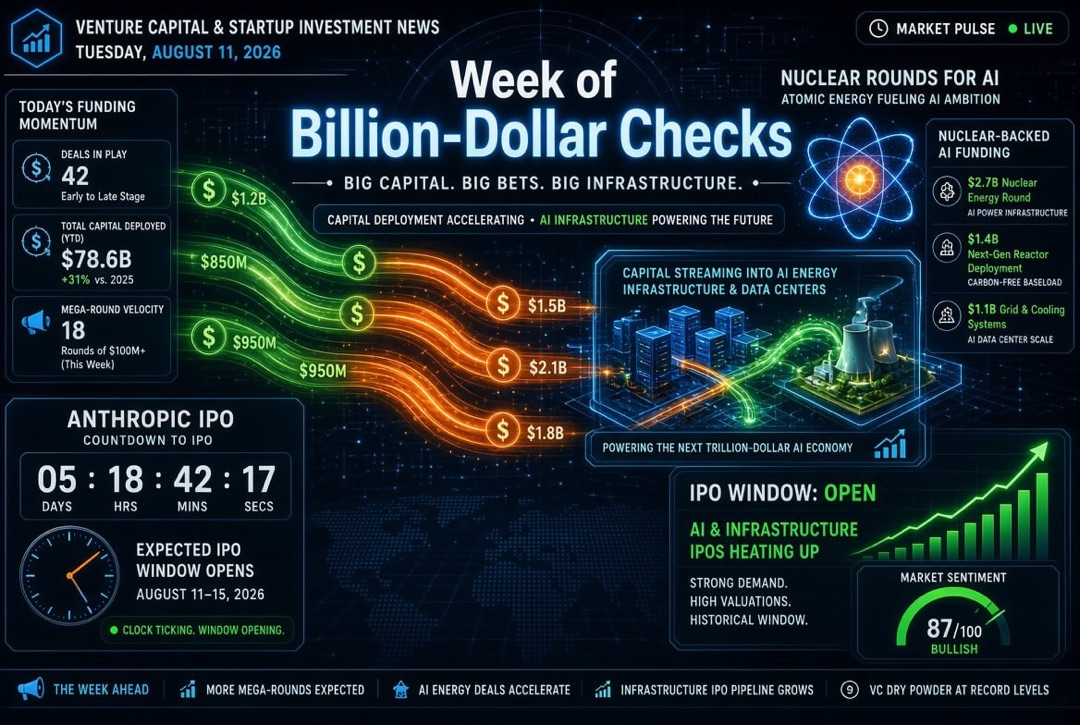
- Week of Billion-Dollar Checks. Hadrian, Base Power, and Valar Atomics closed rounds of $1 billion or more — three "unicorns" in seven days confirm the strength of the upward cycle.
- Infrastructure Shift. Capital is flowing into energy, nuclear reactors, photonic chips, and network infrastructure for AI — the "shovels and pickaxes" of a new technological era.
- Record Mid-Year. $510 billion in global venture investments for the first six months of 2026 — a historic high according to market analysts.
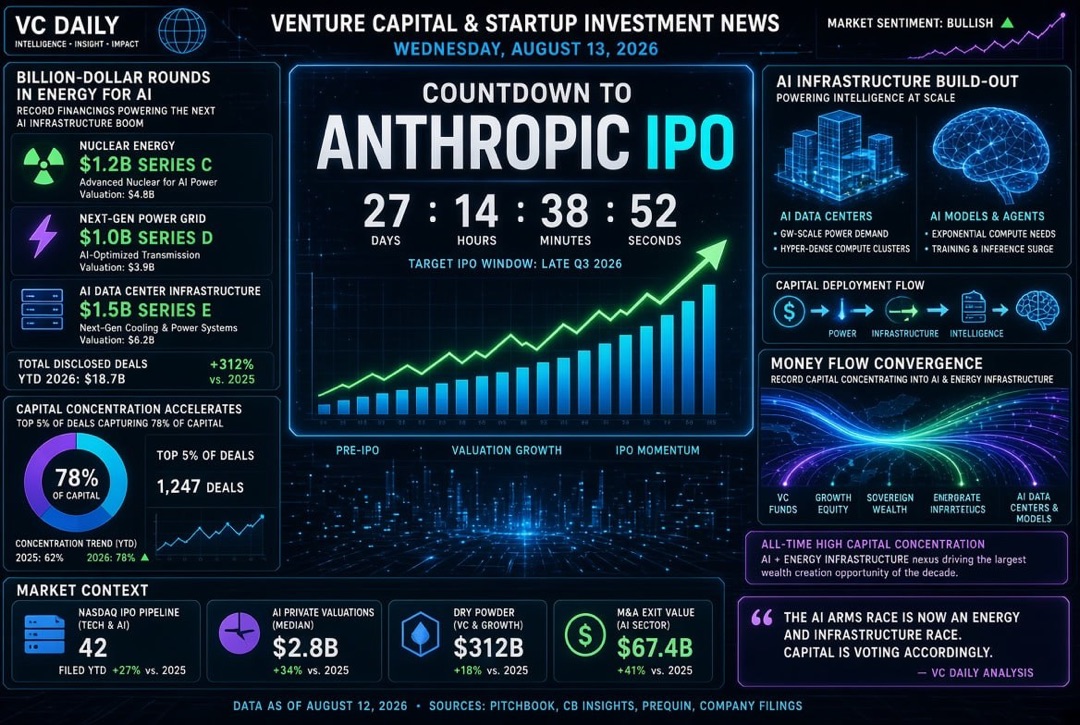
- IPO Conveyor Gaining Momentum. Anthropic is considering a listing as early as October with a valuation of around $900 billion, while OpenAI is preparing for its own public offering in the fourth quarter.
- Sovereign Capital in Play. Sovereign wealth funds from the Persian Gulf and Asia, including the $49 billion MGX fund, are increasingly acting as anchor investors in the largest rounds.
- Russia and CIS. The market in the region is anticipated to grow by 10-15% by year-end; the "Venture Landscape" forum will be held in Moscow on 13 August.
Week of Big Checks: Hadrian, Base Power, and Valar Atomics
Last week was one of the busiest of the year in terms of megadeals. Hadrian, which builds highly automated factories for the aerospace and defence industries, raised $1.37 billion in a Series D round with participation from WCM Investment Management, Valor Equity Partners, JPMorgan Chase, and Baillie Gifford. Energy startup Base Power and modular nuclear reactor developer Valar Atomics closed rounds of $1 billion each.
Notably, the deal involving Valar Atomics deserves special attention: the company raised $1 billion in its Series B at a valuation of $6 billion to mass-produce compact reactors for powering data centres, led by a syndicate from Sequoia Capital with participation from Point72 and Valor Equity Partners, alongside a $200 million credit line secured from a syndicate led by JPMorgan. Another line worth mentioning is the exit from "stealth mode" for startup Lumilens, which is developing a connectivity platform for AI infrastructure, securing over $700 million in a recent round.
AI Infrastructure: Energy and Chips Become Mainstream
The structure of deals in August highlights a strategic shift: investors are financing not just AI applications, but also the physical base necessary for their operation. The market sees bottlenecks in the next wave of innovation related to computing, energy, and specialised equipment. Notable deals from recent weeks include:
- The London startup OLIX Computing raised around $312 million in a Series B at a valuation of $3.3 billion for photonic chips designed for AI inference — a bet on computing beyond traditional GPUs.
- Baseten, a provider of software infrastructure for launching AI workloads, closed a Series F round at $1.5 billion — the fourth round in a year and a half.
- Fireworks AI raised $1.5 billion to transform universal models into specialised corporate intelligence.
- Houston-based energy company Joulent secured $1.75 billion in strategic financing earlier this summer for infrastructure aimed at compute-intensive industries.
The rationale for investors is clear: universal AI products are quickly replicated, while energy, chips, data centres, and proprietary data create formidable barriers to competitors. This is where the largest checks are currently being directed.
Record Mid-Year: $510 Billion and Accelerating Exits
The results for the first half of 2026 confirm that the market is in a phase of robust growth. Global venture investments reached a record $510 billion, with the largest rounds going not only to fundamental model developers but also to defence technologies, robotics, AI infrastructure, and healthcare. The year kicked off with Elon Musk's xAI raising $20 billion in a Series E round — the first of a series of record megadeals for the quarter. Importantly, the growth in volume is accompanied by an acceleration of exits: activity in the M&A and IPO segments is intensifying, returning liquidity to funds and completing the investment cycle.
IPO Conveyor: Following SpaceX, the Market Awaits Anthropic and OpenAI
The June listing of SpaceX on NASDAQ, valued at over $1 trillion, became the largest IPO in history and set a benchmark for the entire market. Attention is now fixed on artificial intelligence laboratories. Anthropic, whose annual revenue on a run-rate basis exceeds $44 billion, is considering a public offering as early as October: discussions are underway regarding raising around $30 billion at a valuation of approximately $900 billion. OpenAI is preparing for its own market entry in the fourth quarter and is strengthening its financial team, although investors cite risks — from legal disputes to an anticipated loss of $14 billion for 2026 amid rising costs for energy and chips.
The revival has also impacted related sectors: geothermal company Fervo Energy conducted the largest IPO in the history of renewable energy, raising $1.89 billion. According to investment banks, the total volume of offerings in 2026 could reach $160 billion — four times higher than last year's level. For venture funds, this means one crucial thing: the exit window is wider than it has been in the last five years.
Megafunds and Sovereign Capital: Who Writes the Largest Checks
A distinctive feature of the current cycle is the dominance of sovereign funds and corporate giants at the top tier of deals. The MGX fund from Abu Dhabi closed its first fund at $49 billion, exceeding its target of $45 billion, and has already invested in companies ranging from semiconductors to AI platforms. Singapore's GIC has recently led two nine-figure rounds in separate weeks. Traditional venture firms are concentrating capital in megafunds — institutional LPs are increasingly opting for the largest managers, enhancing the stratification of the industry into "super heavy" and niche segments.
Europe and Israel: Growth Points Beyond the US
While the US remains a capital magnet, notable deals are also taking place in other regions. Madrid-based HappyRobot, which creates autonomous AI agents for supply chains, secured $150 million in a Series C round with participation from a16z and corporate funds from Orange and Deutsche Telekom. Israeli firm Zenity, operating in the AI security sector, closed a Series C round at $125 million led by Norwest Ventures with participation from SoftBank Vision Fund 2. Together with British OLIX, these transactions demonstrate that European and Middle Eastern ecosystems are successfully integrating into global infrastructure trends, and investors should keep an eye on companies outside Silicon Valley.
Russia and CIS: Cautious Recovery and Focus on Pre-IPO
The Russian venture market, after several years of decline, is showing signs of stabilisation. Analysts estimate that the market may grow by 10-15% in 2026 — to around 17 billion rubles, with private and state funds acting as the main drivers, while the activity of business angels remains subdued due to high base rates. Market participants are pinning their hopes on the pre-IPO segment: a relaxation of monetary policy could spark a new wave of placements and significantly expand this segment. The upcoming sentiment-checking event will be the "Venture Landscape" forum, taking place on 13 August in Moscow’s Lomonosov cluster, gathering funds, development institutions, and technology companies.
Investor’s Perspective: How to Read the Market on 11 August 2026
The current phase of the cycle requires venture capitalists to adopt a two-tier strategy. On one hand, anchor positions in capital-intensive megatrends: energy for AI, specialised computing, automated manufacturing, and defence technologies, where each percentage point of efficiency scales into trillion-dollar markets. On the other hand, selective bets on niche vertical solutions, where a disciplined investor can find fair valuations without the hype premium. The key risks remain unchanged: overvaluation of companies shooting for "unicorn" status in a single round, and the dependence of the entire structure on the success of autumn IPOs. A poor debut of any giant could trigger a revaluation of the entire AI sector — but for now, the market is voting with capital for the continuation of the rally, and Tuesday, 11 August, only confirms this trend.