Current Startup and Venture Investment News as of 19 September 2026: Mega Round for Crusoe, Trillion-Dollar Valuations for AI Leaders, New Unicorns, Data Centre Energy, IPOs, M&A Deals, and Insights for Venture Funds
The global venture market concludes the third week of September in a paradoxical state: money is becoming more expensive while cheque sizes are increasing. The US Federal Reserve has raised interest rates for the first time in over three years, now set at 3.75–4.00%, with the yield on ten-year Treasury bonds climbing above 5%. Despite this, private capital continues to aggressively reassess companies controlling artificial intelligence infrastructure. For venture investors and funds, Saturday, 19 September, serves as a moment to reflect on a week in which startups raised billions, and the IPO market faced a new test.
Key Points for Venture Investors:
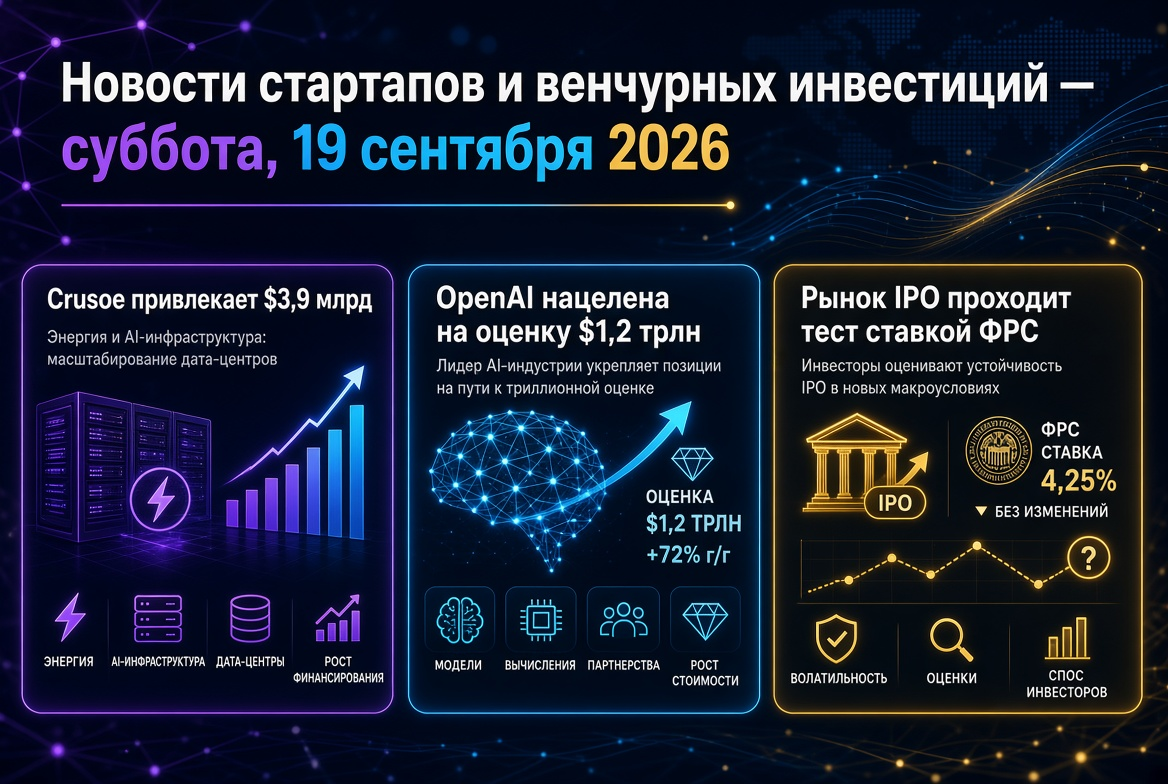
- Crusoe has closed its Series F round at $3.9 billion with a post-money valuation of $30.9 billion.
- OpenAI is discussing a round with an estimated valuation exceeding $1.2 trillion, while Anthropic is preparing for its IPO on Nasdaq.
- Temporal, Positron, Factory, Impulse Space represent the week's mega rounds.
- Mazama Energy, TAR, Holtec — energy for data centres is becoming a standalone investment theme.
- Anew Labs and CADDi — new Asian unicorns.
- The Fed signals another possible rate hike before the end of the year.
Crusoe: $3.9 Billion for Control Over AI 'Bottlenecks'
Denver-based Crusoe has closed its Series F round at $3.9 billion with a post-money valuation of $30.9 billion. Lead investors include Atreides Management and Valor Equity Partners. A year ago, following a $1.375 billion round, the company was valued at just over $10 billion, indicating a valuation increase of threefold. Crusoe builds data centres, sells cloud GPU capacity, and releases modular data centres that are located where electricity is available, with over 6 GW of capacity contracted. Investors view the company as a valuable asset with technological growth potential.
The concentration is illustrative: of the ten largest deals on Thursday, totalling $4.37 billion, approximately 89% pertained to Crusoe. Venture capital is available but increasingly distributed unevenly.
OpenAI and Anthropic: Trillion-Dollar Valuations Awaiting IPOs
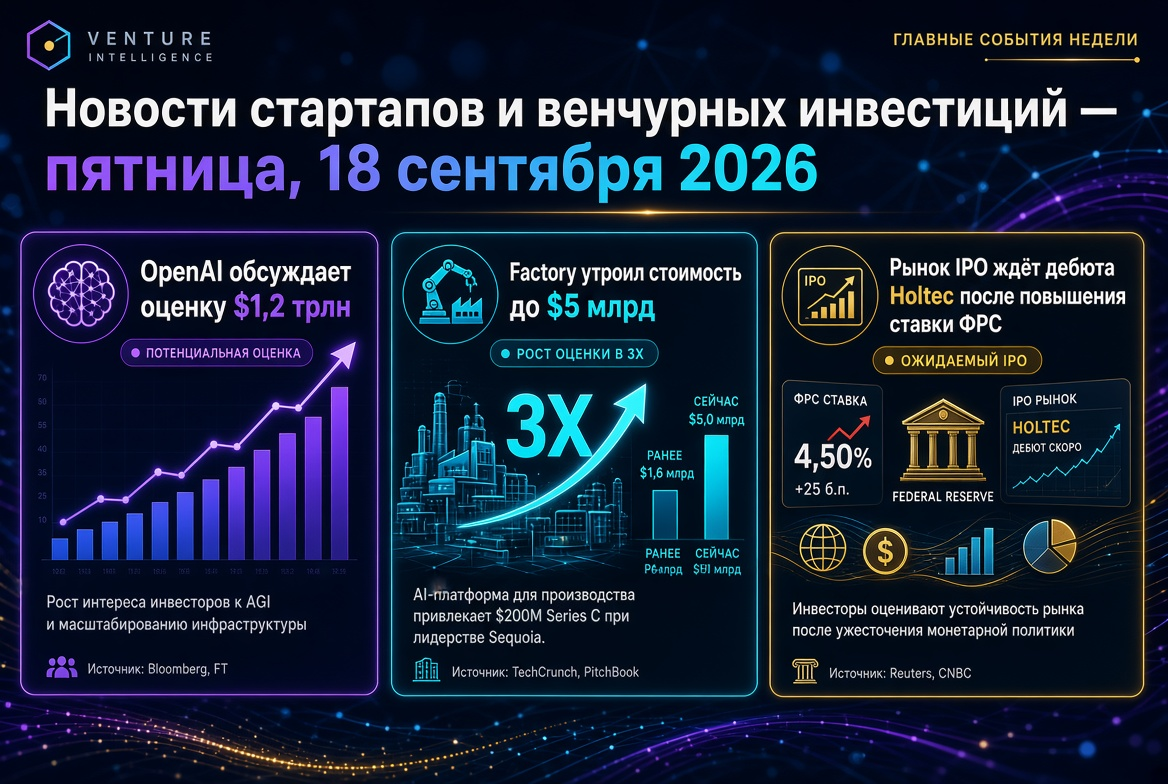
OpenAI is in early discussions for a round with a valuation exceeding $1.2 trillion. This represents an approximate 41% increase from the March valuation of $852 billion, when the company raised a record $122 billion. The initiative is driven by investors, and terms may still evolve. Sam Altman has confirmed that an IPO will not occur in 2026, with annual revenue exceeding $40 billion.
Anthropic raised $65 billion in May with a valuation of $965 billion. According to media reports, the company will begin marketing its listing on Nasdaq no sooner than mid-October and aims for a listing prior to the US midterm elections on 3 November. Before that, it plans to agree on a $15 billion revolving credit line. Following SpaceX's June IPO with a record valuation of $1.77 trillion, this listing will set the public market multiplier for the entire AI sector.
Mega Rounds of the Week: From AI Agents to Space
- Temporal — $550 million Series E at a valuation of $12.55 billion, with Lightspeed as the lead investor. The company creates a reliable execution platform for AI agents.
- Positron — $875 million Series C at a valuation of $5 billion, led by NEA. The product involves chips for inference.
- Factory — $200 million at a valuation of $5 billion from Blackstone, Khosla Ventures, and Sequoia. The product consists of AI agents for software development.
- Impulse Space — Series D extension of $308 million. Valuation increased to $5.4 billion from $4.26 billion in June.
- Nex — over $150 million Series E from Baillie Gifford and BAI Capital. A gaming system based on computer vision represents a rare large round outside generative AI.
- Sling Therapeutics — $123 million Series C with participation from Forbion and TPG. Biotech is making a comeback into the spotlight.
New Unicorns and Early Stages: A Bet on Vertical AI
This week, three companies achieved unicorn status. Profound raised $180 million at a valuation of $1.8 billion from Sequoia and Kleiner Perkins. Thatch secured $108 million at a $1 billion valuation. Arcee AI closed its Series B with a pre-money valuation of $1 billion.
In the early stages, startups are embedding AI into specific budget lines for clients:
- MIND — $72 million Series B at an approximate valuation of $400 million. The company protects corporate data from leaks through AI agents, with revenue increasing 17-fold.
- Adaptive — $30 million Series B (Tidemark) for financial software tailored for construction companies.
- Kastle — $24 million Series A (Insight Partners) for AI agents in credit underwriting.
- Viabot — $24 million Series A (Walden International) for autonomous robots for site maintenance.
- Hang Ten Systems — seed extension of $53 million from Xora, Temasek's structures. The total raised since May amounts to $85 million.
- Hello Haven — pre-seed round of $15 million from Mayfield for personal AI with persistent memory.
Energy for AI: Geothermal and Nuclear Bets
Electricity is becoming the main constraint on the growth of computing, and venture investments are following the deficit. Mazama Energy raised $135 million in Series B for "super hot" geothermal energy. Lead investors include Centaurus Capital and Doerr Capital, with participation from ConocoPhillips, Shell Ventures, Khosla Ventures, and Gates Frontier. TAR is building autonomous power systems for data centres and got $120 million in Series A from Spark Capital at a valuation of $1 billion. Oil and gas corporations and climate funds are increasingly found in the same syndicates.
IPOs and Macro: Fed Rates as a Quality Filter
The Fed committee unanimously raised rates by 25 basis points with a vote of 12, signalling another potential hike by year-end: 16 out of 18 members anticipate an additional increase. The catalyst for this is inflation amid oil prices exceeding $100. The tech market has absorbed the blow, with Nasdaq gaining around 1.6% on Thursday and the semiconductor index rising by 3.3%.
The IPO window remains open. The total volume of offerings in the US has surpassed $145 billion since the beginning of the year, with Altera having confidentially filed for an IPO. A benchmark for the week's end is the upcoming Friday debut of Holtec Nuclear on Nasdaq under the ticker HNUC. The company is offering 50 million shares in the range of $15–18, with proceeds of up to $900 million and a valuation of up to $10.2 billion. The final price and the dynamics of the first trading will demonstrate whether public investors are willing to pay for "nuclear" stories. X-energy is trading below its offering price, and Standard Nuclear saw a drop on its first day of trading.
M&A: Strategists Acquiring AI Assets
Consolidation is occurring alongside funding rounds:
- Nvidia is acquiring Hugging Face for $12.9 billion.
- SpaceX is buying developer Cursor for $60 billion, with the deal being settled in shares.
- Stripe has reportedly agreed to acquire OpenRouter for over $7 billion.
- SAP paid over €1 billion for Prior Labs.
For venture funds, M&A is becoming as significant a liquidity channel as IPOs.
Asia and Europe: State Capital Alongside Venture Capital
ByteDance has spun off its AI-driven pharmaceutical division, Anew Labs, into a separate entity. The first external round amounted to $290 million at a valuation of $1.5 billion, led by HSG, IDG Capital, and Hillhouse, with participation from a Shanghai state fund. ByteDance retains a 56% stake.
Tokyo-based CADDi raised ¥17.7 billion in Series D at an approximate valuation of $1.2 billion. Among its investors are Woven Capital and Salesforce Ventures. In Europe, London-based Mantic received $20 million from Balderton and Radical Ventures for AI forecasting. Scottish firm iGii topped up its Series B round with £11.7 million in government funding amounting to £11 million. The closer a startup is to factories, materials, and medicine, the greater the proportion of strategic and state funds in deals.
What This Means for Venture Investors and Funds
- "AI Exposure" is No Longer Just a Thesis. The market rewards control over scarcity — computing, energy, data, and regulated processes.
- The Market has Split into Two Parts. Gigantic cheques are going to category leaders, while rounds A and B remain moderate for the rest. Expensive money is already a hindrance for median startups.
- Capital Intensity is No Longer a Sentence. With contracted demand, infrastructure models can secure funding even at a 4% rate.
- The Main Risk is the Speed of Revaluation. A tripling in value over a year requires scrutiny of revenue retention and margins.
- Autumn Will Determine Liquidity. The trading results of Holtec and the preparation for Anthropic's IPO will reveal which multiples the public market will accept for private valuations.
The venture market enters the final decade of September with record private valuations and the highest cost of capital in three years. Startups that demonstrate not potential but control over scarce resources and a functioning economy will emerge as winners.