Key themes for Monday, 10 August 2026:
- Record $510 billion for the half-year — the venture market breaks historical highs, yet capital is concentrating within a narrow circle of megadeals.
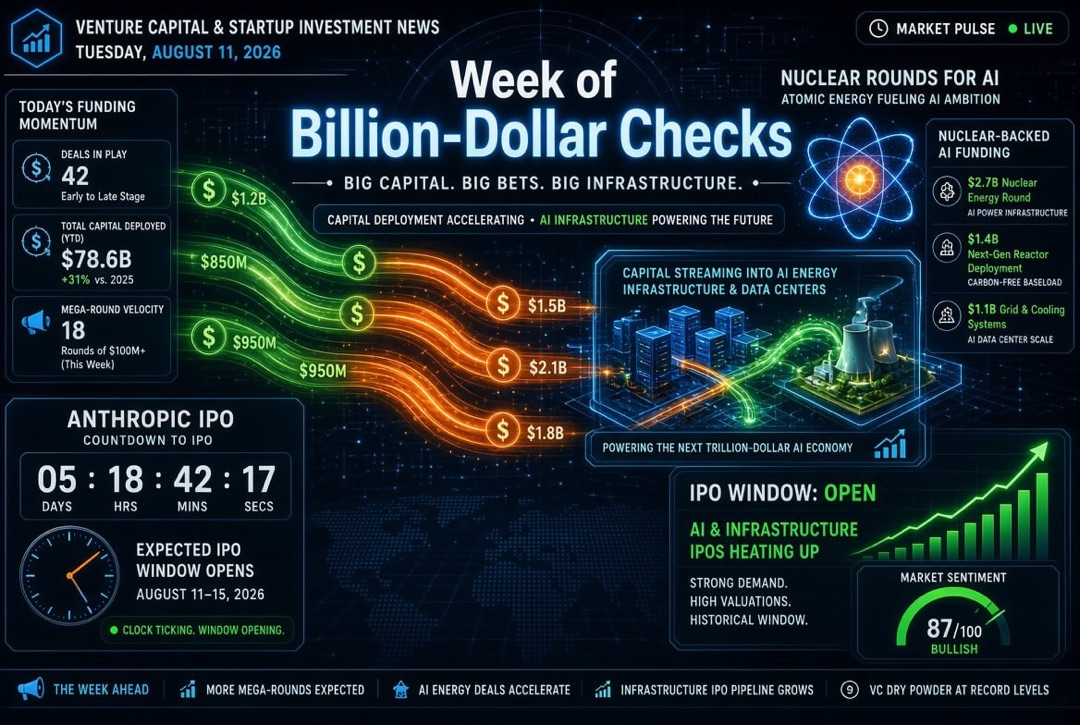
- Energy for AI — a new megatrend — billion-dollar rounds for Valar Atomics and Base Power highlight that "electricity for data centres" has become a standalone investment class.
- The IPO parade continues — this week, the Robinhood Ventures fund is expected to list, while Moonshot AI prepares for a Hong Kong offering of approximately $3 billion.
- Record exits — in the second quarter, 32 companies went public with valuations exceeding $1 billion, and another 24 were acquired for a total of $113 billion.
- Investor selectivity is increasing — capital flows into projects with technological barriers and clear economics, rather than "wrappers" over existing models.
- Russia and the CIS — the local market anticipates a growth of 10–15% for the year, and on 13 August, the "Venture Landscape" forum will take place in Moscow.
Record Half-Year: $510 billion and Unprecedented Capital Concentration
The first half of 2026 has proven to be the best in the history of the venture industry. According to analysts, startups globally attracted $510 billion: $305 billion in the first quarter and another $205 billion in the second — the second-largest quarter on record. More than 70% of global funding in the second quarter was directed towards companies in the artificial intelligence sector, compared to about 50% a year earlier.
At the same time, the market demonstrates extreme concentration: OpenAI and Anthropic accounted for a combined $217 billion, or 43% of all venture dollars for the half-year, and Anthropic, following a massive round in the second quarter, surpassed SpaceX in the ranking of the most valuable private companies globally. July confirmed the trend — approximately $65 billion of global investments, double that of the previous year. For venture funds, this reflects a dual reality: while overall figures are record-breaking, the number of deals is growing much more slowly, and the competition for quality projects outside the "magnetic field" of megadeals is intensifying.
Energy for AI: Nuclear Reactors and Batteries Attract Billions
The main investment theme in recent days has become energy infrastructure for artificial intelligence. The electricity deficit for data centres has transformed from an engineering problem into a standalone venture sector commanding billion-dollar checks.
- Valar Atomics — a startup in the field of small nuclear reactors raised $1 billion in a Series B round led by Sequoia Capital, supplemented by a $200 million credit line from a syndicate headed by JPMorgan. The company has already demonstrated a reactor powering an AI supercomputer by NVIDIA and is constructing a "waterless" energy factory with a capacity of 30 MW for computations.
- Base Power — a Texas developer of home energy storage closed a Series D round of $1 billion at a valuation of $13 billion with participation from Ribbit Capital, Valor Equity, and JPMorgan's strategic division.
- Joulent — a Houston-based company attracted $1.75 billion in strategic financing for energy infrastructure serving compute-intensive industries.
Notably, in these deals, alongside traditional venture funds, banks, sovereign wealth funds, and corporations are also involved. For investors, the "shovels and pickaxes" of the AI era — chips, cooling, power generation, storage — are becoming a way to bet on industry growth without overpaying for the valuations of AI laboratories themselves.
AI Infrastructure and Agent Platforms: Where Large Checks Are Flowing
Beyond energy, capital continues to flow into the infrastructure layer of artificial intelligence. Fireworks AI, which helps corporations transform generic models into specialised systems, raised $1.5 billion in a Series D round. Together AI closed a Series C round of $800 million under the leadership of Aramco Ventures with participation from Nvidia and General Catalyst. Safe Superintelligence, founded by Ilya Sutskever, secured about $5 billion with backing from Nvidia, while Travis Kalanick's startup Atoms in "physical AI" raised $1.7 billion from Andreessen Horowitz.
The second notable cluster involves agent platforms and their security. HappyRobot is attracting tens of millions for the automation of multi-step business processes, Convex closed a Series B round of $57 million for databases tailored to "AI-written" code, while Zenity secured $125 million for protecting corporate AI agents. London-based OLIX Computing, with photonic chips for inference, raised $312 million at a valuation of $3.3 billion, affirming that Europe is capable of cultivating deep-tech champions.
IPO Pipeline: From Robinhood Fund to Moonshot AI
The market for initial placements is experiencing its best period in several years. Since the beginning of the year, over a hundred IPOs have been conducted, and the amount of raised funds surpassed $34 billion by the end of May — 164% more than a year earlier. In the second quarter, 32 companies went public with valuations exceeding $1 billion — a historic record.
The coming week promises several landmark events:
- Robinhood Ventures — the fund providing retail investors access to private companies, including a portfolio associated with Y Combinator, will list on the NYSE on 13 August under the ticker RVII with support from Goldman Sachs, Citigroup, and JPMorgan.
- Moonshot AI — the Chinese developer of the Kimi models is preparing a confidential IPO application in Hong Kong aiming to raise approximately $3 billion.
- Anthropic — the company, according to market sources, has confidentially filed for an offering following a valuation of $965 billion.
- SpaceX — a potential listing is being discussed for the second half of 2026, with a prospective valuation of up to $1.5 trillion as around 70% of its revenue is already generated by Starlink.
For venture funds, the open exit window is a critically important signal: in the second quarter, 24 portfolio companies were sold to strategists at prices starting from $1 billion, totalling $113 billion. The return of capital to partners fuels a new fundraising cycle.
Selectivity as a New Norm: What Investors Demand
Behind the facade of record figures lies an intensifying selection process. Rounds exceeding $100 million account for almost four-fifths of all AI financing, while early-stage companies face more discerning investors. Funds are increasingly demanding:
- verified revenue and paid pilots rather than product demonstrations;
- technological barriers — proprietary data, hardware solutions, regulatory approvals;
- clear unit economics considering the real cost of computations;
- secured distribution channels that competitors cannot acquire with money.
Universal chatbots and thin overlays on third-party models have almost lost access to capital. Vertical solutions for healthcare, logistics, finance, and industry are winning — where AI addresses costly and measurable customer problems.
Industry Diversification: Not Only Artificial Intelligence
Although AI dominates the statistics, venture capital is broadening its scope. Function Health raised $450 million for preventive medicine, strengthening the position of the healthtech segment. Defence technologies remain on the rise: Anduril is preparing for one of the most anticipated IPOs of the year against the backdrop of record-defence budgets. Quantum computing received a public benchmark following the June listing of Quantinuum, which raised $1.68 billion. In Europe, long-duration energy storage, semiconductors, and industrial software consistently secure rounds in the tens of millions of dollars, confirming that deep technologies have become a complete alternative to purely software-oriented bets.
Russia and the CIS: Betting on Recovery in the Second Half
The Russian venture market has reached the bottom of its cycle and is anticipating a turnaround. After a 40% reduction in the number of deals in 2025 — down to 102 transactions valued at around $159 million — market participants forecast growth of 10–15% by the end of 2026, amounting to approximately 17 billion roubles. Constraining factors remain a high key interest rate and the situation in the currency market; however, the expected easing of monetary policy by the end of the year could revive transactions.
The drivers of recovery will be private and state funds, while the activity of business angels and corporate venture remains limited for now. An important event of the week will be the fifth "Venture Landscape" forum, which will take place on 13 August at the Moscow cluster "Lomonosov": investors, development institutions, and technology entrepreneurs will discuss the state of the market, approaches to company valuations, and requirements for projects seeking funding.
Outlook for Investors: How to Navigate an Overheated Market
Monday, 10 August 2026, finds the venture market in a phase of record but uneven growth. For funds and private investors, the agenda for the coming months is as follows. First, energy infrastructure for AI is turning into a distinct investment class, where venture capital, bank lending, and government interest converge — this segment is just starting to form valuations. Second, the open IPO window requires managers to actively engage with portfolios: companies ready for public offerings are attracting premiums, and funds are gaining much-anticipated liquidity. Third, the concentration of capital in megadeals creates opportunities in early stages, where competition for deals is lower and founder discipline is higher than at the peaks of previous cycles.
The primary risk remains the same — overheating valuations at the upper end of AI. However, record exits, actual corporate revenues from AI companies, and an influx of institutional money differentiate the current rise from the speculative bubbles of the past. The market rewards those who combine a risk appetite with rigorous selection — and this formula will determine the winners of the 2026 venture cycle.