Key Themes of the Day: IPO Window, Capital Concentration, and the Shift in Venture Investments Towards Sovereign Technologies and Physical Infrastructure
Highlights of the Day: A Brief Summary for Investors
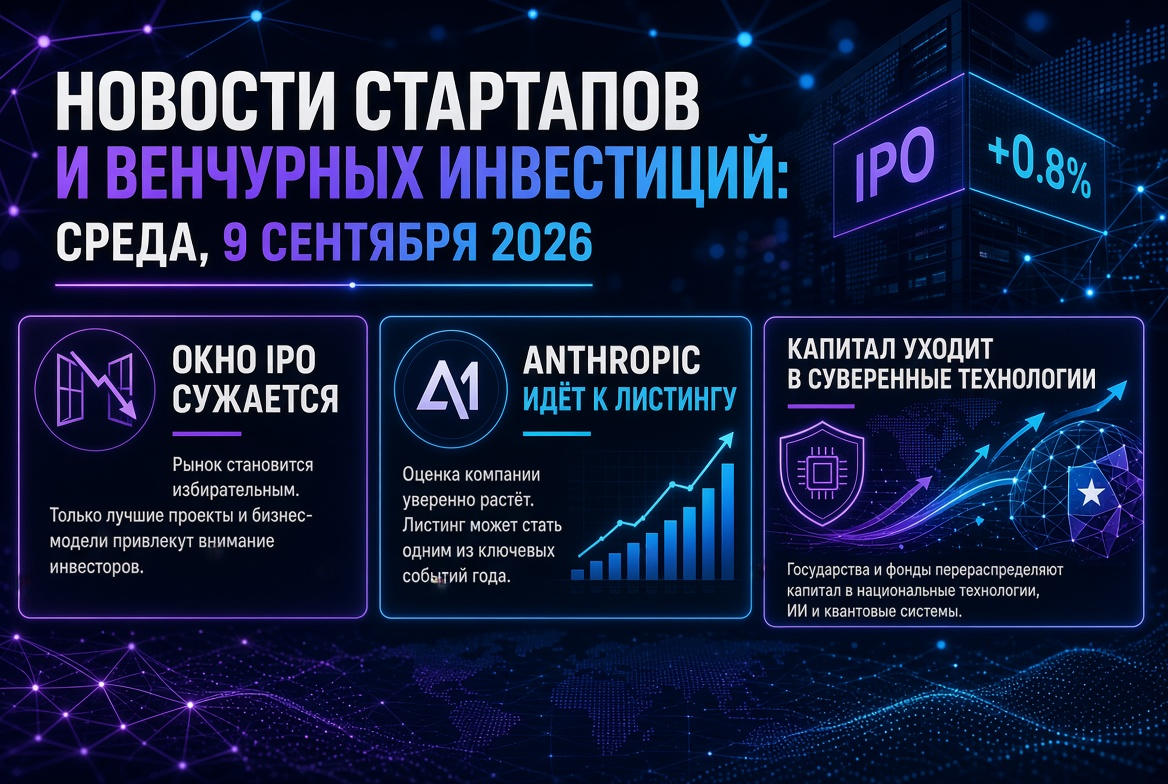
- IPO Window. Anthropic remains targeted for an October listing on Nasdaq following a confidential filing; the offering's volume is discussed to be up to $100 billion. OpenAI, which submitted its application a week later, is leaning towards a postponement until 2027.
- Market for Listings. The number of American tech IPOs in 2026 has exceeded 235, with the second quarter becoming a record in terms of funds raised — approximately $104.8 billion.
- Investment Dynamics. August saw $42 billion go into just over 1,500 startups worldwide: a correction relative to July while maintaining multipliers year-on-year.
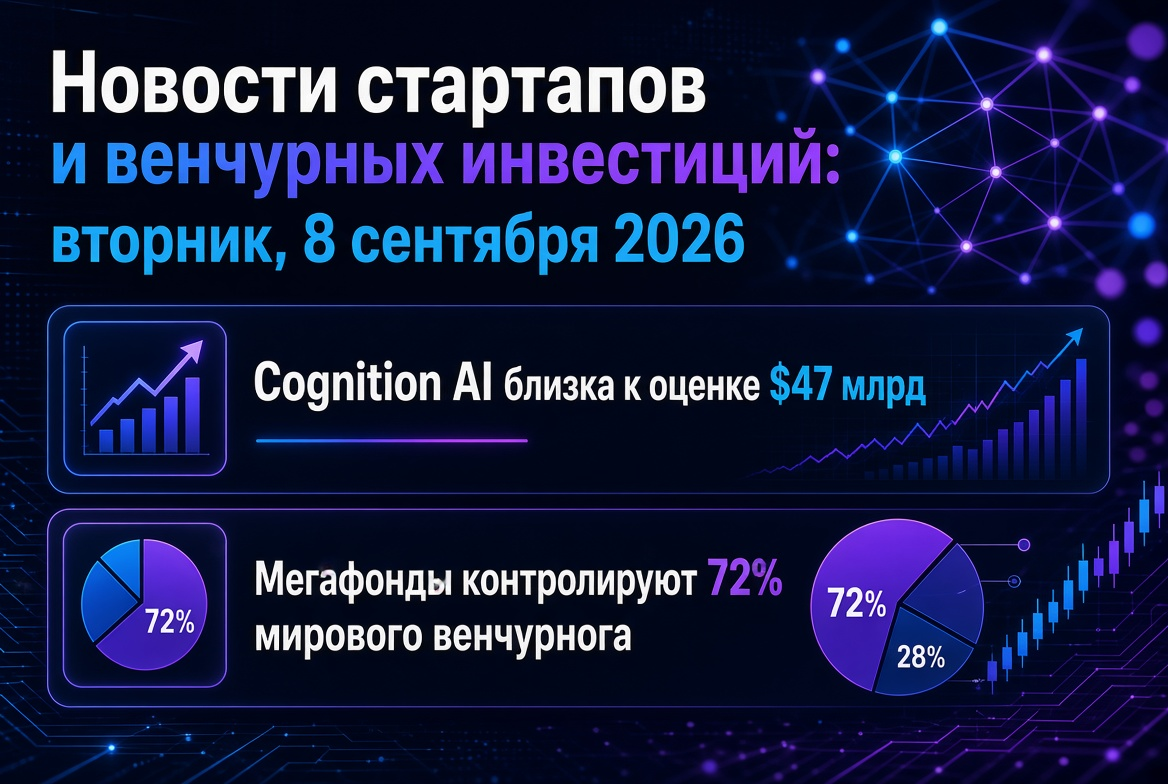
- Concentration. In the first half of the year, global venture investments reached $510 billion, with $217 billion (43%) directed towards just two companies.
- Shift in Focus. Recent deals of the week — space, sustainable aviation fuel, industrial computer vision, voice AI for regulated sectors — highlight the pivot of venture capital towards "physical" and sovereign assets.
The IPO Window is Tightening: Why October is More Important Than Any Mega-Round
The key narrative of autumn is not the size of the next round, but the exit price. June's listing of SpaceX at a valuation of approximately $1.77 trillion became the largest IPO in history, but subsequent correction of prices by about a third from the peak has sent cautious signals to the market. This is why Anthropic's October listing is turning into a reference point: it will set the multiple by which all private companies in the artificial intelligence sector will be reassessed.
For fund managers, this is a question of distribution, not image. The sector has lived with a liquidity deficit for the third consecutive year: LPs are receiving funds more slowly than the funds are requesting new commitments. Large tech IPOs have the potential to unlock distributions and initiate a new fundraising cycle. Analysts have noted that the total expected exit values are comparable to the entire volume of exits in the US venture market over the past twenty-five years.
Investment Dynamics in August: A Correction Without a Trend Reversal
The August statistics deserve a sober reading. The 25% decline from July is attributed not to a deterioration in market conditions but rather to the calendar and base effects: in specific months of 2026, one or two mega-rounds constituted half of the total volume. Three conclusions for market estimation:
- Monthly volatility has ceased to be an indicator. Given the current structure of deals, the dispersion of volumes is determined by the decisions of a few issuers rather than the collective behaviour of thousands of companies.
- The number of deals is more stable than the sum. Approximately 1,500 funded startups per month represent a stable level, indicating a functioning deal flow at early stages.
- Annual dynamics remain multiplicative. The over twofold growth compared to August 2025 confirms that the market is in an expansion phase, not a recovery.
Capital Concentration: A Market Dominated by Two Issuers and Mega-Funds
A structural feature of 2026 is unprecedented concentration. The record $510 billion in global venture investments for the first half of the year has been formed primarily by giant deals rather than an expansion of the number of rounds. Over 70% of capital in the second quarter went to companies related to artificial intelligence, and sixteen rounds exceeding $1 billion accounted for $108.6 billion — more than half of the quarterly volume. North America attracted $392 billion, retaining absolute dominance.
Concurrently, there is a consolidation on the management side: funds with assets exceeding $1 billion control the overwhelming share of deal value, while the bulk of new LP commitments concentrate within a few major platforms. For mid-sized funds, this necessitates a strict focus — competing on capital with mega-funds is futile, but competing on expertise is possible.
Sovereign Technologies and Physical Infrastructure: A New Investment Thesis
The most notable shift in recent days has been the flow of venture capital into companies that control physical systems and critically important data. Noteworthy deals from the beginning of the week include:
- Space. Indian company Pixxel closed a Series C round of $100 million co-led by Temasek and Seraphim, bringing total funding to $195 million. The company is expanding from hyperspectral imaging to an Earth-intelligence platform, satellite manufacturing, and sovereign systems for governments.
- Energy Transition. Australian Jet Zero raised A$30 million with participation from Qantas, Airbus, and POSCO International for a sustainable aviation fuel refinery project with a capacity of up to 113 million litres per year.
- Industrial AI. Swiss company Jaipur Robotics secured €4.3 million for computer vision systems for waste incineration and cement plants, training models on over 50 million labelled images.
The common denominator is the strategic, rather than merely commercial, nature of demand. Governments and corporations seek to control sensing, fuel, computing, and data they deem critical. For venture funds, this opens a segment with a longer cycle but also with higher entry barriers.
Vertical AI: Defensible Value is Shifting Towards Workflows
Valuations of applied AI startups are increasingly less dependent on access to base models. Italian company Cato raised €6 million to automate participation in government procurement worth approximately €309.7 billion, while Indian Navana.ai secured ₹40 crore for voice AI for banks with the requirement for local deployment. The logic of investors is consistent: competitive advantage arises not from the model but from the industry-specific workflow, proprietary data, and regulatory compatibility.
What Investors Check in Vertical AI Deals
- The presence of data that cannot be reproduced by connecting to the same model.
- The depth of integration into the client's operational processes and the cost of switching.
- Compliance with data residency requirements and local deployment.
- The economics of inference and its resilience to decreases in computation prices.
Geography: India, Europe, and Markets Beyond Silicon Valley
The Indian startup ecosystem displays a pattern typical of 2026: volumes are rising, the number of rounds is decreasing — capital is becoming more concentrated and selective. Recent deals in water infrastructure, pharmaceutical distribution, and gaming technologies confirm the demand for applied solutions, while the closure of a health-focused fund exceeding its target volume indicates continued appetite from LPs for specialised strategies.
Europe is operating selectively: small rounds with strong industry leaders and participation from strategic investors. The presence of corporations in seed syndicates is becoming the norm — industrial players are securing access to technologies ahead of growth rounds.
Structured Finance: Venture Debt is Returning to the Stack
A noticeable trend in September is the increase in the proportion of mixed deals combining equity and debt. For companies with predictable revenue, cash flows, or credit assets, this permits raising capital without excessive dilution. For investors, it reduces risk through the structure of the deal, rather than solely through valuation. The financial architecture of late stages is becoming more complex, and funds increasingly require expertise in structuring, not just selection.
Three Takeaways for Venture Investors and Funds
- Autumn 2026 is about liquidity, not access to capital. The key portfolio risk today lies not in the impossibility of raising a round but in the absence of an exit. The pricing of October listings is more significant than any new mega-rounds.
- The barbell structure persists. Capital is distributed between giant deals of leaders and selective early investments. Companies at the Series B and C stages without outstanding metrics are under the most pressure.
- The premium for narrative is disappearing. Due diligence is tightening across the board: investors are demanding verified revenue, a clean structure of intellectual property, and understandable unit economics even at the seed stage.
Outlook: September as a Calibration Point
By the end of September, the market will be in a holding pattern. A successful launch with sustained valuations post-debut will pave the way for a whole class of tech companies and unlock distributions for LPs in the fourth quarter. A weak debut will prompt a reevaluation of the entire pool of private AI assets, which have been marked by growth multiples. For fund managers, the takeaway is pragmatic: in a market where a few issuers absorb almost half of global venture funding, portfolio returns are determined by distribution discipline and selection quality, not access to capital.