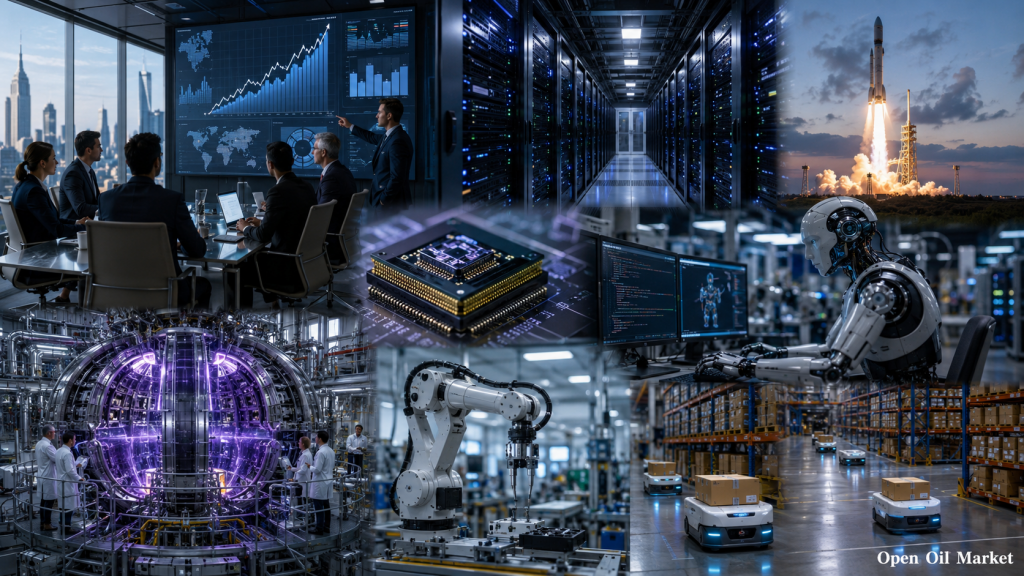
Startup and Venture Capital News Roundup for Tuesday, 2 June 2026: AI Mega-Rounds, Surging Investment in Artificial Intelligence Infrastructure, Deep Tech, Space, Energy, Robotics, and New Opportunities for Venture Funds
The global startup and venture capital market enters June 2026 in a state of high capital concentration. The dominant theme for venture investors and funds is the sharp strengthening of companies linked to artificial intelligence, computing infrastructure, semiconductors, energy, robotics, space, and applied AI services. Amid major rounds at Anthropic, Cognition, OpenRouter, Stord, Corgi, Thea Energy, XCENA, and Unastella, the market confirms that investors are once again willing to pay premiums for scale, technological advantage, and access to the critical infrastructure of the new digital economy.
For venture funds, the current situation looks mixed. On one hand, mega-rounds are returning, valuations of leaders are rising, the IPO pipeline is activating, and new specialised funds are emerging. On the other hand, capital is being distributed increasingly unevenly: the best startups are attracting ever more money, while companies without a technological moat, clear revenue, or a path to global markets face a much tougher selection process.
AI Mega-Rounds Remain the Primary Driver of the Venture Market
The key news for the venture capital market is the new scale of funding for the largest AI companies. Anthropic raised $65 billion in a Series H round at a valuation of approximately $965 billion. This intensifies competition in the frontier AI segment and shows that the largest funds, strategic investors, and technology corporations continue to view artificial intelligence as the essential infrastructure of the future economy.
The Anthropic round is significant not only for its size. It sets a new benchmark for later stages: investors are funding not just a software product but the entire value chain—models, computing power, enterprise clients, cloud partnerships, and a future public exit. For venture funds, this means that an asset class of companies is forming in the AI sector that is comparable in scale to the largest public technology platforms.
In parallel, AI startup Cognition, developer of the autonomous software engineer Devin, raised over $1 billion at a pre-money valuation of around $25 billion. This confirms demand for solutions that automate not individual functions but entire professional processes—coding, testing, code maintenance, and enterprise application development.
Artificial Intelligence Infrastructure Emerges as a Separate Investment Class
Venture capital is shifting increasingly from consumer AI applications to the infrastructure layer. OpenRouter raised $113 million in a Series B round, and according to market data, its valuation reached approximately $1.3 billion. The company operates at the intersection of AI infrastructure and enterprise model usage: its platform helps select different models for different tasks, control inference costs, and improve solution accuracy.
For investors, this is an important signal. The next growth phase of the artificial intelligence market will involve not only the creation of new models but also the optimisation of their use. Companies that help businesses reduce AI costs, manage query routing, boost performance, and integrate models into workflows could become a new layer of venture returns.
A separate direction is semiconductors and memory. XCENA, a startup with offices in South Korea and the US, raised $135 million in a Series B round at a valuation of around $570 million. The company bets that the main bottleneck in AI infrastructure is not only GPU compute power but also memory management. This reflects a broader trend: venture investments are increasingly flowing into chips, data centres, memory architecture, cooling, energy, and network infrastructure.
Physical AI, Robotics, and Deep Tech Gain Greater Attention
The startup and venture capital market is gradually moving beyond classic SaaS. Investors are increasingly looking for companies capable of connecting artificial intelligence with the physical economy: manufacturing, logistics, energy, robotics, autonomous systems, and defence technology.
This shift is driven by two factors. First, AI is reducing the value of many traditional software products, as basic functions are rapidly replicated and automated. Second, physical infrastructure requires capital, engineering expertise, and a long development cycle, creating a higher barrier for competitors.
- Robotics and autonomous vehicles are becoming part of industrial automation;
- Semiconductors and memory are turning into critical resources for the AI economy;
- Energy and data centres are becoming an investment extension of the AI boom;
- Space technology is returning to the venture agenda amid expectations of major IPOs;
- Climate tech is increasingly evaluated not as an ESG segment but as a sector for improving the efficiency of the physical economy.
Space and Energy Return to Fund Focus
South Korean space startup Unastella raised $24 million in a Series B round, bringing total funding to $44 million. The company develops rockets and engines for launching small satellites and, in the long term, is considering suborbital crewed flights. For venture funds, the deal is interesting because the space market is no longer exclusively a US-China story: South Korea, Japan, India, and Australia are seeking a place in the new chain of launches, satellite communications, and orbital infrastructure.
In the energy sector, a notable event was Thea Energy's $100 million round. The startup operates in the field of nuclear fusion energy and plans to use the capital to expand magnet production and build a demonstration device. For investors, this is an example of how deep tech is again gaining access to large capital when a project sits at the intersection of energy security, industrial autonomy, and long-term technological advantage.
Climate Tech Changes Positioning: From ESG to Efficiency
The launch of Gigascale Capital's new $250 million fund shows that climate technology is shifting its investment narrative. Whereas climate tech was once often perceived through the lens of sustainability, funds now increasingly talk about modernising the physical economy: energy grids, automation, supply chains, rare earth materials, recycling, and industrial infrastructure.
For venture investors, this is a fundamental change. Startups in climate tech must demonstrate not only environmental impact but also economic superiority over existing solutions. The winners will be projects that lower energy costs, increase supply reliability, reduce operational expenses, and help corporations adapt to rising demand from AI infrastructure.
Fintech, Insurtech, and Logistics Retain Investment Appeal
Despite AI's dominance, the venture market is not limited to artificial intelligence. Stord, a competitor to Amazon in e-commerce fulfillment, raised $250 million at a valuation of around $3 billion. The company combines a network of warehouses, inventory management software, and AI interfaces for brands that want to compete on delivery speed without losing control over customer relationships.
Insurtech startup Corgi raised $106 million in a Series B1 round at a $2.6 billion valuation soon after a previous $160 million round. The rapid valuation increase shows strong demand for insurance infrastructure for technology companies, including cyber, general liability, and startup-specific products. At the same time, such deals raise questions about valuation quality, especially when rounds occur with short intervals and with a close circle of investors.
For funds, this means that fintech, insurtech, and logistics remain attractive as long as the company shows a scalable infrastructure model, enterprise demand, and the ability to embed AI into operational processes.
Consumer AI Searches for a New Growth Model
In the consumer market, a notable deal is Sekai, which raised $20 million in a Series A round to develop a platform for creating mini-applications via text prompts. Users have already created millions of mini-apps, and the model itself is built on the idea that AI can turn software creation into a mass form of digital self-expression.
This segment remains riskier than enterprise AI and infrastructure. However, for venture funds, it is interesting because of the potential for a new consumer format to emerge after the era of short video, social networks, and mobile apps. The key question is whether consumer AI can convert user engagement into sustainable monetisation rather than just rapid audience growth.
Asia Strengthens Its Position in the Global Startup Ecosystem
The Asian venture market is becoming increasingly prominent on the global stage. South Korean startups are attracting capital in semiconductors and space, Indian companies are launching AI labs and investing at early stages, and funds from India and Southeast Asia are looking more actively at international deals.
For global funds, this is an important geographic shift. Asian startups are increasingly competing not only for their local market but also for a place in international chains of AI infrastructure, hardware, space tech, biotech, and enterprise software. At the same time, regional investors are becoming more global: they are looking for deals in the US, the UK, and Europe to avoid dependence solely on their domestic markets.
What Matters for Venture Investors and Funds
As of 2 June 2026, the startup and venture capital market yields several key conclusions for funds, LPs, and strategic investors:
- AI remains the primary magnet for capital, but competition is shifting from applications to infrastructure, data, memory, chips, and compute power.
- Deep tech is making a comeback because physical assets, engineering barriers, and long development cycles are again perceived as protection against copying.
- Valuations of leaders are growing faster than the market, increasing the risk of overheating and requiring stricter scrutiny of revenue, margins, and customer quality.
- The IPO pipeline is becoming an important liquidity factor: the largest AI and space companies could open a new exit window for late-stage investors.
- The geography of venture capital is expanding: the US retains its leadership, but Asia, the UK, Europe, and select emerging markets are strengthening their positions.
The main practical takeaway for venture funds: the market is once again willing to fund growth, but only where there is a technological moat, global demand, and a clear role in the new economic infrastructure. In 2026, the winners are not simply startups with a trendy AI wrapper, but companies that become critical elements of productivity, computing, energy, logistics, security, and automation.
That is why the startup and venture capital news for Tuesday, 2 June 2026 can be described as a transition from a speculative AI boom to an infrastructure race. Money continues to flow into artificial intelligence, but increasingly into its 'foundation': chips, memory, energy, data centres, enterprise platforms, space technology, and the physical economy. For investors, this creates new opportunities but simultaneously requires stricter selection discipline and valuation control.