Current News on Startups and Venture Investments as of 3 September 2026: The Autumn IPO Window Opens, Anthropic Prepares for a Historic Listing, the Global Venture Market Absorbs Record $510 Billion in Half-Year Investments, and Capital Continues to Concentrate Around AI Leaders.
The beginning of September 2026 finds the venture market in a state that seemed impossible just three years ago. Global venture investments for the first half of the year reached a record $510 billion, surpassing the total for all of 2025. The IPO market is experiencing its best period in a decade, and M&A deals involving technology companies are hitting historical highs. For venture investors and funds, a decisive autumn arrives: the window for public offerings is open, but the question of how long it will remain so is becoming increasingly pressing.
Key topics in the venture agenda for Thursday, 3 September 2026 include:
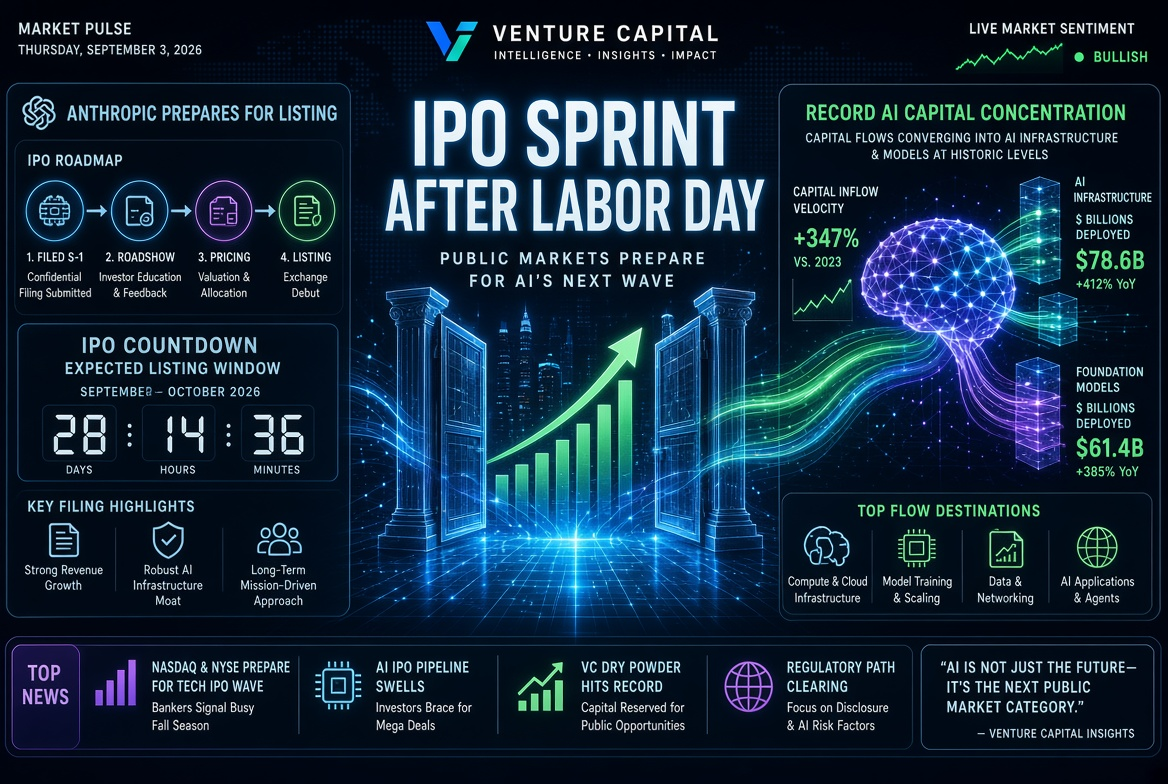
- The Autumn IPO Sprint. Following Labour Day in the USA, the traditional wave of stock listings begins, promising to be a record year.
- Anthropic on the Cusp of Listing. The world's most valuable venture startup is set to go public as early as September–October.
- Concentration of AI Capital. The lion's share of venture funding is directed towards a narrow circle of frontier labs.
- Fresh Rounds this Week. Generative 3D, energy, fintech, and AI infrastructure attract hundreds of millions of dollars.
- Diversification Beyond AI. Defence technologies, robotics, and biotech are gaining share in fund portfolios.
The Autumn IPO Window: The Sprint Post-Labour Day Gains Momentum
The US primary markets are entering the hottest phase of the year. By the end of May, over $34 billion had been raised through IPOs—a year-on-year increase of over 160%, with the number of listings exceeding one hundred. The headliner of 2026 was SpaceX, which conducted the largest IPO in history: the company's shares closed up 19% on the first day of trading. Now, with September underway, investor focus is shifting to the next wave of candidates.
Analysts caution that the opportunity window is narrowing, and companies planning a listing in 2026 must act swiftly. In the coming months, players from the fields of artificial intelligence, fintech, the crypto industry, consumer health, and climate technologies may head to the stock exchange. Finnish startup Oura, which has attracted $1.5 billion in venture capital for its smart rings, is considering an IPO as early as September–October.
Anthropic Prepares for a Historic Listing
The main intrigue of the autumn is the potential debut of Anthropic on the public market. The developer of the Claude model family, which has become the most valuable venture startup in the world with a valuation approaching $1 trillion, has confidentially submitted IPO documents and, according to business media, may list as early as September or October, raising up to $100 billion. This would make the listing the largest in the history of the technology sector.
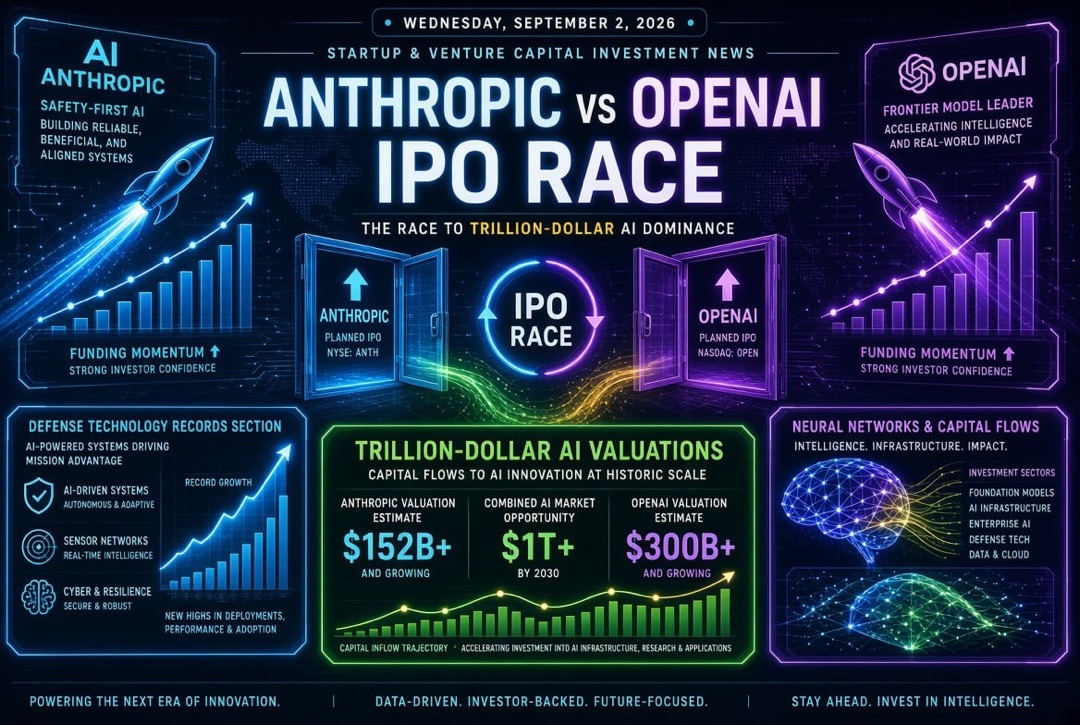
Notably, Anthropic is striving to outpace its main competitor: OpenAI, which closed the largest private round in history at $122 billion this spring with an $852 billion valuation, is leaning towards postponing its own IPO to 2027. For venture funds, the outcome of this race is critical—Anthropic's successful listing could unleash liquidity worth hundreds of billions of dollars and set a pricing benchmark for the entire AI industry.
Record Half-Year: $510 Billion and Unprecedented Concentration of Capital
The results for the first half of 2026 confirm that the venture market is not just recovering but undergoing a structural transformation. The key figures are as follows:
- Global venture investments reached $510 billion in the half-year—more than in all of 2025 ($440 billion).
- North America attracted $392 billion, setting an absolute record.
- OpenAI and Anthropic accounted for $217 billion—43% of all global venture funding.
- In the second quarter, 16 companies closed rounds exceeding $1 billion, totalling $108.6 billion.
Seven of the sixteen billion-dollar rounds were accounted for by frontier AI labs, including China's DeepSeek, StepFun, and Moonshot AI, the UK's Ineffable Intelligence, and American firms Prometheus and Isomorphic Labs. Capital is concentrating in the hands of the few—and this poses the main structural risk of the current cycle, which venture investors must consider when building their portfolios.
Early Stages Revive: Mega-Rounds Enter Seed and Series A
Contrary to concerns that the AI boom would drain resources from early stages, investments in young startups in North America reached $31 billion for the quarter—the highest in over three years. The phenomenon of the quarter was a $12 billion round for Prometheus, a physical AI startup co-founded by Jeff Bezos. Following that were Hark with a $700 million round for "personalised intelligence" and Flourish, which is creating an AI system modeled on the human brain.
Meanwhile, the number of early-stage deals has fallen to a five-quarter low—the market is paying more but choosing more selectively. For early-stage funds, this means increased competition for genuinely quality projects.
Deals of the Week: From Generative 3D to Energy Networks
The beginning of September has brought a series of indicative rounds reflecting the current priorities of venture capital:
- Tripo AI / VAST — approximately $446 million (3 billion yuan) in Series B and B+ rounds for the development of generative 3D models, with participation from CICC, CMC Capital Partners, and Primavera Capital.
- Félix — $200 million Series C for a Miami-based fintech platform with a substantial debt component in the deal structure.
- Gridsight — $26 million Series B led by Insight Partners for an AI platform for managing electricity grid capacity.
- Wispr AI — $280 million Series B at a valuation of $2 billion.
- Sila — $300 million for advanced battery technologies from Atreides Management and Sutter Hill Ventures.
Special attention is warranted for AI infrastructure: Baseten closed a Series F round at $1.5 billion with a $13 billion valuation—the fourth round for the company in a year and a half amid twentyfold revenue growth.
Diversification: Defence, Robotics, and Biotech Gain Weight
While artificial intelligence remains the market's gravitational centre, venture investments are increasingly spreading into adjacent sectors. Defence technologies attracted $12.3 billion in the first half of the year—almost double that of the previous year. Investments in humanoid robotics startups have set a new historical record. Biotech consistently ranks among the top three sectors for weekly rounds, while the energy sector marked strategic funding of $1.75 billion for Joulent.
The consolidation of funds is also ongoing: Khosla Ventures is negotiating to attract up to $5.5 billion for a new series of funds, while Abu Dhabi's sovereign fund MGX has closed its first fund at $49 billion, surpassing its target.
M&A and Exits: Consolidation as Strategy
The second quarter became one of the strongest periods for venture exits in years. A landmark transaction was SpaceX's acquisition of the startup Cursor—the largest venture acquisition in history. Pharma giant Eli Lilly acquired biotech firm Kelonia in the largest deal with a venture startup in years. For funds, this is a signal: strategic buyers have returned to the market, and the scenario of selling to corporations has once again become a credible alternative to an IPO.
Russia and the CIS: The Market Seeks a New Growth Model
The Russian venture market is moving against the global trend: its annual volume has decreased by about 10% to 7.2 billion roubles, and corporate venture investments have fallen fourfold. However, within the decline, there are growth points: investments from private funds have increased by 69% to 2.9 billion roubles, and the first half of the year has shown a 70% growth in the market after several years of decline. New structures are being launched—Kama Flow and "Medscan" funds of 10 billion roubles each, as well as a specialized fund for AI agent-based startups. Market participants pin their hopes on a decrease in the key rate and potential IPOs in 2026.
Outlook: Autumn Will Determine the Cycle's Resilience
September 2026 will serve as a stress test for the entire venture cycle. Successful listings of Anthropic, Oura, and other candidates have the potential to solidify the boom and return liquidity to the ecosystem. Conversely, a failure or postponement of key IPOs will intensify discussions about overheating—especially since signs of cooling in the mega-round market are already being recorded, and consolidation in applied AI verticals is accelerating. Venture investors should maintain discipline: diversify portfolios beyond frontier labs, allocate increased early capital reserves for portfolio companies, and prepare them for potential strategic exit scenarios. The market is more generous than ever—but it is precisely in such moments that the cost of error is maximised.