News from the Oil and Gas Sector and Energy for Tuesday, June 16, 2026: Situation in the Strait of Hormuz, Dynamics of Brent and WTI Oil, Gas Market, LNG, Oil Products, Refineries, Electricity, Renewable Energy Sources, and Coal, Analysis for Investors and Participants in the Global Energy Sector
The global fuel and energy complex enters Tuesday, June 16, 2026, in a state of sharp risk reassessment. The main theme of the day is the potential resumption of shipping through the Strait of Hormuz following preliminary agreements between the United States and Iran. For the oil, gas, LNG, oil products, electricity, coal, and renewable energy markets, this signifies not the end of the crisis, but a transition to a new phase: financial markets are already pricing in a reduction of the geopolitical premium, yet physical logistics, tanker insurance, refinery operations, and inventory balances will take longer to recover.
For investors, participants in the energy sector, fuel companies, oil corporations, and operators of energy infrastructure, the key question now is not merely the price of Brent or WTI. Far more critical is understanding how quickly raw material supplies will normalise, whether diesel and jet fuel shortages will persist, if Europe will have enough gas ahead of winter, and whether global energy can maintain a balance between traditional resources and renewable energy sources.
Oil: Market Reduces War Premium, but Does Not Eliminate Logistics Shortage
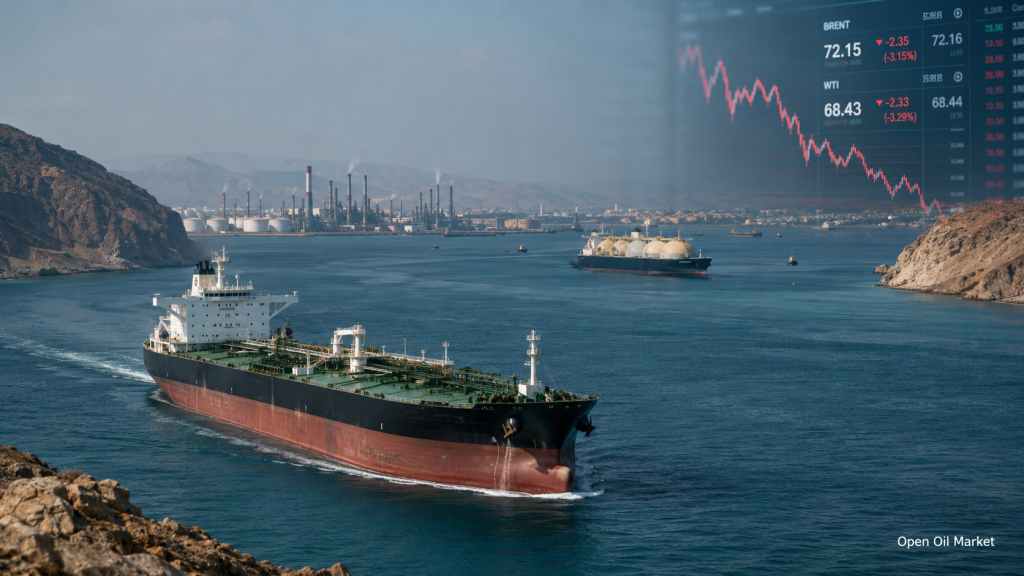
The oil market reacted to news from the Strait of Hormuz with a sharp decline in prices. Brent has dropped to around $83 per barrel, while WTI is hovering around $80. This is a significant psychological signal for the global oil market: traders are beginning to factor in a scenario of a gradual recovery of supply from the Persian Gulf and a reduced risk of disruptions in global crude exports.
However, the price decline does not imply an immediate return to normal balance. The Strait of Hormuz remains a strategic node in global energy, through which a substantial portion of global oil and LNG flows pass. Even with political de-escalation, the market will require time to restore insurance coverage, redistribute the tanker fleet, verify route safety, and fully activate export infrastructure.
For oil companies, this creates a mixed scenario. On one hand, the fall in Brent reduces the windfall profits for producing companies. On the other hand, the persistent risk of supply shortages sustains investor interest in producers with resilient logistics, diversified export routes, and strong cash flow.
OPEC+ Remains Cautious: Supply Will Return Gradually
Amid geopolitical easing, market attention is once again shifting towards OPEC+ policy. In early June, seven member countries of the alliance—Saudi Arabia, Russia, Iraq, Kuwait, Kazakhstan, Algeria, and Oman—confirmed their intention for cautious management of production. A production adjustment of 188,000 barrels per day is planned from July 2026, while participants in the agreement retain the right to suspend or reverse changes depending on market conditions.
This approach is critical for investors: OPEC+ is not looking to flood the market with oil, even as the geopolitical premium declines. The alliance is effectively attempting to maintain a balance between two risks: excessively high prices could accelerate demand destruction, while too sharp a fall in Brent could worsen the budgetary and investment positions of producers.
For the global oil and gas market, the baseline scenario remains moderately tense. Oil demand in 2026 is expected to continue growing, particularly in non-OECD countries. Simultaneously, supply from the US, Brazil, Canada, and other producers is on the rise, but not always at the locations where the market needs physical barrels at a specific moment.
Gas and LNG: Europe Gains a Breather, But Storage Remains a Weak Spot
The gas market has also felt the effects of de-escalation. European gas prices have seen a downward trend following oil prices, as the market begins to assess the likelihood of recovering LNG supplies via key maritime routes. However, Europe’s fundamental problem has not vanished: underground gas storage remains below comfortable seasonal levels, and the aim of filling gas storage facilities ahead of winter requires sustained LNG imports during the summer months.
For Europe, 2026 once again presents a test of energy security. The region is competing for LNG with Asia, where summer electricity demand is rising due to heat and industrial load. If Asian buyers aggressively enter the spot market, European importers will have to pay a premium for flexible gas batches.
Concurrently, the role of long-term contracts is strengthening. European companies are increasingly striving to secure LNG supplies for years ahead, especially through infrastructure in Greece, Southeast Europe, and terminals linked to supplies from the US. For gas companies, this underscores the importance of regasification capacities, pipeline interconnectors, and port infrastructure.
Oil Products and Refineries: Cheap Oil Does Not Guarantee Cheap Diesel
One of the primary risks for fuel companies and consumers is the disparity between crude oil prices and oil product prices. Even if Brent declines, diesel, jet fuel, and gasoline may remain expensive due to limited refining capacity, disrupted logistics, and reduced export flows from the Middle East.
American refineries are already operating at high capacity, attempting to compensate for the shortfall in the global oil product market. US crude inventories have sharply declined amid active refining, whilst oil product exports have remained elevated due to demand from external markets. This supports refining margins, particularly in the diesel and aviation fuel segments.
For investors in the refinery sector, a key indicator now is not only oil dynamics but also the crack spread—that is, the difference between the cost of oil products and raw materials. If the restoration of supplies through the Strait of Hormuz is slow, refining margins may remain above historical averages longer than the market expects.
Electricity: Europe Braces for an Expensive Winter
The electricity sector remains sensitive to the gas balance. In Germany and Italy, where gas generation plays a significant role in covering peak demand, winter electricity contracts are trading at a noticeable premium to longer-term periods. This indicates a persistent fear of fuel shortages during the heating season.
An additional risk factor is the weak hydrological situation in Europe. Low water and snow reserves limit the potential of hydropower plants, which typically help balance the grid during periods of expensive gas or low generation from wind and solar sources. For industrial consumers, this poses a risk of increased tariff volatility, particularly in energy-intensive sectors.
Energy companies will need to maintain more reserve capacities, make greater use of gas stations, and develop energy storage systems. For investors, this increases the appeal of companies operating at the intersection of electricity, network infrastructure, and energy storage.
Renewable Energy Sources: Energy Transition Accelerates but Requires Reserves
Global energy continues its structural transition towards renewable energy sources. Solar and wind generation are increasing their share in the global energy balance, and renewables have already become a key factor in restraining the growth of fossil generation. For long-term investors, this reaffirms a sustainable trend: capital investments will shift towards solar stations, wind farms, networks, batteries, and digital energy management systems.
However, the events of 2026 illustrate the limitations of the energy transition: the higher the share of renewables, the more critical backup generation and network flexibility become. Gas, hydropower, storage, and managed demand are becoming as important as the solar and wind capacities themselves. Therefore, the energy market is evolving not toward a simple rejection of oil, gas, and coal, but toward a more complex architecture where different energy sources play different roles.
Coal: Asia Supports Demand Despite Clean Energy Growth
The coal market remains an essential part of global energy, especially in Asia. China, India, Japan, and other major consumers continue to utilise thermal coal for stable generation. Against the backdrop of LNG disruptions and high gas prices, some Asian countries are reinforcing the role of coal-fired power plants to avoid electricity shortages.
This does not negate the long-term pressure on coal from climate policy and renewables, but in the short term, coal retains its role as a backup fuel. For investors, the sector remains contentious: high current demand is coupled with long-term regulatory and ESG risks.
What Matters for Investors and Energy Sector Companies
The main takeaway for June 16, 2026, is that the global energy sector is transitioning from a phase of geopolitical shock premium to a phase of physical recovery of supplies. Financial markets can quickly adjust to risk reductions, but energy infrastructure recovers more slowly.
- For oil companies, key factors remain export routes, production costs, and cash flow resilience;
- For gas companies, it is access to LNG, long-term contracts, and storage infrastructure;
- For refineries, refining margin, availability of raw materials, and demand for diesel, gasoline, and jet fuel;
- For electricity, gas prices, state of hydro resources, backup capacity, and network constraints;
- For renewables, rates of new capacity installation, investments in networks, and energy storage;
- For the coal sector, resilience of Asian demand and regulatory constraints.
In the coming days, markets will be monitoring practical signs of the restoration of shipping through the Strait of Hormuz, dynamics of Brent and WTI, TTF prices, levels of European gas storage facilities, refinery loadings, and oil product spreads. For the global energy sector, this is a moment when political news has already changed market sentiment, but the real economy of energy still needs to prove that supplies are genuinely returning to a sustainable mode.